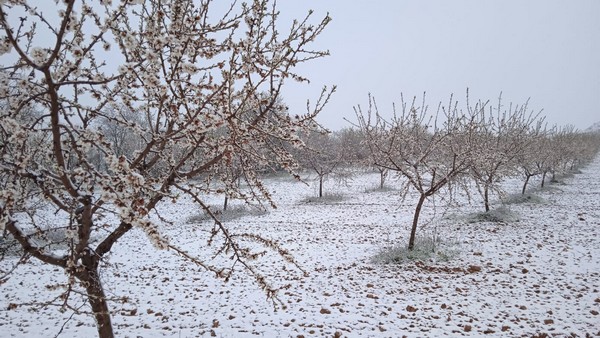
Switzerland - Late frost poses increased risk to crops

24.04.2024 490 views

The risk of late frost damage to fruit crops and vineyards is increasing. As a result of climate change, winters are becoming milder and the growing season is being lengthened, says weather service Meteonews.

This past winter was one of the mildest since measurements began, and the spring has also been particularly mild. This has had an effect on the arrival of seasons, which, as in previous years, has come two to four weeks ahead of schedule, says the private weather service Meteonews on its website on Sunday.

It adds that frost is to be expected on the ground over the next few days. Crops close to frost should therefore be protected. On the other hand, there should be no nights with a clearly negative temperature two metres above the ground, which is positive for fruit trees and vineyards. Frost damage should therefore remain limited.

More spring snow in the forecast

In the last 48 hours, up to half a metre of snow has fallen in certain areas, for example on the Rigi-Scheidegg mountain in central Switzerland, which boasts an altitude of 1,650 metres. The snow is expected to fall again on Sunday, reports Meteonews on the platform X. According to the weather service SRF Meteo, the snowfall limit is 500 metres, but there may also be flakes locally as far down as the plains.

According to the bulletin issued by the Swiss Federal Institute for Forest, Snow and Landscape Research (WSL), the current weather situation means that there is a high avalanche risk in canton Valais in the south, in central Switzerland and in the south-east of the country. Spontaneous avalanches, but also large-scale avalanches, are possible. In some cases, roads may also be affected.

Source - https://www.swissinfo.ch

14.12.2025

USA - USDA launches $700 million pilot to expand regenerative agriculture

The U.S. Department of Agriculture on Wednesday unveiled a $700 million pilot program to help farmers adopt regenerative agriculture practices aimed at improving soil health, water quality and long-term farm productivity while strengthening the nation’s food supply.

14.12.2025

South Africa - Hail and flooding demand critical crop insurance safety net

A single storm can wipe out a season's work. With climate change creating new hail hotspots, as seen across four South African provinces recently, the threat is less predictable than ever. 

14.12.2025

Malaysia - Kelantan’s flood-hit paddy farmers to receive compensation after RM2.3m crop losses

Farmers under the Kemubu Agricultural Development Authority (Kada) recorded losses exceeding RM2.3 million following recent northeast monsoon floods in the state.

14.12.2025

U.S. company Farm Tech meets NDA in Benghazi to discuss 1,000 pivot irrigation project to bolster Libya’s food security

Libya’s eastern-based National Development Agency (NDA) reported yesterday that its Director General received a delegation from US company Farm Tech at his office in Benghazi.

14.12.2025

Ecuadorian papaya production was nearly wiped out by the Papaya ringspot virus

The collapse of Ecuadorian papaya exports was not due to a market adjustment but rather a sanitary crisis. 

14.12.2025

French farmers protest over compulsory cattle culls amid disease outbreak

French farmers stepped up their campaign against agricultural policy and animal health rules this week, with protests in south-western France highlighting growing anger over the compulsory slaughter of cattle following outbreaks of lumpy skin disease.

04.12.2025

EU reaches agreement on use of new genomic techniques in agriculture

The European Parliament and EU Member States have reached a political agreement on the use of “new genomic techniques” (NGTs) in the agri-food sector, the Danish presidency of the council confirmed on Thursday. The deal paves the way for a new regulatory framework governing how these technologies may be used to develop more resilient and sustainable plant varieties.

04.12.2025

Vietnam targets 400 000 ha in winter crop plan

Vietnam's Ministry of Agriculture and Environment reports that the northern region aims to plant 400,000–410,000 hectares of winter crops, with an estimated output of 4.8–5 million tonnes.