Canada - After heavy rains damage crops, Holland Marsh farmers hope for clear skies

27.06.2017 286 views
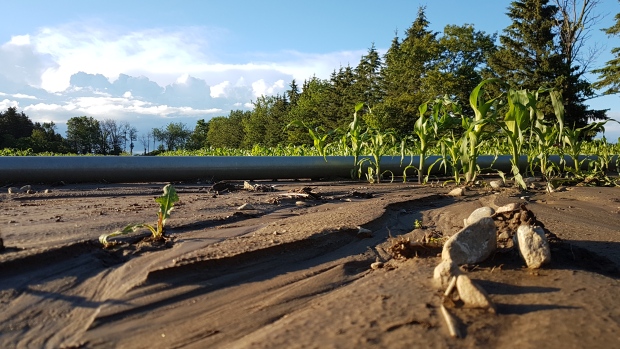
Farmers in the Holland Marsh area spent the weekend scrambling to pump water off their fields and save their crops after heavy rainfall. The rain reached its peak on Friday when a storm unleashed a total of 36.2 mm of precipitation in the region. Fields were drowned by flash floods. Farmer Avia Eek said that by 6 a.m. that day, her normally dry plots of carrots and onions were flooded. "There was water between the rows. And you look at that, and you go, 'Uh oh,'" she said. That kicked off a busy weekend for Eek and her neighbours, who hustled to pump water away from their land so that crops wouldn't stay submerged for too long. "What it translates to is potential crop loss," she explained. Eek lost four arable acres on the weekend, and said that many of her neighbours with low-lying plots were hit even harder.

An 'incredibly challenging' season

Jason Verkaik, owner of Carron Farms, said such heavy rain at this point in the growing season is a once-in-a-generation kind of event. He suffered some losses in his carrot, onion and celery fields, but was heartened to see the Holland Marsh community band together to help neighbours salvage as many crops as possible. For farmers like Verkaik and Eek, it's now a matter of watching the weather. If the ground stays wet, more crops will be lost. "It's been a challenging year. We were already about a week-and-a-half to two weeks behind, the weather was too cool, too wet," said Eek. "For the last two months it's just been incredibly challenging."

Struggling to plant fields

And the struggle has not been confined to only small regions. Keith Currie, president of the Ontario Federation of Agriculture, told CBC Toronto that the Holland Marsh experience "is pretty consistent across the province." He points out that some of the growing regions hardest hit by extended drought conditions last summer are now dealing with the fallout from a cool, wet spring. Farmers have struggled so far to get fields planted. Many who wanted to grow corn were forced to switch to soybean, which has a slightly shorter growing season, Currie said.
[caption id="" align="alignnone" width="684"]Holland Marsh flooding Farmer Avia Eek, who grows carrots and onions in the Holland Marsh, snapped this picture of her flooded field on Friday. (Avia Eek/Twitter)[/caption]

But even those who planned on switching crops are now abandoning fields altogether because it's too late even for soybean. "Some parts of Ontario did rebound and got crops in but, especially when you look east of the 400 and south of Hamilton, Ont., there's some areas there that are really struggling to get their planting completed," Currie said. "I'm expecting there will be a shortage of some crops this year for sure.

Will prices be affected?

The Holland Marsh, often called Ontario's "soup and salad bowl," provides the GTA with all sorts of veggies like onions, carrots, celery and lettuces. Eek said the rain, while challenging, has not yet reached crisis level and it's unlikely costs will be passed on to consumers. There are options for farmers who have lost crops, she said, explaining that they can plant what is called a "short day" crop, beets for example, that will grow faster than the original crop, though a financial loss is inevitable. "Every year farmers experience weather events, it's just that they're not always publicized. It is very rarely passed along to the consumer," she said. "We have trading partners. If we don't have the product, one of our many international partners have it." Currie said that while shortages are likely, it's too early predict how productive the harvest may be. He expects that more reliable projections will be made public in late August and September. Source - http://www.cbc.ca
14.12.2025

USA - USDA launches $700 million pilot to expand regenerative agriculture

The U.S. Department of Agriculture on Wednesday unveiled a $700 million pilot program to help farmers adopt regenerative agriculture practices aimed at improving soil health, water quality and long-term farm productivity while strengthening the nation’s food supply.

14.12.2025

South Africa - Hail and flooding demand critical crop insurance safety net

A single storm can wipe out a season's work. With climate change creating new hail hotspots, as seen across four South African provinces recently, the threat is less predictable than ever. 

14.12.2025

Malaysia - Kelantan’s flood-hit paddy farmers to receive compensation after RM2.3m crop losses

Farmers under the Kemubu Agricultural Development Authority (Kada) recorded losses exceeding RM2.3 million following recent northeast monsoon floods in the state.

14.12.2025

U.S. company Farm Tech meets NDA in Benghazi to discuss 1,000 pivot irrigation project to bolster Libya’s food security

Libya’s eastern-based National Development Agency (NDA) reported yesterday that its Director General received a delegation from US company Farm Tech at his office in Benghazi.

14.12.2025

Ecuadorian papaya production was nearly wiped out by the Papaya ringspot virus

The collapse of Ecuadorian papaya exports was not due to a market adjustment but rather a sanitary crisis. 

14.12.2025

French farmers protest over compulsory cattle culls amid disease outbreak

French farmers stepped up their campaign against agricultural policy and animal health rules this week, with protests in south-western France highlighting growing anger over the compulsory slaughter of cattle following outbreaks of lumpy skin disease.

04.12.2025

EU reaches agreement on use of new genomic techniques in agriculture

The European Parliament and EU Member States have reached a political agreement on the use of “new genomic techniques” (NGTs) in the agri-food sector, the Danish presidency of the council confirmed on Thursday. The deal paves the way for a new regulatory framework governing how these technologies may be used to develop more resilient and sustainable plant varieties.

04.12.2025

Vietnam targets 400 000 ha in winter crop plan

Vietnam's Ministry of Agriculture and Environment reports that the northern region aims to plant 400,000–410,000 hectares of winter crops, with an estimated output of 4.8–5 million tonnes.