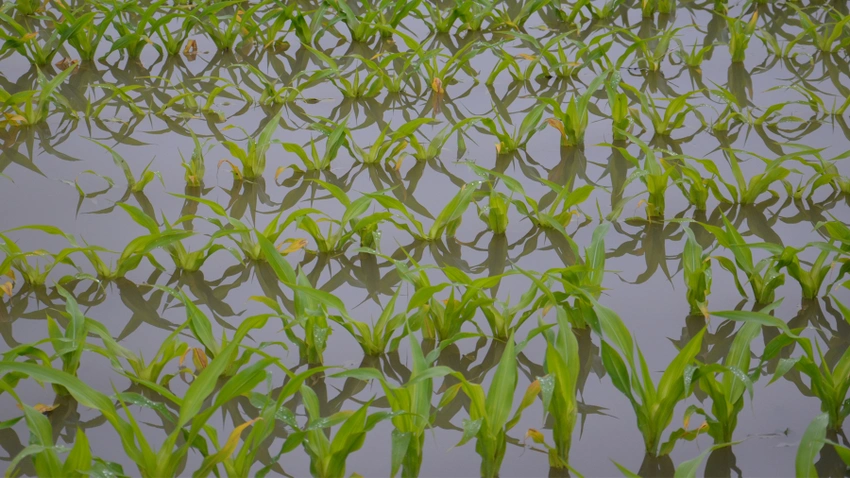
While waterlogging and salinity are serious issues across Pakistan, the situation in Sindh is critical with 53 per cent of the total irrigated area experiencing their debilitating effects. An effective solution, however, is available in the shape of tile drainage technology that has many success stories in the country.
These points were highlighted during a workshop held on Monday at the regional office of Pakistan Council of Research in Water Resources (PCRWR).
The event’s aim was to acquaint and take feedback from researchers and scientists on a project titled ‘Integrated approach for control of waterlogging and salinity in low-lying areas of Sindh’, which has recently been approved by the ministry of science and technology.
The project’s objective is to reclaim, increase land resources and improve livelihood by introducing tile drainage technology among farmers on capital-cost sharing basis. The PCRWR is to execute the Rs55.262 million project over three years.
Presenting some statistics on waterlogging and salinity during his presentation, project director engineer Abdul Salam Arain, a senior scientific officer at PCRWR, said that waterlogging and salinity had become a burning issue in Sindh which caused crop loss of 31pc every year.
The total waterlogged irrigated area in the province, he pointed out, stood at 50pc whereas the total irrigated area affected by salinity was 56pc.
“The irrigated land experiencing the effects of both waterlogging and salinity is around 65pc to 70pc,” Mr Arain said, adding that the problem was more serious in low-lying areas.
According to him, obstruction in natural water flow, flat land topography, seepage from unlined irrigated channels, questionable performance of Left Bank Outfall Drain and Right Bank Outfall Drain, over or deficit dosing of irrigation, are among the factors which have led to waterlogging and salinity in Sindh.
Sharing the project’s details, Mr Arain said that it would be implemented in low-lying areas on the left side of old riverbeds; research and demonstration of tile drainage units would be provided at two sites comprising more or less 100 acres each.
“The problem of waterlogging and salinity is very serious here. High water table associated with build-up of soil salinity has also converted productive land into wasteland,” he said, adding the project’s aim was to popularise an integrated drainage and water management concept among land owners to control water table and reclaim land.
“It will engage farmers having low financial status. They would be required to pay 20pc of capital cost in the shape of either labour or operation and maintenance charges during installation of drainage units.”
The project, the audience was told, would also involve a detailed topographic survey of selected sites. Reclamation of soil would be carried out through reuse of drainage effluent through different techniques.
According to Mr Arain, the tile drainage technology has been in use in Pakistan since 1970s but there is not a single case of failure. The whole system is buried underground and doesn’t require any repairs. It’s only the system’s pumping which, he said, at times developed problems.
The units installed in Khairpur and Mirpurkhas in Sindh, Rahim Yar Khan and Faisalabad in Punjab, and Swabi and Mardan in Khyber Pakhtunkhwa had been working smoothly for a long time whereas the recent installations include sites in Sukkur, Nawabshah, Hyderabad and Sujawal, he said.
Earlier, Mohammad Khan Marri, former PCRWR director currently heading Baanhn Beli in Tharparkar, spoke about how the tile drainage technology was introduced in Pakistan. He regretted that though the technology had many success stories, it couldn’t be popularised in the country owing to lack of government interest and political will.
In the end, senior scientists and researchers representing the Pakistan Council of Scientific and Industrial Research, National Institute of Oceanography, Karachi University, and NED University of Engineering and Technology were asked for feedback on specific questions related to project improvement.
According to them, factors like reduced flow of freshwater linked to increasing sea intrusion, high underground water extraction, rapid urbanisation and lack of awareness among farmers had also aggravated waterlogging and salinity.
Chairman PCRWR Mohammad Ashraf, Vice Chancellor Dadabhoy Institute of Technology Prof Shahana Urooj, also the chief guest, and Zamir Ahmed Soomro of PCRWR also spoke.
Source - https://www.dawn.com