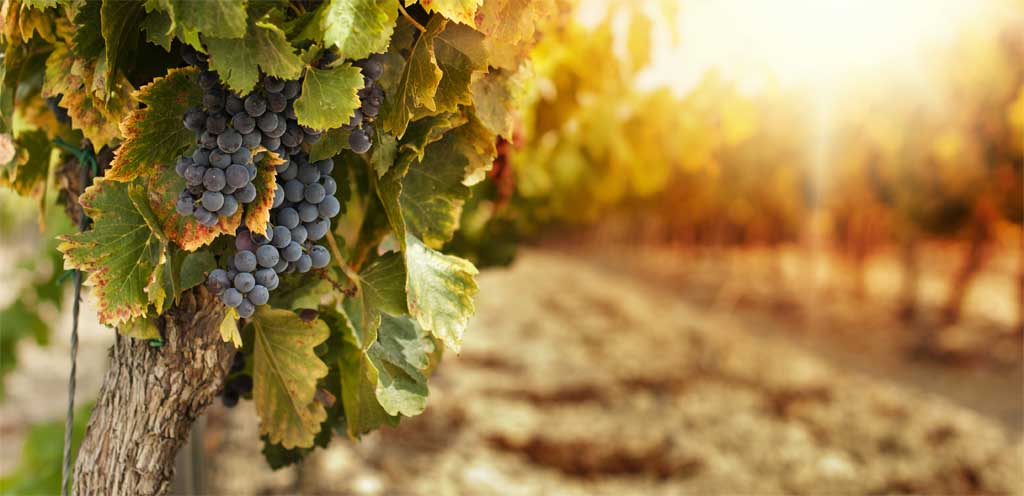
Wayne Mills lingers at the end of a row of Norton grapes, a popular red variety growing on the bucolic, rolling hills in Centreville, Virginia. Mills, the manager of the Winery at Bull Run, plucks a grape from the bunch, pops it in his mouth and spits the chocolate-colored seeds out into his hand.
They’re almost ready, Mills says. But there’s a problem. The leaf canopy is infected with a fungus called black rot.
“What it does, it starts to get these little spots on here,” Mills says. “They’ll end up as lesions. And these little speckles [are] actually spores waiting for a raindrop to hit it and spread it to another leaf.”
The heavy rains the region experienced this year helped to spread the disease, which destroyed tons of fruit. Black rot wasn’t the only problem this year, Mills says. All that rain was bad for the grapes just by itself. The refrain is echoed through grapevines all over the Washington region. Some growers say it’s the worst year they’ve ever seen. Mills says the rain forced growers to make a tough decision: pick some grapes too soon or let them rot on the vine.


“We picked Cabernet Franc, and we got about a ton and a half maybe. And last year out of the same vineyard block we picked 7.9 tons,” he says.
Mills estimates the winery lost between 30 and 80 percent of its crops, depending on variety. Red wine grapes suffered the most because they take longer to mature.
Production and ‘Chaptalization’
A bad harvest makes production challenging.
“It’s easier to make bad than good wine,” says Bull Run’s winemaker Ashton Lough. “In a year like this we just try to survive.”
The amount of alcohol in a wine is directly affected by the amount of sugar the grapes produce naturally. When grapes take in too much water, the sugar content gets diluted. Lough said this can be corrected by meticulously adding sugar before or during fermentation.
“I use table sugar if I need to. And it gives you both the fructose and the glucose which is naturally in grapes itself,” he says.
The process is called chaptalization, and it’s legal in Virginia, but it isn’t everywhere. Some in the viniculture world feel the process gives an added advantage to producers in areas with a poor climate. Many wine-making countries like Italy and Argentina have banned chaptalization. It’s also prohibited in California.
The Bottom Line
There are other ways for winemakers to lessen the blow of bad harvest, too. Rob Cox, the head winemaker at Paradise Springs Winery in Clifton, Virginia, says that even in good years, winemakers will purchase grapes from other growers. This year he’s had to purchase more grapes than usual from other farmers to maintain normal production. But those farmers have also suffered heavy crop losses. Paradise Springs — like all the other area vineyards — could take a big financial hit.
Cox uses the vineyard’s Cabernet Franc, which sells for about $25 a bottle, as an example.
“When you look at the number of bottles lost, even if it’s two barrels less than what it normally is, you’re looking at 600 less bottles,” Cox said. “So, when you take 600 just say, times 25, you’re looking at $15,000 in retail value of wine lost.”
And that’s just one variety. Paradise Springs makes several wines. Luckily for them, they have vineyards in California from which they have been able to harvest a few varieties of grapes, and they’ll use those grapes at the Virginia winery to salvage as much of their year as they can, Cox said. That’s a luxury smaller vineyards don’t have.
“Unfortunately, we lost our entire harvest this year,” says William Livingston, general manager of the four-acre Gemeny Winery and Vineyards in Brandywine, Maryland.
Everything that could go wrong did, and the rain started it all, he said.
“So, what it really does to us is, this year we will not have a 2018 vintage from this farm, from our vineyard,” Livingston says.
What To Expect In Tasting Rooms
Some vineyards will make up for the financial loss by bottling wines made with grapes from other regions. Or they may release “Reserve” wines from previous years. The ripple effect won’t be seen by consumers for about six months. The white wines will be released first; red wines won’t hit tasting rooms for another year at least.
For the last 20 years or so, winemakers in Virginia and Maryland have strived to show the world that exceptional wines can be produced from grapes grown in this region, even though they say vineyards here struggle with more bad weather than their counterparts in the West. But this year the weather was about as bad as it gets. So, don’t expect to find many of those fine local wines from 2018.
Source - http://dcist.com