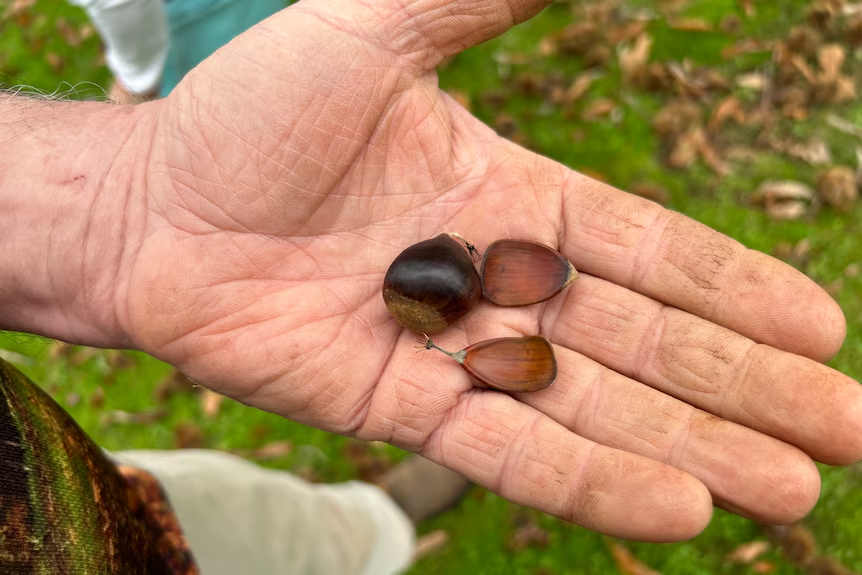
John and Linda Stanley have just come out the other side of what they are calling "the worst year for any chestnut grower".
For the past 10 years, they have owned and operated Chestnut Brae, a 28-hectare, 1,000-tree chestnut farm near Nannup, 260 kilometres south of Perth.
A warming climate and a lack of rainfall over the past 10 months have caused a huge drop in production at their recent harvest.
"We normally expect a 12 tonne on average, this year we got 1.7 tonne," Mr Stanley said.
"When you're expecting 12, that is a major challenge especially when the market is demanding more product."
However, the chestnut growers consider themselves the lucky ones.
"Most farmers didn't collect any nuts, they didn't harvest at all, so I guess you could think of us lucky that we managed 1.7 tonne," he said.
Working with a changing climate
According to the Bureau of Meteorology, annual rainfall in the past 30 years has decreased by 6 per cent in the South West of WA, with the biggest drop in autumn and the early winter months.
The chestnut farmers believe agriculturalists need to start seriously looking at alternative crops, to work with the drying climate instead of against it.
"There's a farmer near us considering growing dates, I would have laughed at him a few years ago but now it's becoming more suitable for those types of crops," Mr Stanley said.
Looking at their own business model, the Stanleys have been expanding the range of products they supply, as well as dividing the crop into three to ensure maximum profitability.
"We know we can sell the largest third of the crop as a nut, the middle third goes to our products, and the smallest third we feed to our chestnut-fed pigs," Ms Stanley said.
"But while we've been expanding our product this year, we have only got 1.7 tonne instead of 12, so it's going to be huge challenge.
"We can't just do the same thing moving forward, that's going to be failure."
Thinking sideways instead of forwards
Mr and Mrs Stanley want to be known as price makers, instead of price takers, so they have developed products that are unique.
"We sell chestnut ale, liqueur, mustard, flour," Mr Stanley said.
"It means thinking sideways, looking at how you can develop a product that interests consumers."
The company is also part of the Global Agritourism Network and recently received 2024 World Agri-Tourism awards.
Farms from around the globe entered the competition, with Chestnut Brae and a farmstay in Tasmania highlighted for their innovation and development.
The Stanleys' choice to build agritourism into their business was their way of educating people about how agriculture is changing.
"It's all about city people coming to explore, getting them to come and look at how their food is produced; the new generations need to understand this," Ms Stanley said.
"We run tours which cover everything from the gardens, the orchard, the uses of chestnuts, and how the chestnuts are processed. They can taste the end product."
Mr Stanley added how important it was to create opportunities for metropolitan areas to understand the changing climate.
"I'm not being critical of the city folk, but it is harder to see what is happening in rural situations, they don't see the grass change colour," he said.
Overseas interest
Chestnut Brae's product is considered a part of a "boutique market".
They are limited to growing 1,000 trees, due to management restrictions and water availability.
Major interest is coming from overseas buyers and in recent weeks the farm has had visitors from as far away as Japan.
"Places like Singapore, Kuala Lumpur or Dubai is the right size market for a business like ourselves," Mr Stanley said.
"International visitors and potential buyers are coming down to the farm wanting to know about where their food comes from; they are foodies by nature."
Source - https://www.abc.net.au