US - Corn planting is slowest on record for this time of year

21.05.2019 970 views
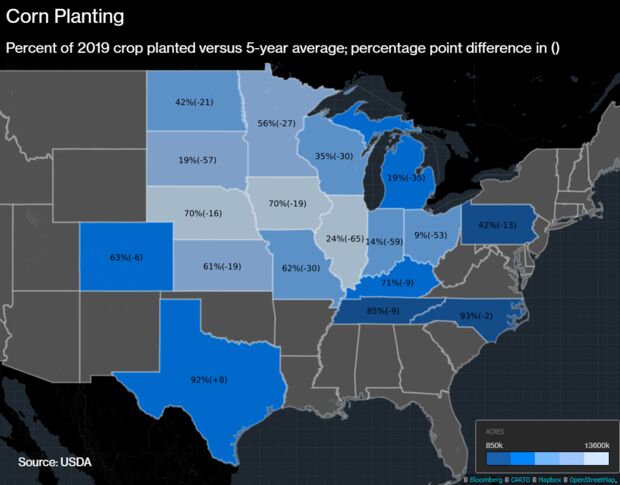
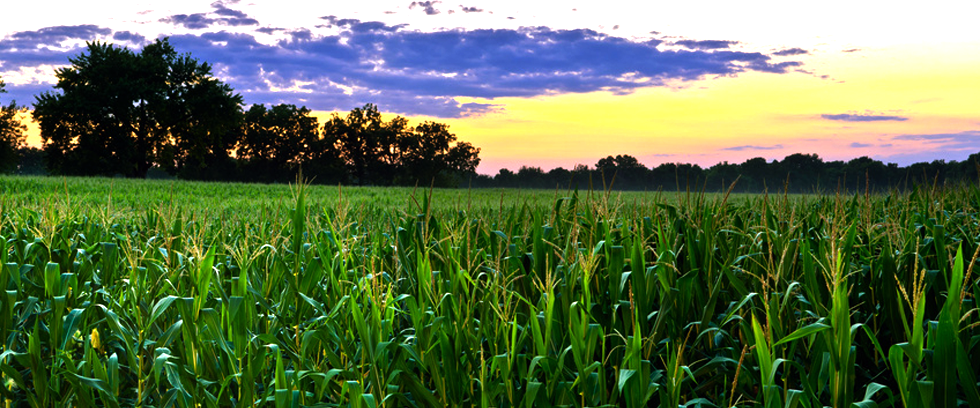
US corn planting has never been this late after storms battered the Great Plains and Midwest and kept farmers out of their fields. As of Sunday, only 49% was in the ground, according to a U.S. Department of Agriculture report released Monday. That’s the slowest pace in records dating back to 1980. Last week, the most widely grown American crop was only the furthest behind in six years. Some farmers are now facing deadlines to get their crop in the ground in order to still be covered by federally backed crop insurance policies. They can still plant corn, but after certain dates based on geography, their fields no longer qualify for policies that protect against drops in crop prices or weather events that cut harvests.

Slow Pace

Percent of corn planted as of May 19 lowest on record for this period

Soybean plantings also have been delayed by a deluge of rainy weather so far this year -- the last 12 months were the wettest on record in 48 U.S. states, according to NOAA’s National Centers for Environmental Information. As of Sunday, only 19% of the U.S. soy crop was planted, compared with 53% at the same time in 2018.
  • Corn emerged from the ground 19% vs 10% last week, 47% a year ago
  • Soybeans planted 19% vs 9% last week, and 53% a year ago
  • Soybeans emerged 5% vs 24% a year ago
  • Spring wheat planted 70% vs 45% last week, and 76% a year ago
  • Spring wheat emerged 26% vs 10% last week, and 34% a year ago
  • Cotton planted 44% vs 26% last week, and 50% a year ago
  • Winter wheat 66% g/e vs 64% last week, and 36% a year ago
    • Kansas 60% g/e vs 56% a week ago
Map

Source - https://www.bloomberg.com/
27.01.2026

New Zealand growers report limited crop damage but logistics disruption

Early reports indicate that most growers in New Zealand came through the recent heavy rain and flooding with limited impacts, according to Horticulture New Zealand chief executive Kate Scott. While the weather created operational challenges, there have been no widespread crop losses or major damage to orchard infrastructure reported so far.

27.01.2026

USA - Row crop farmers continue to face financial stress amid federal payments

As the U.S. Department of Agriculture prepares to give $11 billion to farmers across the U.S., row crop producers are continuing to see a yet another year of financial strain.

27.01.2026

FAO Boosts Food Security in Haiti and the Dominican Republic with Emergency Agriculture Support

A high-level mission from the Food and Agriculture Organization of the United Nations (FAO) to Haiti and the Dominican Republic highlighted the critical need for coordinated action to address food security across the Caribbean. 

27.01.2026

US$9,4m drive to climate-proof Zimbabwe agriculture launched

Zimbabwe is taking bold steps to safeguard its agriculture against climate shocks with the launch of the US$9,4 million Resilient Agriculture Cluster Project (RACP), a pioneering initiative supported by the African Development Bank (AfDB) and IFAD.

27.01.2026

Kenyan Small-Scale Farmers Gain Crop Insurance Amid Climate Shocks

In Kenya, crop production is gradually shifting from a struggle for survival to a pathway for economic opportunity. For many years, farmers have faced unpredictable weather, fragile soils, limited drying options, and uncertainty about where their harvest would be sold.

27.01.2026

USA - Winter storm takes a toll on agriculture in the South

Freezing temperatures and ice of the past weekend have impacted industries from timber to sugar cane, crawfish to cattle. 

26.01.2026

EU streamlines farm rules, promising €215m savings for agriculture

The European Commission has adopted nine new legal acts to cut administrative requirements under the EU’s Common Agricultural Policy (CAP), including changes it said could save farmers across the bloc up to €215 million a year.

26.01.2026

Uzbekistan, Canada Discuss Joint Agricultural Research

Uzbek Minister of Agriculture Ibrokhim Abdurakhmonov has held a working meeting with Ben Bradshaw, Assistant Vice-President for International Cooperation at the University of Guelph (Canada), to discuss prospects for joint scientific research.