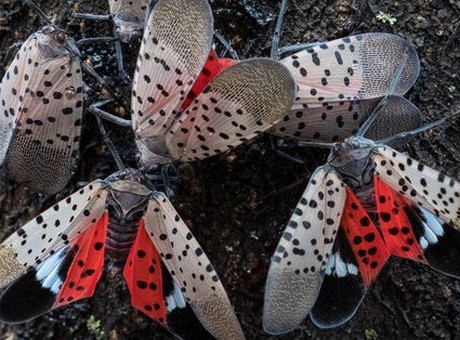
The impacts could extend well beyond California. According to industry reports, the state is the world's fourth-largest wine producer, selling an estimated $35 billion domestically and exporting $1.5 billion annually.
Around 44% of non-native insects arriving in California were first established elsewhere in the U.S. Given the speed with which the spotted lantern fly has spread, Hoddle realized the state needed a proactive approach to this predictable problem.
"Normally, when a bug shows up, we try to contain and eradicate it," Hoddle said. "But by the time the population is found, it tends to already be widespread and hard to handle."
The state Department of Food and Agriculture recently granted Hoddle $544,000 to test whether a tiny parasitic wasp, also originally from China, could be the solution to the looming problem. The wasp lays its own eggs inside the lantern fly's eggs. While developing, the wasp larvae eat and kill their hosts, and then emerge after chewing escape holes through the lantern fly eggs.
These wasps pose no threat to plants or people, but before they can be used to control the lantern fly, Hoddle must prove they won't cause unnecessary harm to other native insects. "We can't just release a Chinese parasite into the wild in California," Hoddle said. "Chances are low it will harm the wrong targets, but we have to be sure."
Safety testing will be conducted in a highly secure quarantine facility at UC Riverside. Native lantern flies, the subjects of safety testing, will be collected from natural areas in California and southern Arizona this summer.
Source - https://www.freshplaza.com
USA - Threat of insect invasion for Californian avocados
19.06.2019 1132 views
The impacts could extend well beyond California. According to industry reports, the state is the world's fourth-largest wine producer, selling an estimated $35 billion domestically and exporting $1.5 billion annually.
Around 44% of non-native insects arriving in California were first established elsewhere in the U.S. Given the speed with which the spotted lantern fly has spread, Hoddle realized the state needed a proactive approach to this predictable problem.
"Normally, when a bug shows up, we try to contain and eradicate it," Hoddle said. "But by the time the population is found, it tends to already be widespread and hard to handle."
The state Department of Food and Agriculture recently granted Hoddle $544,000 to test whether a tiny parasitic wasp, also originally from China, could be the solution to the looming problem. The wasp lays its own eggs inside the lantern fly's eggs. While developing, the wasp larvae eat and kill their hosts, and then emerge after chewing escape holes through the lantern fly eggs.
These wasps pose no threat to plants or people, but before they can be used to control the lantern fly, Hoddle must prove they won't cause unnecessary harm to other native insects. "We can't just release a Chinese parasite into the wild in California," Hoddle said. "Chances are low it will harm the wrong targets, but we have to be sure."
Safety testing will be conducted in a highly secure quarantine facility at UC Riverside. Native lantern flies, the subjects of safety testing, will be collected from natural areas in California and southern Arizona this summer.
Source - https://www.freshplaza.com
ScaleAgData Stakeholder Engagement Event
22.10.2024The ScaleAgData project is pleased to invite you to our second stakeholder event. Building on the discussions and connections formed during our first webinar, this event will focus on fostering collaboration among stakeholders, providing updates on our project’s progress, and outlining future opportunities for engagement.
Vietnam - Aid for agricultural insurance premiums proposed to rise
The Ministry of Finance has proposed increasing support for agricultural insurance premiums and expanding eligible beneficiaries in a move aimed at encouraging greater participation by farmers and agricultural organisations.
USA - MDARD Awards Over $3.2 Million Through Resilient Food Systems Infrastructure Grant Program
The Michigan Department of Agriculture and Rural Development (MDARD) today announced more than $3.2 million of grants to 10 Michigan entities through the U.S. Department of Agriculture’s (USDA) Resilient Food Systems Infrastructure (RFSI) Grant Program.
India - 100 acres of maize and jowar crops reduced to ashes in fire
Farmers, who had worked for months, were just days away from bringing their harvest home. Unfortunately, an accidental fire turned their hopes into ashes, destroying nearly 100 acres of maize crops.
Philippines - Abra farmers, fisherfolk benefit from more than P14M crop insurance
Lagayan farmer Roberto Layao is thankful for the crop insurance money he received from the Philippine Crop Insurance Corporation (PCIC).
India - Fresh hailstorm hits South Kashmir apple belt, farmers seek crop insurance
A hailstorm struck apple-growing villages in Shopian and Kulgam districts, adding to worries of growers already facing erratic weather this season.
Canada - Organic and seed growers gain access to MASC’s contract price option
Contract price option now offered on organic, pedigreed seed and forage seed acres — and producers have until June 30 to sign on for higher dollar coverage.
USA - Congress considers farm bill as farmers are pinched by rising costs
A sweeping law that governs crop insurance, conservation programs, and nutrition assistance is up at one of the toughest moments for farmers in recent memory.
India - Nor’westers wreak havoc across north Bengal, normal life disrupted
Nor’westers wreaked havoc in different districts of north Bengal late on Tuesday night. Trees were uprooted, the electric supply was affected, along with standing crops. Many areas also witnessed waterlogging.