Adverse weather cuts Korea's citrus production to 10-year low, impacting exports and prices

02.01.2025 435 views

South Korea's marketing year (MY) 2024/25 citrus production is forecast down 2.6 percent to 565,000 MT, a 10-year low, on gradually declining acreage and adverse weather conditions.

Jeju Island, where nearly all Korean citrus is grown, experienced a prolonged summer heat wave lasting into mid-September, followed by excessive fall rain, which caused fruit cracking and rot. Citrus consumption increased in MY 2023/24, as shortages of other domestic fruit (apples, pears, persimmons) led consumers to substitute with amply supplied domestic mandarins and imported oranges, whose consumption increased by 4.3 and 11.5 percent, respectively. Imports of fresh oranges, mostly from the United States, are forecast down in MY 2024/2025, as emergency tariff rate quotas for imported fruit are not expected to be renewed. In June 2024, the United States gained market access for Texas grapefruit, and the first shipments are expected to arrive in Korea in December.
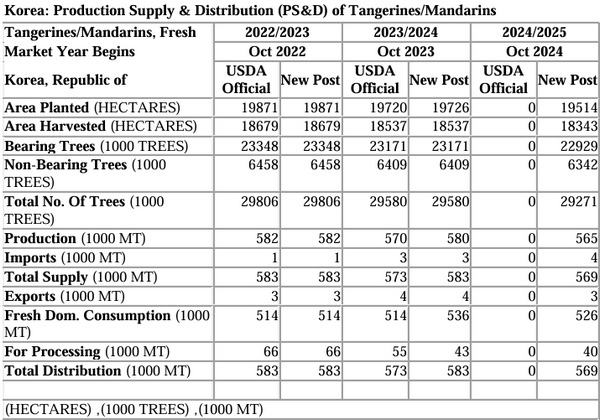


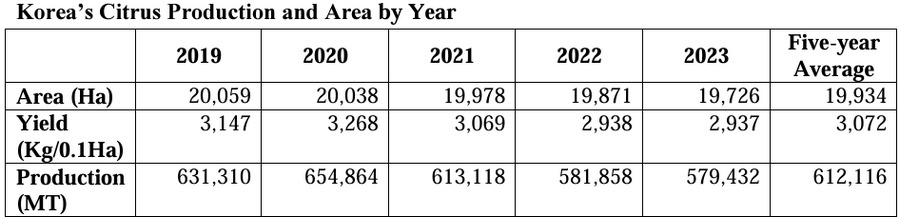
In marketing year (MY) 2024/25 (October 2024 to September 2025), Korea's tangerine/mandarin production is projected to reach 565,000 metric tons (MT), marking a 2.6percent decline (15,000 MT) from the previous year's 580,000 MT. This represents the lowest citrus production level in the past decade and is also about 8 percent lower than the five-year average production of 612,000 MT. The primary reason for this decline is the reduced harvest of open-field Unshu tangerines, which account for approximately 70 percent of total citrus production in Korea, because of gradually declining planted area, adverse weather conditions, and the alternate fruit-bearing cycle.


In 2024, Jeju Island, where nearly all Korean citrus is grown, experienced extreme heat during the summer season and frequent rainfall just before the harvest period (September to October), which led to increased rates of fruit cracking, fruit drop, and spoilage. Consequently, the 4 production of marketable fresh fruit for MY 2024/25 is expected to decrease. Fall rains particularly affected the quality of extra-early maturing and early maturing varieties and disrupted the harvest. Some late-maturing varieties such as Redhyang also experienced severe fruit cracking.
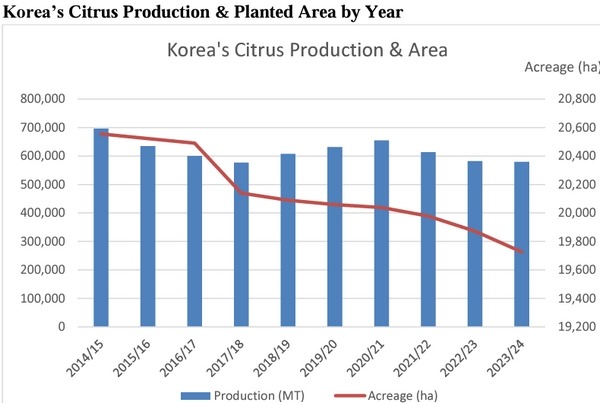


Additionally, the Seogwipo area of southern Jeju, a region responsible for around 65 percent of Jeju's citrus production, experienced an "off-year" in its alternate fruit-bearing cycle, further contributing to the overall reduction in citrus production. The northern part of Jeju typically follows the opposite fruit-bearing cycle, and thus had an "on-year" in 2024, partially offsetting the reduction in Seogwipo.

In September 2024, a crop survey conducted by the Jeju citrus industry forecasted open-field tangerine production for this season to reach approximately 400,000 MT, similar to the previous year (406,000 MT). However, they later revised their forecast downward by 20,000 MT to 380,000 MT due to frequent rainfall, which increased fruit cracking and spoilage.


Source - https://www.freshplaza.com

16.04.2026

USA - Forecast Performance of RMA Expected Yields: Comparison of Yield Projection Methods

Building upon the analyses discussed in the Farmdoc Daily articles of Jan. 27, 2026 and April 1, 2026, this study finds that the current method used by USDA’s Risk Management Agency (RMA) provided the least accurate projection of actual RMA county yields across the five crops and four projection methods examined in this study. 

16.04.2026

Philippines - DAR orients agrarian beneficiaries on crop insurance

The Department of Agrarian Reform (DAR) facilitated an orientation workshop for the agrarian reform beneficiary organizations (ARBOs) from the provinces of Surigao del Norte and Dinagat Islands to strengthen their access to crop insurance and equip them to become authorized underwriters of the Philippine Crop Insurance Corporation (PCIC). 

16.04.2026

Estonia - AgriFi Brings Agricultural Real-World Assets On-Chain with $AGF on Polygon

Agriculture remains one of the largest and most complex industries in the global economy, contributing over $3 trillion annually to global GDP and supporting the livelihoods of billions of people worldwide, according to data from the Food and Agriculture Organization and World Bank.

16.04.2026

USA - Aid Available for Nebraska Wildfire Victims

Just over one month ago, Nebraska experienced the worst series of wildfires in history, burning nearly 950,000 acres. Since then, assistance for farmers and ranchers affected has been rolling in.

16.04.2026

Thailand - Storm batters Si Sa Ket durian orchards, losses hit B39m

A summer storm caused extensive damage to durian plantations in Kantharalak district, toppling hundreds of trees and wiping out tonnes of Thailand’s economic crop just days before harvest, local officials said on Thursday.Following the storm, district chief Somkuan Singkham ordered an urgent survey in tambon Phu Ngern, where strong winds and thunderstorms hit five villages, damaging durian orchards belonging to 110 farmers.The affected fruit is a geographical indication (GI) product known as “Sisaket Volcanic Area Durian,” grown in Khun Han, Kantharalak and Si Rattana districts. Popular varieties include Monthong, Chanee and Kanyao, prized for their creamy texture, mild aroma and relatively dry flesh.

16.04.2026

Cropshader approved for organic farming in Europe

Cropshader, developed by Lumiforte, has been verified as suitable for use in organic farming under the control of Ecocert in Europe. The product complies with the requirements for inputs used in organic production in accordance with applicable European regulations.

15.04.2026

USA - Federal aid programs aim to help Southeast Texas farmers recover from losses

Southeast Texas farmers grappling with crop losses due to extreme weather are turning to federal aid.

15.04.2026

India - Landowners waive lease payments after crop damage

Farmers with large landholdings are doing their part to ease the burden on small and marginal farmers whose crops were damaged by the April 4 storm.