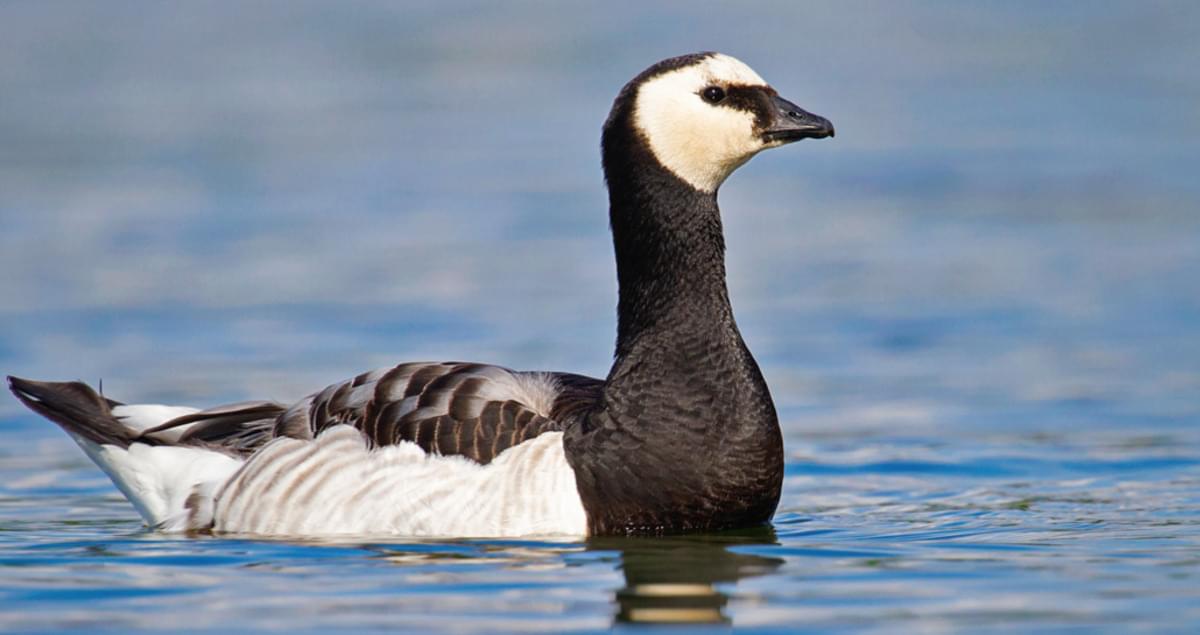
A team of researchers from the University of Turku and the Natural Resources Institute Finland has examined the foraging behavior of barnacle geese in Northern Karelia, Finland.
In this region, geese feeding on agricultural fields cause significant economic damage to farms.
Published in the Journal of Applied Ecology, the researchers' findings suggest that the combined use of areas where geese are not disturbed and no-go areas where geese are repelled from fields can help to mitigate the damage to crops as well as the local human-wildlife conflict.
In Finland, barnacle geese are responsible for most of the agricultural damage caused by protected species, and the Finnish government pays annually up to €4 million in compensation to farmers.
"Most of these compensations were paid to farmers in Northern and Southern Karelia, an important region in Finland for dairy farming, reflecting the local intensity of this human-wildlife conflict. We need effective strategies to proactively mitigate the conflict and methods to minimize the damage," says Professor Jukka Forsman from the Natural Resources Institute Finland.
One possible solution is establishing accommodation fields where some areas are devoted to geese and others are no-go areas where the geese are repelled. The idea is to centralize geese and damage to certain areas and protect important crops elsewhere. The accommodation and repelling fields are selected jointly by farmers and authorities.
In this study, fields were designated into three groups: normal crop fields where no goose management took place, accommodation fields, and repelling fields. Geese were trapped and equipped with GPS transmitters that allowed for following their habitat use.
The results suggest that in several different feeding contexts, individual barnacle geese prefer feeding on accommodation fields, compared to the other types of fields. Furthermore, the repelling fields were used less than expected, suggesting that the repelling effectively decreases the number of foraging geese.
"The impact of accommodation fields on the distribution of foraging geese has usually been estimated as the number of observed geese or costs of damage. However, so far, we haven't known about one of the most important pieces in the puzzle: the individual behavior of geese in the network of accommodation fields, repelling fields and other fields," says Professor Toni Laaksonen from the University of Turku.
"In order to mitigate this human-wildlife conflict with the help of the accommodation field concept, the knowledge of local farmers is invaluable," says Dr. Martin Seltmann from the University of Turku, the lead author of the study. "Accommodation and repelling fields were established in areas that were known to have a long history of high foraging pressure by barnacle geese."
Hence, the researchers suggest that using stakeholder knowledge and the coordinated use of well-designed accommodation and repelling fields can help farmers to proactively prepare for goose damage and to mitigate the costs of goose foraging.
Source - https://phys.org