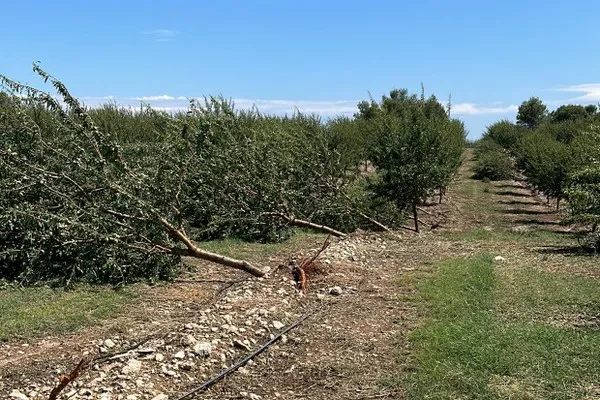
The increasing movement of elephants in the Vindhya region of Madhya Pradesh has spread panic among villagers. Herds of elephants have damaged houses, destroyed food stocks and trampled crops in several villages. In many places, fear has become so intense that entire settlements have been deserted and villagers are being forced to leave their homes.
For the past two weeks, a herd of elephants has been continuously moving between forests and villages in the Chuhia Valley, Gudh, and Govindgarh areas across Sidhi, Mauganj, and Rewa districts. Forest Department teams are monitoring the situation, but the continuous movement of elephants has created a serious threat for rural areas.
To understand the situation on the ground, Dainik Bhaskar visited affected villages and spoke with residents living under constant fear. The newspaper also tried to understand the reasons behind this increasing elephant movement by speaking with officials from the Forest Department and wildlife experts.
Maximum damage reported in Sidhi district
Investigations reveal that Sidhi district has suffered the most damage due to elephant activity in the Vindhya region. In several villages, herds of elephants entered settlements at night and caused large-scale destruction. The animals broke down the walls and doors of mud (kaccha) houses and damaged household property.
Grains stored inside houses, including paddy and other food stocks, were either eaten by the elephants or scattered across the floors. In nearby fields, wheat and paddy crops were trampled, destroying the farmers’ hard work.
Due to the fear of elephants entering villages at night, residents have started staying awake throughout the night to guard their homes and fields.
Entire settlement evacuated in Padkhuri village
Fear of elephants forced residents of Padkhuri village in Sidhi district to evacuate their settlement. Villagers say they had no option but to leave their homes and move to the houses of relatives in nearby safer areas.
According to them, a herd of elephants has been roaming continuously in the region, posing a threat to both life and property. Fear increases as night falls, because elephants mostly enter villages during the night.
Many families have therefore shifted temporarily to other places along with children and elderly members. Residents Rambai Bansal, Rajkumar Bansal, Babbu Bansal, Rajesh Bansal and Sonu Bansal said panic spread across the village after reports of elephants moving nearby.
Villagers said,

We live in a temporary settlement, so the danger is greater. Due to fear, we have had to leave our homes and take shelter with relatives.
They said the herd usually enters the village at night and returns to the forest at dawn. Because such incidents have been occurring repeatedly, many villagers are leaving their homes at night and taking shelter in safer locations.
Villagers stay awake all night in Mauganj district
After creating havoc in Sidhi district, the herd of elephants has now moved towards several villages in Mauganj district. Here too, elephants have damaged houses in many villages. They destroyed grain and food reserves stored in homes and also trampled crops in the fields.
Fear has forced villagers to adopt unusual methods to protect themselves. People now stay awake throughout the night, beating drums and trumpets and lighting torches to scare the elephants away.
Meanwhile, teams of the Forest Department are continuously tracking the elephants’ movement and advising villagers to remain alert.
Panic and traffic disruption in Rewa’s Chuhia valley
The herd has also moved towards Rewa district, reaching the areas of Chuhia Valley, Gudh, and Govindgarh. The presence of elephants has even affected road traffic in the region.
At one point, a herd camped inside the forest area near the valley, forcing authorities to stop vehicle movement on the highway in the morning. As a result, traffic remained disrupted for several hours and travellers faced inconvenience.
Nearby villages also reported damage to crops, as elephants moved through agricultural fields. For safety reasons, the Forest Department temporarily stopped traffic so the elephants could move safely back towards forest areas.
Radio-collared elephant that killed 3 people active again
- According to forest officials, a male elephant fitted with a radio collar has once again become active in the region.
- This same elephant had earlier killed three people in the Jaisingh Nagar area.
- Forest Department officials say the elephant emerged from the Bandhavgarh Tiger Reserve forests and has been moving continuously for the past around 15 days.
- Using the radio collar, forest officials are tracking its movement.
- According to available data, the elephant is covering approximately 20 to 25 kilometres daily and frequently reaching areas close to villages.
- Recently, its movement has been recorded near Mauganj and Hanumana, creating a strong atmosphere of fear among villagers.
Electricity supply shut down as precaution
- With elephant movement increasing, the Forest Department has started implementing several precautionary measures in affected villages.
- Whenever elephants approach a village, electricity supply is temporarily shut down. This step is taken to prevent accidents caused by electric current and to ensure that elephants do not get agitated.
- Villagers have also been advised to stay indoors at night and avoid going to fields or forest areas.
- Forest officials are constantly tracking the elephants using radio collar technology. Announcements are also being made in villages to alert residents so that no loss of life occurs.
Understand the fear of elephants in 6 points
- Ramsumir Singh, a resident of Shikarganj village in Sidhi, says they are very poor and had somehow built a mud house through hard work. One night, a herd of elephants came and broke the wall of the house. They also scattered the grain stored inside. Now he and his family have been forced to take shelter with neighbours.
- Ramkushal Loni, a resident of Marwa in Rewa district, says elephants entered the fields near the village at night and trampled the entire wheat crop belonging to his relatives. Many farmers lost their hard-earned crops in a single night. Now they are worried about how they will repay their loans.
- Subal Rawat, a farmer from Marwa in Rewa district, says herds of elephants come out of the forest and reach near the village. Due to fear, villagers remain awake all night, guarding the area with torches and drums. Women and children are also scared to step outside their homes.
- Kallu Adivasi from Mauganj says elephants came at night and ate the paddy and grain kept outside his house. They also broke fences and trees, and several houses in the village have been damaged. He says if the forest department does not arrive soon, a major accident could occur.
- Rajesh Tiwari, who lives in the Chuhia Valley area of Rewa, says he was passing through Sohaghi Valley when news spread that a herd of elephants had come out of the forest. Police and forest department teams stopped vehicles for some time. He said it was the first time such a frightening situation had been seen in the valley.
- Bhaiyalal Saket, a resident of Kudia village in Sidhi, says that as soon as news of the elephants’ arrival spread, announcements were made across the village. People locked themselves inside their houses with their children. Villagers are afraid to go towards the fields or forest. Electricity supply was disrupted for several days and a blackout was imposed.
Pattern of Elephant movement in MP
Wildlife experts say that Singrauli district in Madhya Pradesh and Surguja district in Chhattisgarh are almost connected through dense forest areas. Because of this forest corridor, elephants can easily move between the two states.
Chhattisgarh–Vindhya elephant corridor
The distance between Singrauli and Ambikapur, the main city of Surguja division in Chhattisgarh, is about 200 kilometres. However, Wadrafnagar, a border area of Surguja, is only about 120 kilometres from Singrauli.
Dense forests connect these regions, allowing wildlife to move freely between states. Although Sidhi district does not directly border Surguja, the forests of Balrampur, Surajpur and Koriya districts in Surguja division connect with the forests of Singrauli and Sidhi.
Because of this ecological connectivity, the region is known as the “Chhattisgarh–Vindhya Elephant Corridor.”
Two major routes used by Elephants
Route 1
- Elephants often emerge from Surguja and Balrampur districts of Chhattisgarh.
- They first enter the dense forests of Wadrafnagar, then move towards the forests of Deosar and Jiyawan in Singrauli district.
- From there, the herd enters Sidhi district and sometimes travels further to Rewa and Shahdol.
- This movement frequently creates fear among villages located along the route.
Route 2
- Another important route begins from the forests of Bandhavgarh in Umaria district.
- From there, elephants move towards Shahdol, Sidhi and Rewa, forming a corridor through forests, rivers and reserve areas.
- Herds coming from Chhattisgarh also use this route at times.
Elephants stay in one area for 15–20 days
Wildlife experts say,
Herds usually stay in one region for 15 to 20 days. After that, they move towards another forest area depending on the availability of food and water.
Forest department increases surveillance
- Due to increased elephant activity, the Forest Department has strengthened surveillance.
- Special monitoring teams have been deployed in affected areas. Villagers have been advised not to visit forests or fields during the night.
- Patrolling teams are also using microphone announcements and other methods to guide elephants back towards forest areas.
- Authorities have also started surveying the damage caused by elephants so that farmers can receive compensation.
Why is elephant movement increasing?
Experts say several factors are responsible for the rising movement of elephants in the Vindhya region.
The most important reason is deforestation and declining food availability inside forests.
Other reasons include the creation of new elephant corridors, expansion of forest areas, environmental changes, and increased wildlife movement along the Chhattisgarh–Madhya Pradesh border forests. Because of these factors, the Vindhya region is gradually becoming a new habitat for elephants.
Forest Department Monitoring the Situation
DFO Lavkesh Nirapure said,
At present information is available about the movement of two elephants in Rewa, which have come from Bandhavgarh forests.These elephants are being continuously tracked. People are being advised to remain alert and avoid forest areas.Announcements are being made in villages near forest areas, and surveys are being conducted to assess crop damage.After the survey, a list of affected farmers will be prepared under the supervision of the district collector.
Uncertainty continues
Due to the constant movement of elephants, residents across the Vindhya region of Rewa division are living in fear.
It remains unclear how long the elephants will stay in the region.
Senior forest official Hiralal Singh said,
The movement of elephants depends entirely on natural conditions.“Their movement depends on the availability of food and water. At present the herd is continuously changing its location, so it is difficult to predict how long they will stay in this area. Whenever we receive information about their presence, forest staff immediately reach the spot.”For now, the people of Vindhya continue to live under the shadow of fear as the elephant movement shows no sign of stopping.
Source - https://www.bhaskarenglish.in