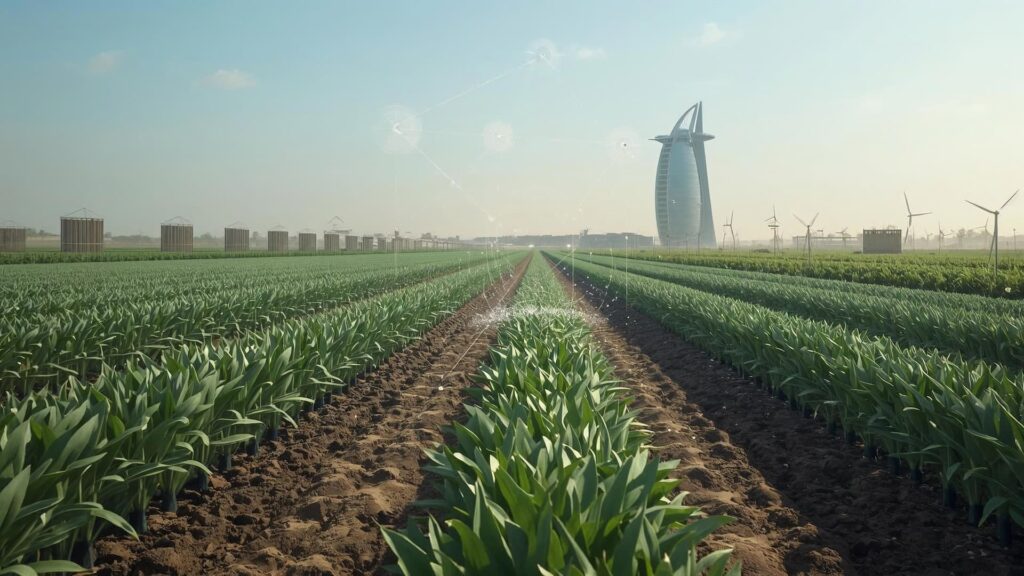
UAE deploys AI ecosystem to support climate-vulnerable agriculture

06.01.2026 221 views

The United Arab Emirates has launched an AI-driven ecosystem to help climate-vulnerable agricultural regions adapt to increasingly volatile weather. The initiative reinforces the country’s ambition to position itself as a global hub for applied AI in climate resilience and food security.

Unveiled in Abu Dhabi, the programme builds on a US$200m partnership with the Gates Foundation announced during COP28. It reflects a shift from climate pledges toward deployable technology as droughts, floods and heat stress intensify pressure on agriculture, particularly in the Global South.

At the core is an integrated ecosystem linking scientific research, AI model development and digital advisory tools with large-scale deployment. Rather than isolated pilots, the programmes are designed to translate data into practical tools used directly by governments, NGOs and farmers.

Abu Dhabi is positioning itself as a hub for agricultural AI through the CGIAR AI Hub and a new institute at Mohamed bin Zayed University of Artificial Intelligence. The ecosystem also includes AgriLLM, an open-source model trained on agricultural and climate data.

Delivery is supported by AIM for Scale, a joint UAE–Gates Foundation initiative expanding AI-powered weather forecasting in data-scarce regions. In India, AI-enabled monsoon forecasts reached an estimated 38 million farmers in 2025, with further deployments planned.


Source - https://dig.watch

11.03.2026

Scaling up crop insurance in Africa for climate resilience and agricultural transformation

As climate change impacts intensify, African economies face increasing exposure to extreme weather events. The World Bank estimates that nearly 18% of the world’s population is at risk from severe weather events from which recovery would be difficult; in Africa, that number is 37%.

11.03.2026

USA - Specialty Crop Losses Outpace Federal Bridge Assistance Funding

The U.S. Department of Agriculture (USDA) is rolling out a new Farmer Bridge Assistance (FBA) program for specialty crops — that is, crops not included in the first $1 billion relief package — but early analysis from Terrain suggests economic losses across the sector far exceed available funding.

11.03.2026

India - Maharashtra Govt Sanctions ₹15.77 Crore Relief For Jalgaon Farmers, Increases Compensation Limit To 3 Hectares

Relief and Rehabilitation Minister Makarand Jadhav-Patil informed the Assembly that the Government of Maharashtra has sanctioned ₹15.77 crore for farmers in Jalgaon district affected by crop damage due to unseasonal rains in Raver and Yawal talukas.

11.03.2026

Fertilizer emissions may damage soil bacteria that help crops grow

Nitrous oxide (N₂O) is usually discussed as a climate problem – a powerful greenhouse gas that can spike in soils after fertilizer use. But new research from the Massachusetts Institute of Technology (MIT) suggests it may also play an unexpected biological role.

11.03.2026

India - ₹243.52 crore interim crop insurance relief released to 2.9 lakh farmers in Kalaburagi

Minister for Rural Development and Panchayat Raj Priyank Kharge said the State government would make every effort to ensure that the proposed Millet Hub is established in Kalaburagi district, provided the Agriculture Department submits a detailed project report (DPR) along with a blueprint at the earliest.

11.03.2026

USA - Wheat Prices Rise on Poor Crop Conditions as Insurance Deadline Nears for Spring Plantings

Wheat markets have seen strong price movement in recent days following a disappointing crop condition report across several major producing states.

10.03.2026

India - Nearly all crop insurance claims settled, Centre tells Lok Sabha

The Centre on Tuesday informed the Lok Sabha that nearly all claims under the Pradhan Mantri Fasal Bima Yojana (PMFBY) have been settled, asserting that the crop insurance scheme now ensures timely and transparent compensation for farmers across the country.

10.03.2026

Turkish Malatya apricot crop recovers after 2025 frost damage

Malatya in Turkey, which accounts for about 85% of global dried apricot production, is entering the budding stage following frost damage recorded in April 2025. Early assessments from the region indicate improved crop conditions compared with earlier expectations.