Lipman Family Farms wanted to mitigate flood risk associated with heavy rain on their 2,000-acre farm in Naples.
As general manager, Lucas Conran helps oversee seven farming operations for Lipman in Florida and other states along the East Coast.
So, he asked for help from his longtime friend, Sanjay Shukla, a University of Florida hydrologist, who had just developed his “compact-bed geometry,” with state and federal funding, including the U.S. Department of Agriculture.
“My working relationship with Dr. Shukla began about 10 years ago, when he first had the idea to narrow and raise beds in our tomato production,” Conran said. “By raising the beds, the initial idea was to get the root system higher than the water table. That way, if it rained heavily, we could protect the crop from possible flooding.”
He’s thankful for Shukla’s help, which has resulted in what Lipman conservatively estimates is a 25% annual savings on water use since it started conducting trials with Shukla’s input.
The idea for compact-bed geometry goes back to about 2005, when Shukla saw hurricanes causing significant wind and flood damage to Florida crops. With compact beds, Shukla reasoned he might be able to help growers prevent severe flooding.
Instead of planting crops on beds that were normally 6 to 8 inches high and about 3 feet across, he designed soil beds that are 10 inches to a foot high and 1 ½ to 2 feet across. Therefore, crops sit higher from the ground, and the soil bed takes less ground space.
As a result, compact soil beds reduce the amount of water, fumigants and fertilizer needed to treat the crops, while maintaining or increasing yields. The design also results in less bending and stretching for field workers. If laborers are less tired, they can harvest more.
Before he worked with Lipman in Florida, Shukla tested his compact-bed design on the company’s farms in Virginia. Once he and the company saw success there, he wanted to test the system in the Sunshine State.
“I brought this compact-bed geometry as a proposed solution for water and overall sustainability — both economic and environmental,” said Shukla, a professor of agricultural and biological engineering at the UF/IFAS Southwest Florida Research and Education Center. “It’s more of a holistic design. You make a better crop. You reduce your input and your cost, and you reduce your production risk, whether it’s from some of the pests and diseases, hurricane wind damage or flooding.”
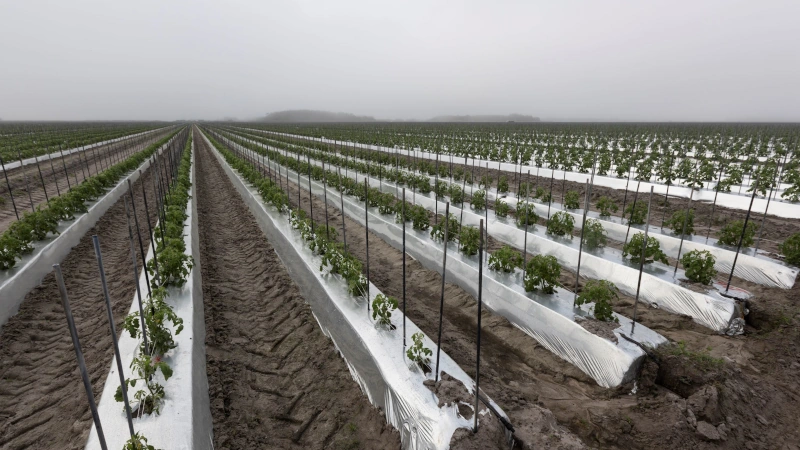
This photo shows compact soil beds, developed by UF/IFAS Professor Sanjay Shukla. This geometric soil-bed design, which also uses plastic mulch, is taller and narrow than conventional soil beds. The design helps Lipman farms save 25% on water, plus nutrients and fumigants. Credit: Tyler jones, UF/IFAS.
Crops that use compact-bed geometry grow on raised soil beds covered with plastic. The plastic mulch protects crops from pests and weeds, provides a warmer soil environment and protects the fertilizer from being washed away, Shukla said.
Conran couldn’t be happier with the results of the raised soil beds.
“Good stewardship of our water, much like other resources, is critical because they’re finite,” Conran said. “We don’t have infinite phosphorus or nitrogen in the world. So, reducing that need is huge.”
Lipman’s efforts to save water can be a message for everyone in Southwest Florida, he said. Everyone shares the same water the farming company uses.
“It’s a resource for the residents that live all around us,” Conran said.
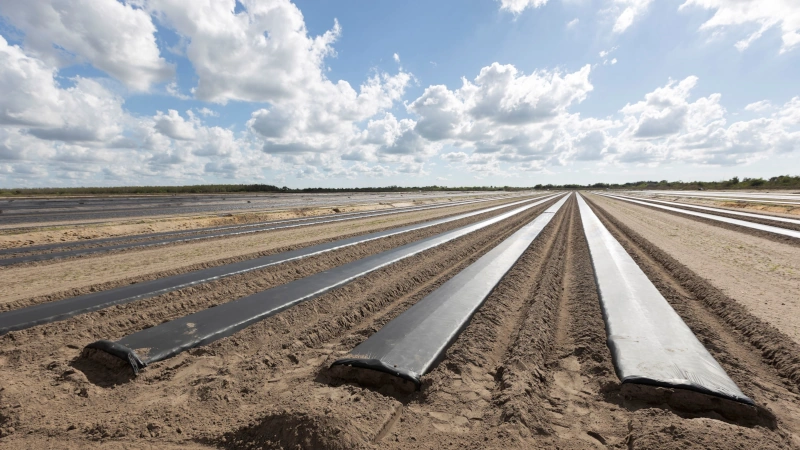
Shown are conventional beds of soil, covered in plastic, at Lipman Family Farms near Naples. Credit: Tyler jones, UF/IFAS.
Working with Shukla has been extremely collaborative, he said.
“There’s a high level of trust between our company and Sanjay and his team,” Conran said. “We know that information we use on our farm will be science-based and invaluable.”
Shukla said it gives him great satisfaction to help farms, large and small.
“The reason I enjoy my job the most is my ability to influence change, positive change, for the producers, and there is no bigger reward, personally, than seeing any of your ideas help our producers, this is our mission as a land grant university” he said.
Source - https://wherethefoodcomesfrom.com