

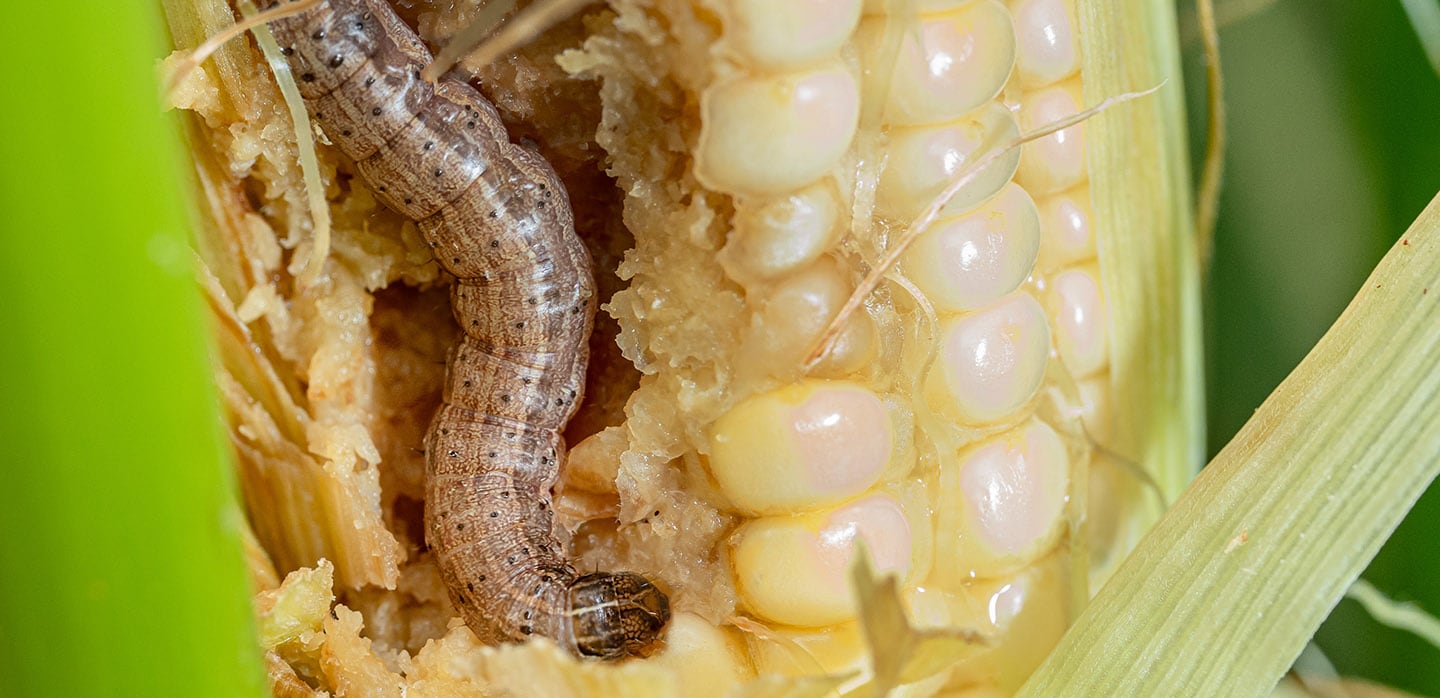
Almost all of Africa's maize crop is at risk from the devastating fall armyworm pest (Spodoptera frugiperda).
Scientists from the University of Minnesota's GEMS Informatics Center, and CABI's Dr. Roger Day, Global Advisor, Plant Health, have highlighted how almost the entire African maize crop is grown in areas with climates that support seasonal infestations of the pest.
The researchers assembled 3,175 geo-tagged occurrences of the fall armyworm worldwide and use that data in conjunction with information about the physiological requirements of the pest to spatially assess its global climate suitability.
They also found that almost 92% of Africa's maize growing areas support year-round growth of fall armyworm. Alarmingly, 95% of the crop is also deemed climatically suitable for fall armyworm and at least three or more pests such as the maize stalk borer, Western corn rootworm and Asiatic witchweed.
Starkly, over half (52.5%) of the African maize area believed suitable for fall armyworm is at further risk from an additional nine pests, while over a third (38.1%) of the area is susceptible to an additional 10 pests.
Dr. Senait Senay, lead author from the University of Minnesota, said, "The spatial concurrence of climatically suitable locations for these pests raises the production risk for farmers well above the risks posed from fall armyworm alone."
"This constitutes an exceptionally risky production environment for African maize producers, with substantive and complex implications for developing and implementing crop breeding, biological, chemical and other crop management strategies to help mitigate these multi-peril risks," notes Professor Phil Pardey, co-lead author of the study.
Outbreaks of fall armyworm in Africa were first observed in southwest Nigerian maize fields in January 2016 and thereafter in Benin, Togo São Tome and Principe. Since then, the pest has spread to more than 40 African countries including Ethiopia, Kenya and Tanzania.
In 2021, CABI scientists conducted the first comprehensive study on the economic impact of a range of Invasive Alien Species (IAS) on Africa's agricultural sector which they estimated to be USD $65.58 billion a year. They established that the fall armyworm alone caused the highest annual yield losses at USD $9.4 billion.
Dr. Day said, "Climates that favor maize production are also seasonably suitable for fall armyworm infestations—not just in Africa. Indeed, around half of the world's maize area, mostly in the moist and warm tropical locales, is also likely to sustain the development of fall armyworm year-round."
"Strategies to deal with fall armyworm, or any other crop pest are best conceived and executed from a multi-peril pest perspective—especially as part of an Integrated Pest Management practice—rather than a piece-meal, pest-by-pest approach."
The study, which is part of a broader GEMS informatics effort concerning Global Pest Risk Analytics, concludes by suggesting that crop management may benefit more from genetic solutions and environmentally friendly biological control agents.
These, they say, require less frequent and timely trips to markets to secure necessary fungicides/insecticides as seasonal pest infestations unfold.
However, they also admit that while IPM practices constitute another, often complementary, strategy for controlling crop pests—especially in tropical regions where natural enemies can have year-round survivability, IPM is not widely adopted in the developing world.
Dr. Senay added, "A multi-peril pest risk approach can be used to both benchmark future multi-peril pest risk assessments—under prospective changes in climate—while also informing current and nearer-term strategies to target market and government resources."
"This can be done in ways which have the most beneficial effect in mitigating the complex of crop pests that pose the most risk for farmers growing particular crops in particular locales."
Source - https://phys.org










