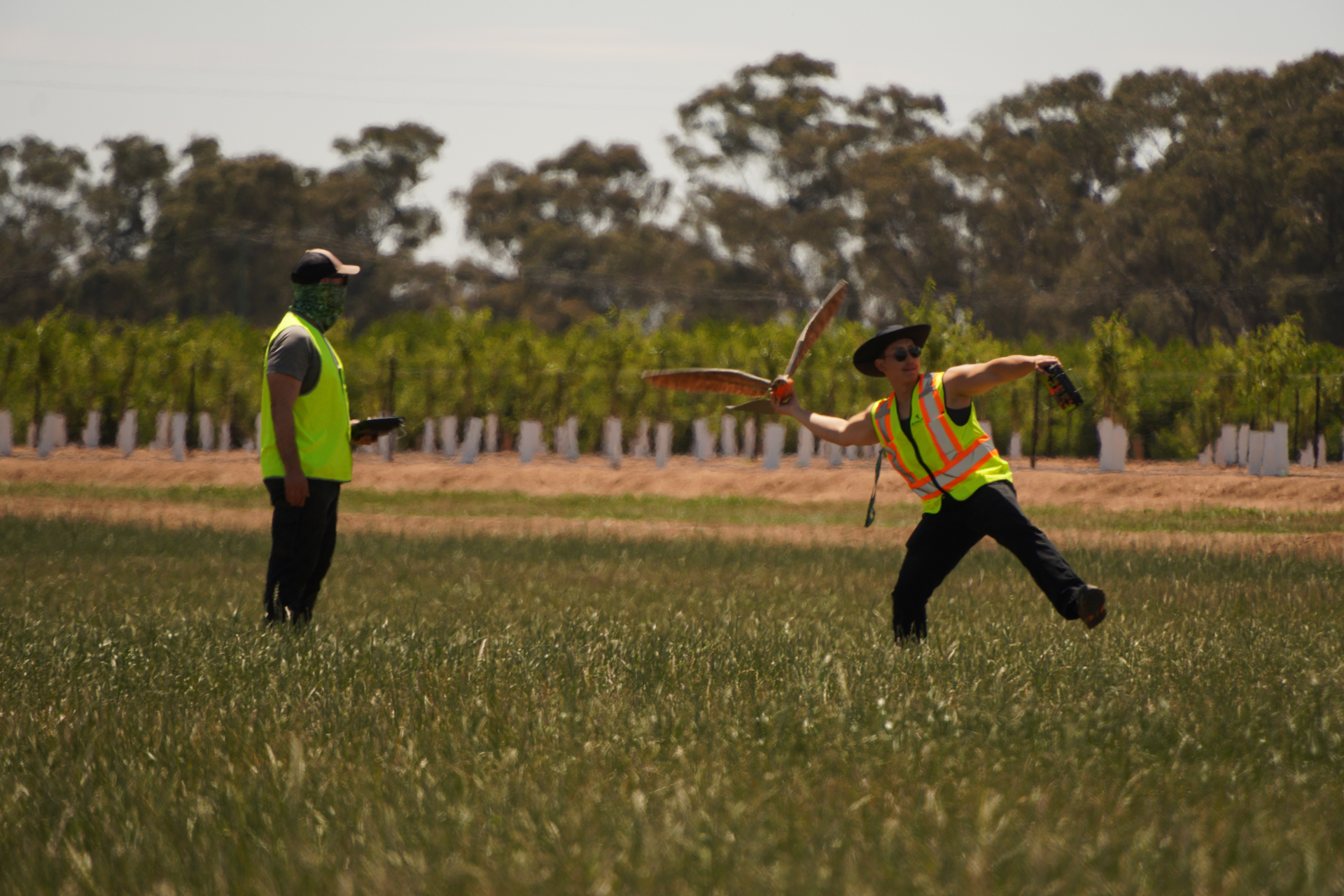
RoBird is now flying around Moreton Bay skies to protect the city’s $100 million strawberry industry from the real deal.
The drone is being tested by council in a deal with research and development corporation Hort Innovation and Canadian technology company Aerium Analytics.
It was developed by Aerium to mimic natural predatory flying and hopefully will drive birds away from strawberry crops.
Mayor Peter Flannery says the trials show Council’s willingness to try innovative ways of protecting an $846m agricultural industry.
“Tech adoption is a key part of Council’s industry development plan; if proven, this kind of technology offers a scalable, wildlife friendly solution to a persistent industry problem,” he says.
“The trials aim to demonstrate reduced crop loss, improved yield protection and consistent performance over time, particularly in bird hotspots which are common around berry production.”
ROBIRD CARRIES HOPES
Bellmere-based TSL Family Farms owner Laura Wells, whose farm is one half of the Taste’n’See strawberry brand, says birds like lorikeets and corellas feasting on their strawberries are proving costly.
“It does vary depending on the weather but when it gets very overcast, we can have hundreds of lorikeets coming in at one time,” she says.
“They’ll settle in and within a week, we can lose $50,000 to $200,000 worth of crops between the two Taste’n’See farms. They are very disruptive.
“They will annihilate crops that are close to trees, and the financial impact is massive; it can be gut-wrenching.”
Wells remains quietly optimistic about RoBird after having no luck with other deterrence methods.
“We’re hoping that RoBird will essentially make its presence known here over a long period of time and (that) those birds will start realising it’s not worth the risk, change their patterns and move on,” she says.
“No-one wants to see hundreds of thousands of dollars’ worth of crops going anywhere but into people’s mouths.”
Wells points out that agriculture plays a “massive role in the City”.
“We’re a City that feeds a nation so this kind of innovation is very welcome,” she says.
Hort Innovation’s Sustainability and Production R&D General Manager Anthony Kachenko says that bird damage is a persistent challenge for growers.
“This project brings together cutting-edge drone technology and expert wildlife management to deliver practical, scalable solutions that protect crops, improve productivity and do not harm local bird wildlife,” he says.
Aerium Analytics Chief Growth Officer Jill Viccars said the trials’ objective is to demonstrate a sustained predatory presence in the air over time.
“By establishing that presence early and maintaining it throughout the season, we help prevent new bird pressure while steadily decreasing activity in areas already impacted, ultimately supporting growers with more reliable, efficient, and sustainable outcomes,” she says.
Council says Moreton Bay accounts for about 62% of all strawberry farm hectares, and 64% of all strawberries grown in South-East Queensland, raising $100m.
A quarter of all punnets of strawberries grown in Australia are grown in the Bay, contributing to $420m in total agricultural crop exports.
The drone is part of a three-year national trial program that will run until 2028, funded by Hort, AERIUM and the federal government; it was previously field tested in Victoria and South Australia.
The first field demonstration of RoBird was held at Bellmere earlier this month attended by strawberry growers and industry representatives.
Source - https://newscop.com.au