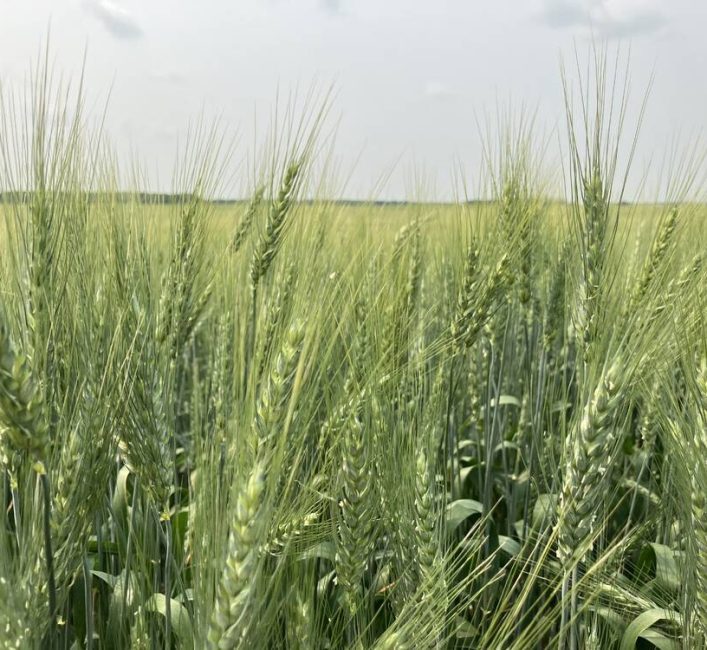
The future of wheat breeding in Canada is on uncertain ground.
Agriculture and Agri-Food Canada (AAFC) may be moving away from field-ready wheat development and towards upstream research, attendees heard during Edmonton’s Crossroads Crop Conference Jan. 29.
The event featured a round table of four prominent wheat breeding figures, with an eye to what the future would look like if their field isn’t getting the federal support industry is used to.
WHY IT MATTERS: Climate-heavy federal research funding has come under fire in the agriculture sector, which points to other crop development priorities farmers say also need support.
The discussion included Todd Hyra, western business manager for SeCan; Stuart Smyth, an agricultural economist at the University of Saskatchewan; Robert Graf, science advisor with SeedNet and retired AAFC wheat breeder; and Dean Hubbard, Alberta farmer and chair of the Canadian Wheat Research Coalition (CWRC).
Graf, a veteran breeder who developed or helped develop many of Western Canada’s varieties, said AAFC needs to be straightforward with its intentions. All he’s heard to date is the possibility of a three-year phase-out of AAFC’s wheat breeding activity.
“What we really need to get is some straight answers from Agriculture and Agri-Food Canada on what exactly is the plan right now. It’s quite vague,” he said.
“It’s very difficult to come up with a good plan if we don’t know what we’re moving towards, and so I think there needs to be some real, honest discussion amongst the entire industry on ‘what is the plan?’”
Departure a ‘seismic shift’
At first glance, AAFC seems too big to get out of breeding.
Hyra estimated 75 per cent of new varieties in Canada come out of the federal pipeline, not to mention the web of support connecting AAFC with universities and industry.
“All of the programs in Western Canada are intertwined and the AAFC program provides a base for which all of them work,” he said.
“There’s pathology support, there’s co-ordination, there’s expertise. And so a change within AAFC not only impacts the flow of products to commercial producers, but it impacts the effectiveness of the other breeding programs.”
If AAFC does get out of the game, Hyra said it would mean a “seismic shift” in the way wheat varieties are delivered in Canada. He would like to see a great deal of consultation before the department goes any further on the file.
“Farmers have been funding AAFC for 30 years, so there should be that level of consultation on this to move it to a high level,” he said.
It isn’t the first time AAFC has floated the idea of getting out of wheat breeding, but Graf thinks that, this time, there’s substance to the talk.
“When I started my career 38 years ago with private industry, I was told Agriculture Canada will be out of plant breeding within five years,” he said.
“I think it’s different this time. Programs are already shutting down … Things are starting to go and so I think it’s a train that’s moving forward. We just need to prepare for it and really start engaging.”
Smyth also said that he feels the move goes beyond idle chatter.
“My sense in talking to policy makers in Ottawa is they’re expecting the producers to step up and share a little bit more of that burden. Rightly or wrongly, that’s the conversations I’ve had in the last 12 or 18 months with policy makers within Ag Canada,” he said.
Look at all angles
As the Canadian wheat seeks a new research model, sans the federal government, Smyth said there should also be a reconsideration of current intellectual property regulations for plant breeders.
That — along with the chance AAFC may sell its research resources — may incentivize smaller, regional seed companies to enter the development arena, he argued.
“Those Ag Canada resources are likely going to be sold and if you look at the land that Ag Canada holds, that’s very valuable land. In Saskatoon, the Ag Canada research station now has city around it. That land could be worth as much as half a billion dollars.
“So if a government’s looking to reduce deficits, selling off the land that Ag Canada owns is likely going to be part of that strategy.”
Building a new breeding model will require a look around the world to see what’s been tried, what’s been successful and what’s failed, said Smyth.
“We build on the strengths of other changes that have occurred and then, hopefully, that helps reduce the amount that producers are expected to contribute to this change in funding … and we’ll see more contributions, possibly from provincial governments, wanting to step in.”
Students needed
One challenge lies in who’s going to do the actual research. The loss of AAFC’s human resources will open a void not easy to fill, said Smyth. Young people aren’t exactly breaking down university doors to get their masters in plant breeding, he said, pointing to issues like low wages post-graduation.
That’s true for many corners of agriculture, he added.
“When you can walk out with an undergrad [degree] to a $60,000 a year job, plus the likelihood of having a company vehicle, it makes the decision to get $25,000 a year for the next six or seven years seem like the worst economic decision you could possibly make as a 22-year-old,” he said.
Universities and funding councils need to come in on that conversation, he argued.
Market on quality
On the export side, marketing based on quality could be a winning tactic, said Hubbard.
Last year, he went on a Cereals Canada trade mission to Algeria, Morocco, Italy and the United Kingdom.
“A common thread came up in the meetings we went to about how good the Canadian durum varieties have become in the last 10 years,” he said. “We had an Italian tell us that Canadian durums are the Ferrari of durums. I thought that was kind of big.”
He added that Western Canada enjoys “pretty unique growing conditions” that facilitates that quality.
“I don’t know that we could compete internationally on just a commodity basis … If we lose the ability to compete with quality, it’s going to be a substantial hurt for Canada, especially Western Canada,” he said.
He urged farmers to talk to their producers groups about the private versus public breeding conversation and get their voice and their priorities on the table.
Source - https://www.manitobacooperator.ca