Ecoation co-founder and CEO Dr. Saber Miresmailli is nothing if not interesting and eclectic. There, we said it! He's also the brilliant, passionate leader of the CAAIN-funded ANT: An Innovative Approach to a Fully Autonomous Greenhouse Mobility Platform, which is itself fascinating. A native of Iran, Saber had a decision to make in 1996—go to Japan or move to Canada to study at UBC and join a woman with whom he'd fallen in love online through Yahoo! Messenger. He chose love, and the rest is history…or perhaps we should say, "their-story," since he and Maryam Antikchi are business and life partners. In fact, if anything, she's more interesting—sorry, Saber. In addition to being ecoation co-founder and CTO, she is a chess grandmaster and, like her husband, a recipient of a Top 40 under 40 award. Years after the online romance, Saber met Yahoo!'s Canadian founder, tech mogul Jeff Mallett, and told him the story of how he and Maryam became a couple. Mallett's response was to invest in ecoation.
Their company has been around since 2010 and its original focus was digitising pest management—a subject near and dear to Saber's heart because one of his aunts passed away due to an illness caused by pesticide exposure. Later, they added yield forecasting, which led Saber and Maryam to identify an industry need for autonomous equipment capable of successfully navigating controlled environment agriculture (CEA) facilities, or greenhouses. Saber's interest in agriculture stems from Iranian roots firmly anchored in farming. Many years ago, he had his own greenhouses, and he keeps a reminder of those origins on his desk in the form of a vial containing the first pepper and tomato he grew in the early 1990s. Despite running a tech company with 36 full-time employees, Saber considers himself a farmer first and a CEO second.
This attitude explains his engagement in his current work but not why he returned to Canada after a successful stint in the US, first doing his post-doc at the University of Illinois, then working on Wall Street, where he invested in international development and cleantech. He opted to set up shop at UBC because of his excellent Canadian contacts and, more importantly, our nation's standing as a global leader in machine learning. Saber knew that kind of technology would be essential to his success. He has stayed here because of the excellent support available for entrepreneurs and because many CEA growers are Canadian, providing a strong emerging market for the company's technology.
Several years of greenhouse pest management monitoring and yield forecasting led the ecoation team to notice a gap in the CEA ecosystem: Interesting advances were taking place in the field of robotics, specifically in the development of technology capable of performing specific functions such as picking a fruit from its plant, or pulling a weed so that spraying with a herbicide was no longer necessary. But the developers of these robots were having a hard time figuring out how to get their equipment to the right place in the greenhouse to perform the programmed task. Navigating an enclosed environment autonomously while avoiding numerous obstacles is a highly complex function.
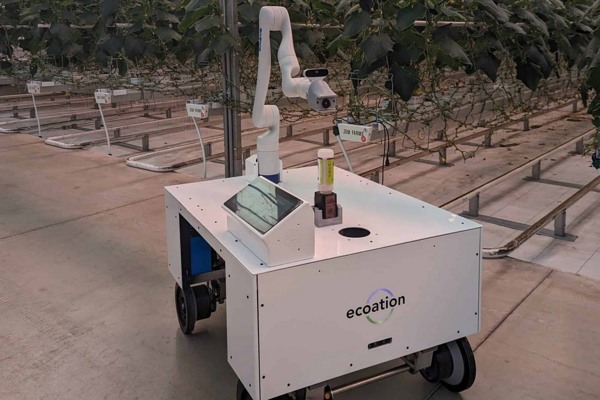
Saber, Maryam, and their team eventually turned to nature for inspiration. For tens of millions of years, ant colonies have demonstrated the kind of organizational structure ecoation was seeking to recreate in its autonomous platform. Each member of an ant farm has a specific function. Similarly, the ecoation technology focuses exclusively on getting from A to B autonomously. The value lies in its programmability and interoperability. Once it's programmed, it can make its way to a specific greenhouse location while communicating with its robotic cargo. What's particularly clever is that the platform can be modified to fit any robot requiring transportation. Need a bigger table to carry a larger machine? No problem. Two bolts won't hold it? Don't worry; they will add more. In other words, just like the ant colony, the ecoation solution performs a specific task without having to include additional functionality. This makes it usable in any greenhouse.
Creating a fully automated CEA facility is valuable for several reasons. First, working in a greenhouse is hot and tiring, and many people find it to be also repetitive and boring. That means it's tough for workers to provide consistent quality. Second, it's hard enough to recruit labor for traditional farms. Finding people who want to work in greenhouse is almost impossible. If the CEA sector is to advance significantly, automation and robotics will play an essential role. Finally, many remote, northern, and Indigenous communities lack access to a reliable supply of affordable produce. Greenhouses are seen by many as a solution to this challenge, and autonomous technology could facilitate their adoption.
In effect, the ecoation autonomous mobility platform will provide economic, social, and environmental impact. First, it will create jobs for skilled technology professionals. It will also replace the dull, dirty, dangerous positions that are so hard to fill, leading to a more viable greenhouse sector. That, in turn, will provide significant long-term social value by facilitating the establishment of commercial greenhouses in remote locations, providing residents with access to fresh produce year-round. It's important to note the ANT platform will offer an environmentally friendly solution that will reduce potential crop loss. Finally, the development of this technology offers educational opportunities in cutting-edge fields important to Canada's transformation into a global R&D leader. A number of students from institutions across Canada have benefited from ecoation co-op placements, and the academic collaborations will continue for the foreseeable future.
Saber wraps up by noting that CAAIN's funding has been critical to the success of his team's work, allowing them to build the product and demonstrate its feasibility. And ecoation hopes CAAIN support will be available as they progress to additional innovation such as a drone version that is in the works. Why exactly, though, has the support been so helpful? The money is, of course, valuable. But just as important are the guidance available to project partners and the legitimacy conferred on an organization as a result of the approval of a government-backed funding body.
Source - https://www.hortidaily.com