Agricultural insurance, long valued as a financial safety net for farmers, appears to deliver an unexpected ecological dividend: it measurably increases the amount of carbon that crops pull out of the atmosphere. That is the central finding of a new study published in Frontiers in Sustainable Food Systems, which analyzed fourteen years of data from 333 prefecture-level cities across China and concluded that expanding agricultural insurance coverage significantly raised gross crop biomass carbon absorption.
The research team, led by Lu Zhang of the Zhejiang Academy of Agricultural Sciences together with Tian-liang Cheng of Zhejiang A and F University and Bao Hu of the Zhejiang Academy of Agricultural Sciences, set out to test whether insurance does more than stabilize farm incomes. Their motivation rests on a simple behavioral logic. Farmers facing frequent droughts, floods and other natural disasters tend to make defensive production choices: they plant fewer seasons per year, avoid risky crops, and cut back on inputs. Insurance, by guaranteeing compensation after losses, loosens those risk constraints and frees farmers to make different decisions about what to plant and how intensively to farm their land.
Those decisions matter for carbon. Crops absorb atmospheric carbon dioxide through photosynthesis and lock it into grain, stems, leaves and roots. The authors are careful to define their scope precisely: their measure captures gross biomass carbon uptake, not the net ecosystem carbon sink that would include soil carbon retention or the return of crop residues to fields. Even so, gross absorption is a core component of the farmland carbon cycle, and shifts in planting patterns can move it substantially.
To establish that insurance actually causes higher carbon absorption rather than merely coinciding with it, the researchers layered three identification strategies. First, they used a two-way fixed effects model that controls for all time-invariant characteristics of each city and for shocks common to all cities in a given year, then strengthened it with province-by-year interaction effects to absorb time-varying provincial shocks. Second, they exploited the staggered rollout of China’s central premium subsidy program, which began with six pilot provinces in 2007 and reached nationwide coverage by 2012, applying the heterogeneity-robust Callaway and Sant’Anna difference-in-differences estimator to avoid the negative weighting problems that can distort conventional staggered designs. Third, they built an instrumental variable approach based on historical and geographic features of information infrastructure: the distance from each prefecture to the nearest national optical-fiber backbone city, and the density of post offices per million inhabitants in 1984, each interacted with a time trend.
The results converge. In the baseline specification, a one-standard-deviation increase in insurance premium income, about 104.1 million yuan, was associated with an increase of roughly 9.37 units in crop carbon absorption, approximately 5 percent of the sample mean. The staggered difference-in-differences analysis produced a positive and statistically significant average treatment effect, and pre-trend tests showed no divergent trajectories before policy adoption, while a spatial placebo test that randomly reassigned treatment status 500 times placed the true estimate in the extreme right tail of the placebo distribution. The instrumental variable estimates, with a Cragg-Donald Wald F statistic of 20.49 ruling out weak instruments and a Sargan test supporting the exclusion restriction, also returned a positive and significant effect. Robustness checks using indemnity payments, insurance density and depth, carbon absorption per unit of arable land, and alternative sample restrictions and clustering levels all held up.
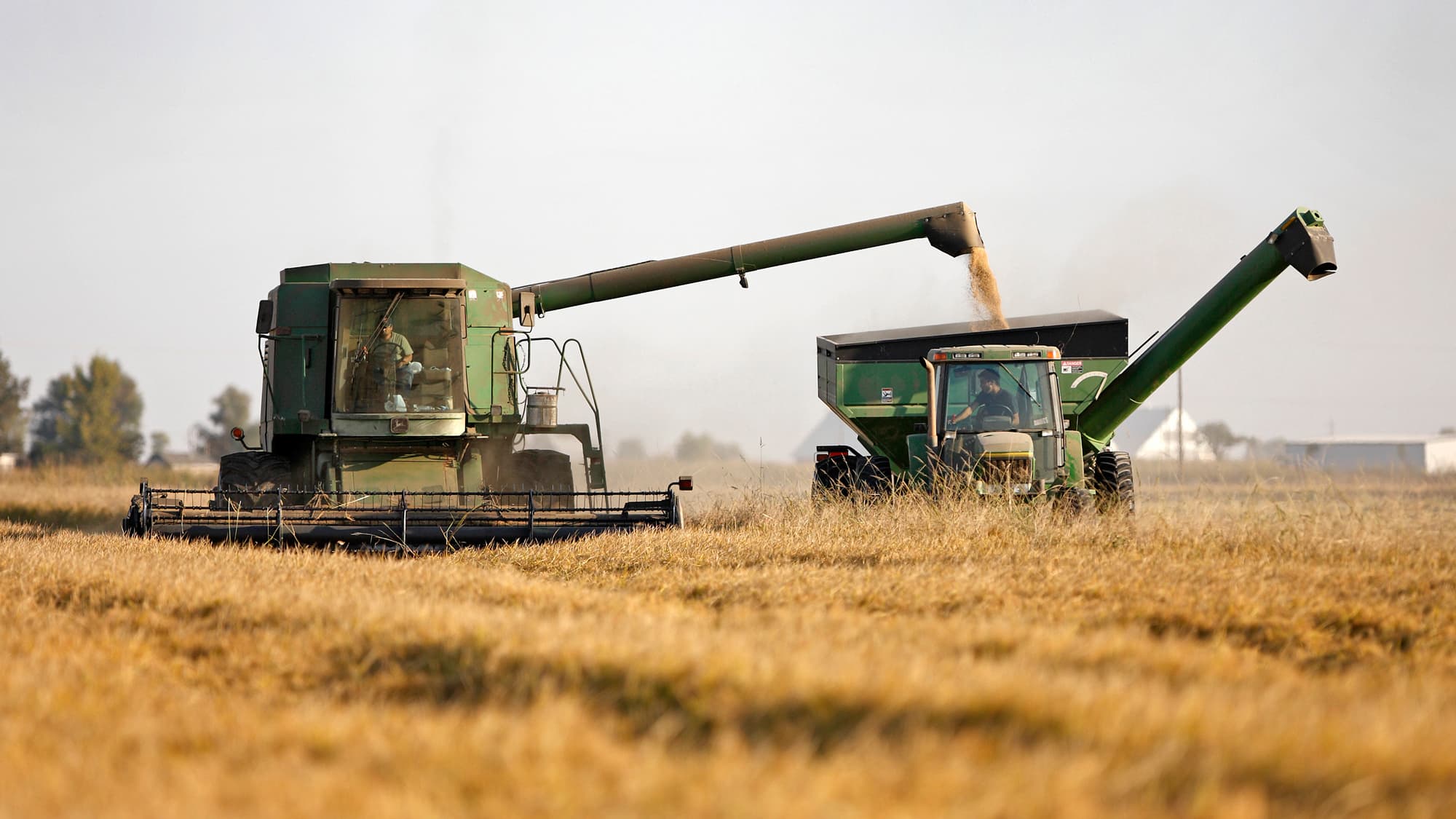
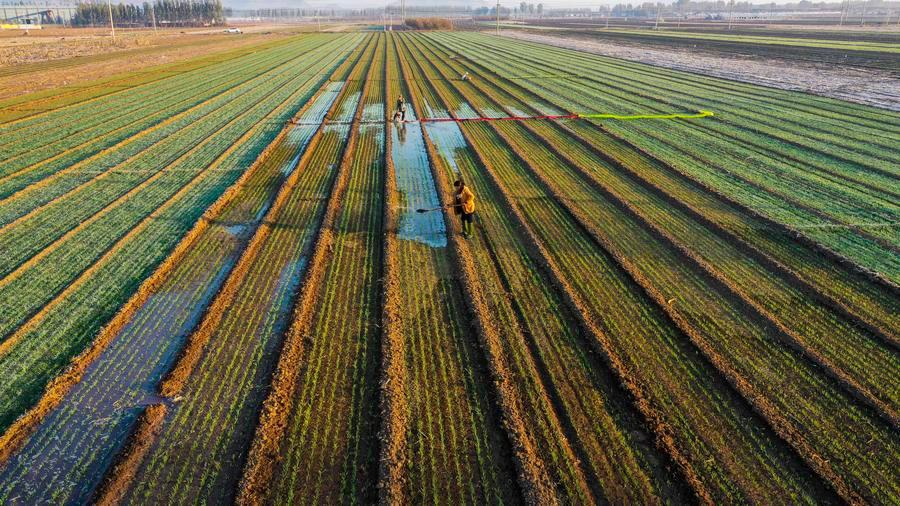
The more interesting question is how insurance produces this effect, and the study traces two channels. The first is structural. Because central premium subsidies for staple crops often exceed 80 percent, far exceeding support for general cash crops, insurance lowers the relative cost and risk of growing grains. Staple crops such as maize and sorghum are tall, fast-accumulating plants with high photosynthetic efficiency, producing substantial biomass and therefore more carbon fixation per unit of land. The data confirm that insurance significantly increased the share of sown area devoted to staple crops. The second channel is scale. Without protection, farmers often limit themselves to a single main-season crop to avoid the financial ruin of a failed second or third planting. With insurance, the downside of an extra season is capped, and the study found that insurance significantly raised the multiple cropping index, the number of times crops are cultivated on the same plot within a year, extending the period of green land cover and annual photosynthetic uptake.
The benefits are not evenly distributed, and the heterogeneity results carry a policy warning. In China’s 13 designated major grain-producing provinces, insurance significantly boosted carbon absorption, consistent with the structural channel operating where staple cultivation already holds comparative advantage. In non-major grain-producing areas, the effect flipped significantly negative. The authors attribute this to a subsidy mismatch: central subsidies are concentrated on staple grains, so insurance in regions whose comparative advantage lies in cash crops may push farmers toward staples that are less productive and sequester less carbon per unit of output in those environments. They are candid about the limits of the prefecture-level data, which lack farm-level input use and land-retirement records, and they note that moral hazard reducing purchased inputs, or marginal land abandonment under shallow coverage, could also contribute to the decline and remain unresolved alternative explanations.
Economic context also shaped the results. The carbon benefit was significantly amplified in lower-GDP regions, where farmers have fewer self-protection options such as assets, diversified income and social networks, and where insurance shifted planting structure toward staples more strongly at the margin. In richer regions the structural effect was absent. Similarly, the effect was stronger in regions with larger per capita arable land, where cropping intensity starts from a lower baseline and insurance unlocks room to raise the multiple cropping index, and in regions with a lower industrial upgrading index, where agriculture remains the core economic activity.
The study’s contribution lies partly in shifting attention from the emission side of agricultural climate accounting to the absorption side. Previous research on the environmental effects of insurance has concentrated overwhelmingly on chemical input use, non-point source pollution and carbon emissions, with sharply divergent findings; some work, for instance, has found that insurance pilots aggravated fertilizer-related pollution through moral hazard. By contrast, this analysis shows that insurance also reshapes what farmers plant and how often they plant it, margins that prior studies largely ignored, and that these planting decisions translate into measurable carbon outcomes. The consistency of estimates across three distinct identification strategies on fine-grained prefecture data makes it less likely that the co-benefit is an artifact of any single specification.
For policymakers, the findings suggest that agricultural insurance deserves consideration as more than a risk-management tool. In major grain-producing areas, where the carbon-sequestration effect is clearest, the authors argue the existing insurance and subsidy system should be maintained and refined to sustain long-term carbon sink gains. In non-major grain-producing areas, they caution against uniform rollout and propose piloting targeted adjustments, such as linking subsidy levels to carbon-friendly planting practices or introducing eco-labeled insurance products. With China’s agricultural insurance premium income reaching 155.55 billion yuan in 2025, covering 125 million farming households, even modest per-unit carbon effects aggregate into meaningful ecological consequences. The authors frame the result as a policy lever that translates micro-level farmer behavior into macro-level ecological gains, one that they argue should carry greater weight in future insurance design as countries pursue both food security and climate goals.
Source - https://bioengineer.org