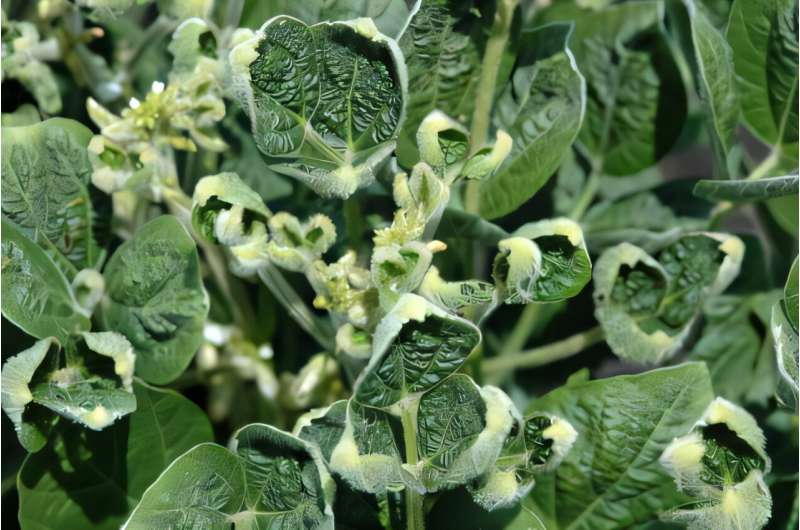
Drones can now detect subtle soybean canopy damage from dicamba at one ten-thousandth of the herbicide's label rate—simulating vapor drift—eight days after application. This advancement in remote sensing from the University of Illinois Urbana-Champaign provides a science-based tool to accurately detect and report crop damage at the field scale, reducing human error and bias.
It's a tool Aaron Hager has been calling for since dicamba-tolerant soybeans—and the accompanying surge in dicamba use and off-target damage—arrived on the scene in 2016.
"We would have an annual teleconference with the Environmental Protection Agency, where they would ask how extensive the damage was and whether their label modifications were making a difference. They were relying on pesticide misuse complaints, but there are a lot of factors going into whether someone makes a complaint," said Hager, professor in the Department of Crop Sciences and an Illinois Extension Specialist; both units are part of the College of Agricultural, Consumer and Environmental Sciences at Illinois.
"On the last call we did in 2020, we still didn't have a way to quantify the magnitude of what was really happening," he said. "Now we do."
Hager and his colleagues calibrated sophisticated cameras mounted on drones to detect damage on sensitive soybean canopies treated with one ten-thousandth, one three-thousandth, one-thousandth, and one three-hundredth of dicamba's label rate. These rates represent exposure from vapor drift (volatilized) dicamba at one extreme and particle drift at the other.
After flying drones over the fields and assessing the damage, the team reported their findings in Pest Management Science.
"We really wanted to make sure we could differentiate damage representing volatilized dicamba at that one ten-thousandth rate from an untreated or dicamba-tolerant soybean field, and we were able to do that," said the study's first author, Dylan Kerr, a doctoral candidate in crop sciences.
For the first time, the team showed that symptoms can be detected eight days after exposure, even at the lowest level. Symptoms, which were rated using a previously published standardized scale, increased in severity with increasing dicamba exposure levels and with time. Although none of the exposure levels were strong enough to kill dicamba-sensitive soybean plants, all treated fields showed worsening symptoms by day 29.
"We're using sensors to detect things the human eye can't see. I mean, we all know what a cupped-up soybean plant looks like after dicamba drift, but we don't always know when that exposure took place," Hager said. "This gives us a better idea."
Now that they've isolated the spectral signature of dicamba injury in soybeans, the team is scaling up. They're working to analyze satellite imagery to detect damage across wider swaths of the Midwest. With a bit of tuning, they think they'll be able to detect damage in other species, as well.
"What we've learned here could absolutely be used to develop a protocol for drones to fly out and detect drift. But we always knew we'd be scaling up and using multi-spectral sensors to understand larger patterns across the landscape," Kerr said. "Could we monitor tree and shrub canopies with this? Sure, it would be the same thing: ground truth where we see damage and where we don't, and eventually detect it from space."
The researchers say the drone and eventual satellite tools could empower growers and policymakers to better protect sensitive plants.
"A lot of growers are fatigued after filing complaints and not seeing any response. And you have urban communities asking, 'What's going on with my trees or the ornamentals in my yard?' It's critical for us as public sector scientists to figure out the extent of this problem using research-based evidence," said co-author Marty Williams, adjunct professor in crop sciences.
"We're not trying to push any sort of agenda or take sides. We're just asking the question, figuring out the answer, and sharing it. I think this is a beautiful example of what public sector research is all about."
Source - https://phys.org