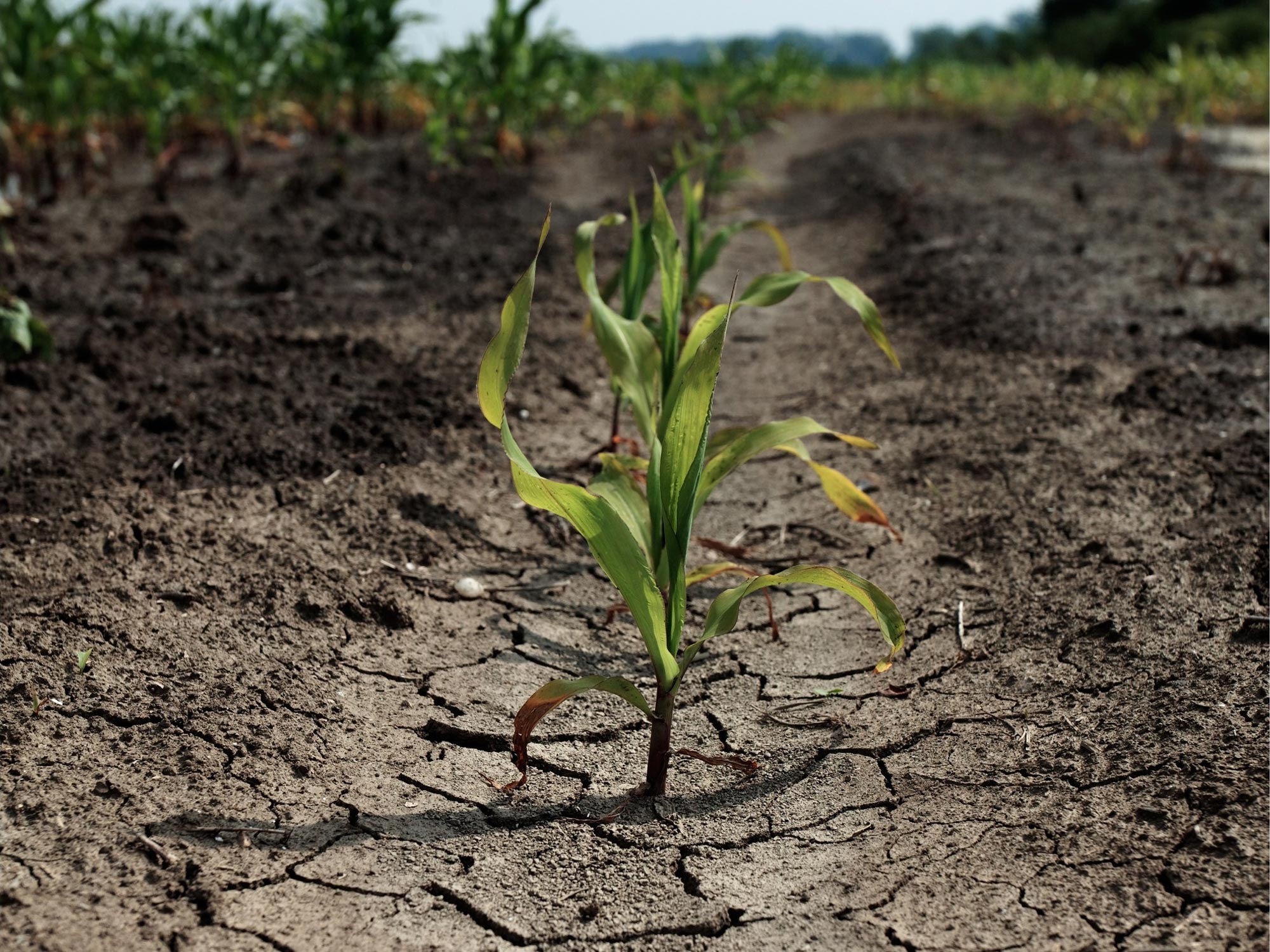
Maize is affected by abiotic stresses, including extreme heat and drought, which is exacerbated by climate change.
According to a paper in CABI Reviews, heat and drought pose a major threat to food security and agricultural production and are exacerbated by ‘extreme and rapid’ climate change.
In order to come up with more practical solutions and management to heat and drought, a team comprising international scientists argue that we must understand plants’ biochemical, ecological and physiological responses to these stresses.
Plant responses to these challenges may be divided into:
- Phonological
- Physiological
- Biochemical
How does extreme heat and drought affect plants?
Lead researcher Dr Aqarab Husnain Gondal, of the University of Agriculture Faisalabad, Pakistan, argues that as a result of physical damages, biological disruptions and biochemical abnormalities, sub-optimal water supplies and unusual temperatures negatively impact crop development and yields.
Supported by colleagues from Yarmouk University, Jordan, the National University of Huancavelica, Peru, and the Citrus Research Institute Sagodha, Dr Aqarab Husnain Gondal says a distinctive aspect of the phenomenon is comparing fundamental behaviour with abiotic stresses.
Drought has reduced wheat and maize yields by up to 40% worldwide.
Referring to a study examining data from research published between 1980 and 2015, scientists show how heat and drought have reduced wheat and maize yields by up to 40% worldwide.
Shockingly, projections suggest that for every degree Celsius rise in temperature, this would result in a 6% loss in global wheat yields.
Abiotic stresses are reducing crop yield all around the world
Dr Aqarab Husnain Gondal explains, “This review gives a thorough description of the adaptation of plants towards heat and drought stress with a particular emphasis on identifying similarities and variations.”
“Abiotic stresses are reducing crop yield all around the world. Heat and drought stress causes plants to respond in various ways – the most notable of which is by altering their development and morphology.”
“While the capacity of plants to withstand these pressures differs significantly across species, it is worthy to note that recent advances have been achieved in limiting the adverse consequences – either through genetic methods or by the induction of stress tolerance.”
Even though heat and drought stress may have a negative impact on the plant’s growth and development, reproductive growth is the most affected, the scientists argue.
Anthesis or grain-filling stress may majorly impact crop production if it is mild. Furthermore, heat and drought can also cause damage to the photosynthetic machinery, and oxidative stress and membrane instability.
Source - https://www.openaccessgovernment.org