Climate change poses a threat to yields and food security worldwide, with plant diseases as one of the main risks. An international team of researchers surrounding Prof. Senthold Asseng from the Technical University of Munich (TUM) has now shown that further spread of the fungal disease wheat blast could reduce global wheat production by 13% until 2050. The result is dramatic for global food security.
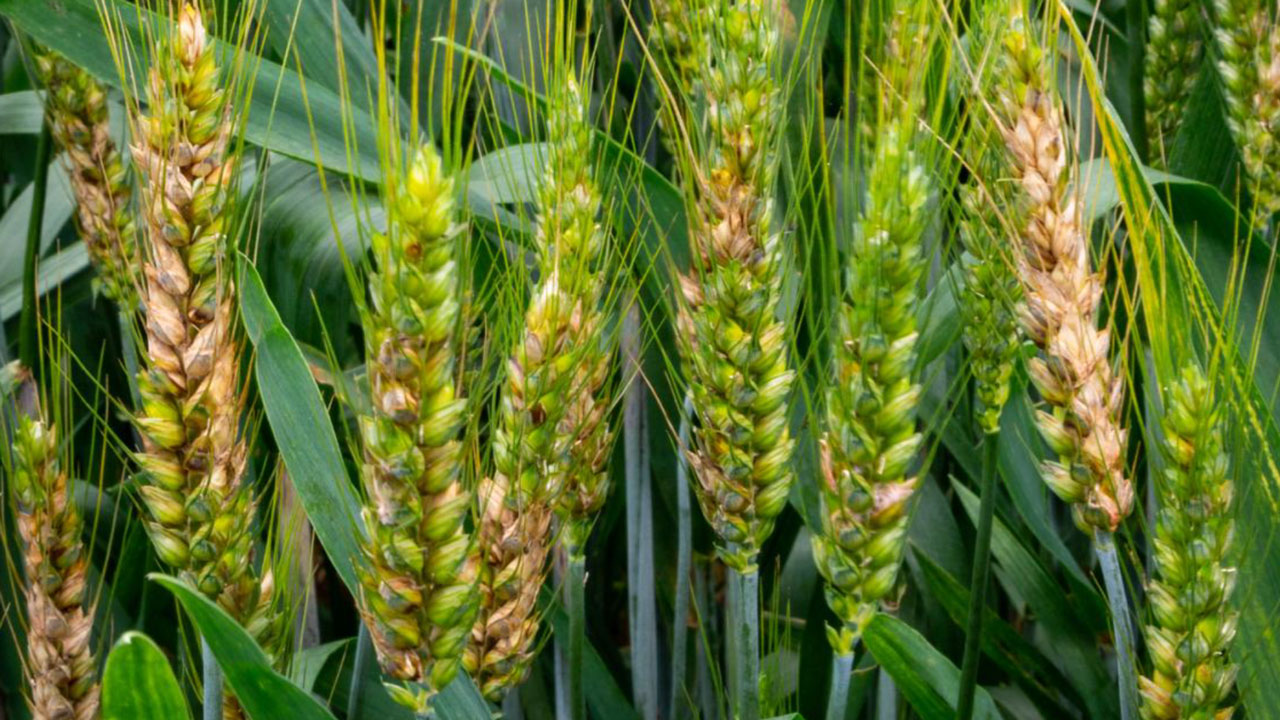
With a global cultivation area of 222 million hectares and a harvest volume of 779 million tons, wheat is an essential food crop. Like all plant species, it is also struggling with diseases that are spreading more rapidly compared to a few years ago because of climate change. One of these is wheat blast. In warm and humid regions, the fungus “Magnaporthe oryzae” has become a serious threat to wheat production since it was first observed in 1985. It initially spread from Brazil to neighboring countries. The first cases outside of South America occurred in Bangladesh in 2016 and in Zambia in 2018. Researchers from Germany, Mexico, Bangladesh, the USA and Brazil have now modeled for the first time how wheat blast will spread in the future.
Regionally up to 75% of total wheat acreage affected
According to the researchers, South America, southern Africa and Asia will be the regions most affected by the future spread of the disease. Up to 75% of the area under wheat cultivation in Africa and South America could be at risk in the future. According to the predictions, wheat blast will also continue to spread in countries that were previously only slightly impacted, including Argentina, Zambia and Bangladesh.
The fungus is also penetrating countries that were previously untouched. These include Uruguay, Central America, the south-eastern USA, East Africa, India and eastern Australia. According to the model, the risk is low in Europe and East Asia – with the exception of Italy, southern France, Spain and the warm and humid regions of south-east China. Conversely, where climate change leads to drier conditions with more frequent periods of heat above 35 °C, the risk of wheat blast may also decrease. However, in these cases, heat stress decreases the yield potential.
Dramatic yield losses call for adapted management
The affected regions are among the areas most severely impacted by the direct consequences of climate change. Food insecurity is already a significant challenge in these areas and the demand for wheat continues to rise, especially in urban areas. In many regions, farmers will have to switch to more robust crops to avoid crop failures and financial losses. In the Midwest of Brazil, for example, wheat is increasingly being replaced by maize.
Another important strategy against future yield losses is breeding resistant wheat varieties. CIMMYT in collaboration with National Agricultural Research Systems (NARs) partners have released several wheat blast-resistant varieties which have been helpful in mitigating the effect of wheat blast. With the right sowing date, wheat blast-promoting conditions can be avoided during the ear emergence phase. Combined with other measures, this has proven to be successful. In more specific terms, this means avoiding early sowing in central Brazil and late sowing in Bangladesh.
First study on yield losses due to wheat blast
Previous studies on yield changes due to climate change mainly considered the direct effects of climate change such as rising temperatures, changing precipitation patterns and increased CO2 emissions in the atmosphere. Studies on fungal diseases have so far ignored wheat blast.
For their study, the researchers focused on the influence of wheat blast on production by combining a simulation model for wheat growth and yield with a newly developed wheat blast model. Environmental conditions such as the weather are thus included in the calculations, as is data on plant growth. In this way, the scientists are modeling the disease pressure in the particularly sensitive phase when the ear matures. The study focused on the influence of wheat blast on production. Other consequences of climate change could further reduce yields.
Source - https://www.eurasiareview.com