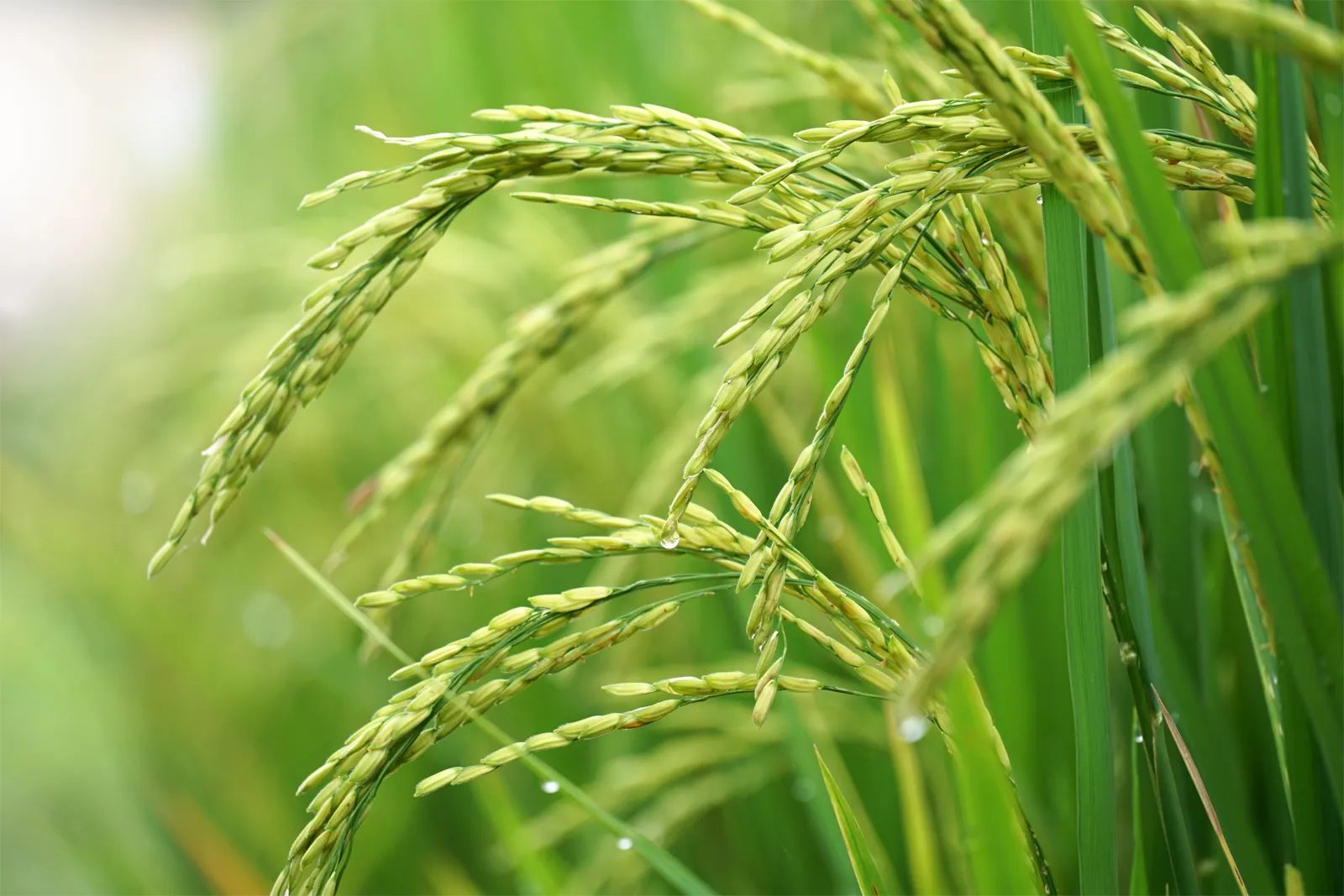
A new study on how rising temperatures will affect rice production in Science Advances compares 214 observations from field-warming experiments with seven crop models, revealing modelled estimates for yield reductions from 1°C of global warming were roughly half those of the real-world observed experiments (3.8 percent instead of 8.1 percent). The study was led by the Helmholtz Centre for Environmental Research with contributions from the Potsdam Institute for Climate Impact Research (PIK).
Rice is a staple food for more than half of the world’s population, but estimates of how climate change will affect production vary widely. One reason for this is that many scientific assessments do not clearly distinguish between the more gradual effects of higher average temperatures, versus acute damage caused by heat extremes.
In the new study, results from 214 observed experiments show that extreme heat (exposure to temperatures above 30°C) is the dominant factor behind rice yield losses from warming. At more than 70 percent of observed sites, high-temperature exposure accounted for more than half of absolute yield change.
However, when compared to seven crop models, the models were shown to be less sensitive to heat extremes than the real-world observations.
“The discrepancy between the observations and models appear to arise mainly because many current crop models don’t yet capture heat damage in rice’s reproductive stages well. Observations in the study show this is exactly when rice is particularly vulnerable to extreme heat, as panicles and grains develop,” commented lead author, Yiwei Jian, from the Helmholtz Centre for Environmental Research.
After correcting the models in line with the observed data, the study estimates that an increase of 1°C in global mean temperature would reduce global rice yields by an average of 8.1 percent. This is approximately twice the loss previously estimated by the crop models (3.8 percent). The authors stress that their estimates isolate temperature effects, and should therefore not be interpreted as a complete forecast of future rice production.
“This is a really significant jump for the models and emphasises the role of heat extremes in projected losses, not just average temperatures. This intuitively makes sense – when we check the weather in summer to know how to cope with heat, we’re looking for the daily high, not the average temperature,” commented PIK scientist, Christoph Müller, another author of the study.
The study also rethinks the geographical distribution of crop losses. The biggest revisions are in South and Southeast Asia, where rice crops have high exposure to extreme heat. For Pakistan, India and Bangladesh, the yield-loss estimate increases from 2.1 to 6.6 percent. For Thailand, the Philippines and Myanmar, it increases from 3.7 to 7.7 percent.
The authors highlight the importance of adaptation measures for rice production that protect crops at their reproductive stage such as: developing and adopting heat-tolerant varieties, adjusting planting dates, optimising irrigation practices and improving soil quality.
Source - https://www.environewsnigeria.com