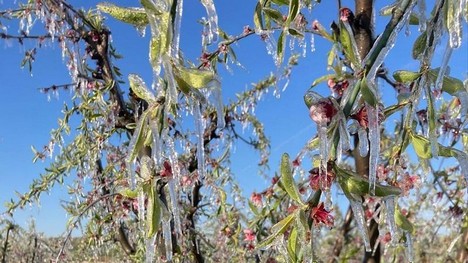
At the beginning of April, frosts of between minus 3 and minus 8°C were recorded in Hungarian apricot orchards. There were also reports of cold temperatures during the relatively early flowering period, which started in early to mid-March. But it was the damage caused by the transported frost in early April that exerted the real damage to Hungarian apricot plantations.
The frost has not spared any of the main production areas, with yield losses of 90-100% expected in some places (typically in the Plains), and losses of at least 60-70% are common in higher altitude areas, which is highly dependent on the variety, and in some places very intensive frost protection has been able to reduce the extent of the damage.
At present, the phenological condition of the plantations is as normal or a day or two behind normal, following an earlier start - the relatively early start was held back by a later cold spell. Monilia pressure is very strong on most orchards and this could also be a problem for sour cherries this year. Stigmina and aphid infestations have also been reported locally, but their extent is limited.
Feedback from producers across Hungary provided to Márton Kocsis, from FruitVeb in Budapest indicates the extent of the frost damage seen in orchards and what is expectedly left over.
“In Somogy County (Southwest), farmers are generally expecting yields of around 30-40% of normal produce. Certain varieties were better able to withstand frosts, and this was quite independent of location or exposure, with the sensitivity of the phenological condition being the most important factor.
The areas of Bergeron, Bayoto, Kioto and Farbaly endured the frosts quite well under the conditions, with Bergarouge and Big Red remaining in appreciable quantities. Severe frost damage was suffered by early Tsunami, Spring Blush, Pinkcot, Mediabel, Cegléd Giant and Harcot. Prolonged flowering and cool, rainy weather favoured Monilia infection and adversely affected fertility. In Somogy county, the frosts in early April did not bring temperatures below -3°C, but this affected the plants at a very sensitive stage after flowering.”
“In Tolna County (Middle), early varieties with low cold requirements suffered severe frost damage (Tsunami, Spring Blush, Pinkcot), while fertility was less of a problem here. Early varieties here started flowering very early. The county recorded a -4°C transported frost, but medium-ripening varieties such as Kioto, Bergeval survived relatively well. Poor to medium yields are expected from Bergarouge and Anegat.
At farm level, farmers are generally expecting yields of 30-40% currently. Monilia and Stigmina pressure has been strong, with reports of local aphid outbreaks. Fruits of Pricia and Kioto are now around 2 cm with much redder than average skin and are likely to have large fruit, with thinning already underway. If the weather warms up a bit in the coming weeks, harvesting could start around Pentecost, in the last days of May. At the end of June, Bergeval and then Kioto are expected to ripen,” reports
In Győr-Moson-Sopron County (Northwest), very early varieties suffered heavy frosts already in January, and frosts of around -6°C in April also caused damage, but with phenology here a good ten days behind normal, Bergarouge and Big Red have survived the cold relatively well, and Pinkcot has survived as well. In general, the damage currently seen is around 30-35%, less in Bergeron and Kyoto, but how much of a drop will be due to stress can only be seen more accurately later. Fertility problems have not been reported in this area and Monilia infection has been milder.
In Bács-Kiskun County (Middle), frost damage is complete on early varieties (Spring Blush, Pinkcot), but even the medium ripening Kioto were lost due to the -6°C transported frost in early April.
“In Borsod County (Northeast), frost damage of between 40-70% was reported, with Bergeron and Flavor Cot remaining the most intact. Magic Cot, Wonder Cot orchards suffered almost complete, 100% damage. Here too, the phenology was rushed ahead at flowering, but now the trees are some days later than usual, and there have been problems with fertility in the snow-covered stands. Pressure from Monilia is also significant in this region,” states Kocsis.
Some of these apricots are traditionally exported to Germany and Austria, following the expected lower volumes due to the frost damage, very little will likely flow to these fellow European countries.
Source - https://www.freshplaza.com