On August 16 this year, the first day of the ten-day harvest festival of Onam in Kerala, P. Vijayalakshmi made her way to a restaurant in Thiruvananthapuram. For the first time in her life, the 72-year-old has purchased a ready-to-eat “packet Onam sadhya” or Onam feast rather than preparing it herself.
“Every Onam, I would make at least twenty dishes for the Onasadhya with vegetables I grew on my own land. But this time, the crops perished in the torrential rain, leaving me to fall behind the popular trend [of packet feasts],” Vijayalakshmi says.
Onam celebrates the prosperity that traditionally arrives with the end of the southwest monsoon in Kerala, when the annual paddy is harvested, along with a diversity of tubers and local vegetables. The start of the festival is generally marked by the predictable frenzy of temporary stalls being erected selling a diversity of agricultural products that feature in the Onam feast. Instead, this time, hotels and restaurants were selling packet feasts for ₹250-1000.
What the rise of a “packet feast” indicates
Vinu A. Muthukuzhi points to the remnants of his plantain farm that has been impacted by strong winds and torrential rainfall on August 2. The farmer who lives in Kalliyoor gram panchayat in Thiruvananthapuram district, asks, “How do I celebrate Onam? Half my plantains were destroyed, costing me a loss of ₹40,000.”
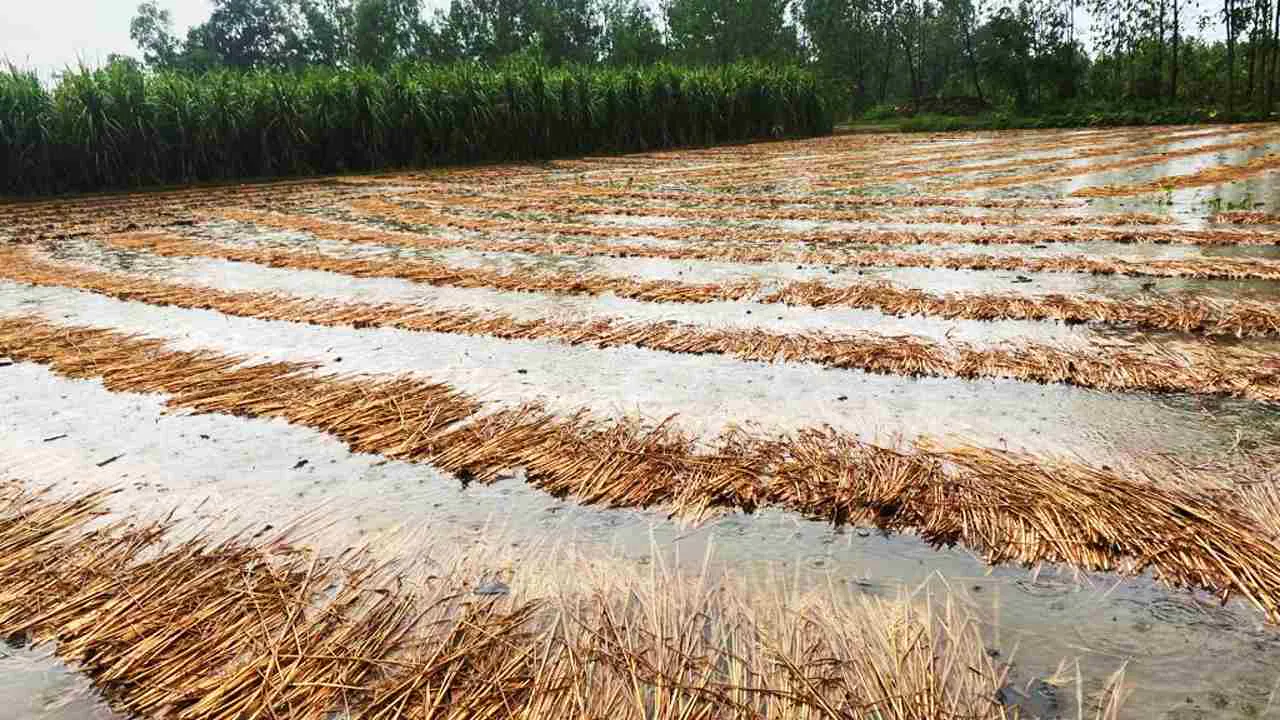
According to Kerala’s Department of Agriculture Development and Farmers’ Welfare, Muthukuzhi is one among the 45,904 farmers in the state impacted by the recent heavy rain and floods. An initial assessment estimated losses at around ₹127 crores (₹1.2 billion) as of August 9, but farmers say the loss cannot be quantified.
Sangamaithri Farmers Producer Company Ltd, a collective of over 2,000 farmers in Thiruvananthapuram district, works to maintain fair minimum prices that go directly to the farmers. This year, their headquarters remains unusually empty, unlike previous Onam seasons, when it would be bustling with farmers and traders.
V. Manoharan Chettiyar, the CEO of Sangamaithri says, “Last Onam, we procured around 11 tonnes of bananas daily. This year, we’re hardly receiving one tonne.”
The decrease in banana production is reflected in market prices, that have increased by 30% from last year, according to E.S. Biju, Secretary of Kerala Vyapari Vyavasayi Samathi, an organisation campaigning for traders’ rights.
Crops fail as Onam arrives
R.P. Balachandran Nair in Pallichal gram panchayat grows over 20 vegetables like cucumber, pumpkin, yam and okra. Anticipating the economic gains from Onam, he had sown in June. But his vegetables haven’t ripened. “Climate change is affecting my crops. I am seeing this kind of impact after the 2018 floods. I can harvest only after the Onam season, when the prices are much lower,” he says.
According to the India Meteorological Department, during the peak of the southwest monsoon from June 1 to August 15, Kerala suffered a rainfall deficit of 23%, falling from the normal 1,556.2 mm to 1,213.2 mm.
Kerala’s rainfall departure (the difference between rainfall received at a given time and the long-term average) was in the “deficient” range (between -20% and -59%), according to M.G. Manoj, a meteorologist at Cochin University of Science and Technology.
“Farmers maintain a harvest calendar according to traditional knowledge and their lived experiences. But climate change is now delaying germination, flowering and the harvest,” says S. Saradha, head of the Department of Vegetable Science, College of Agriculture, Vellayani.
After a dry July that brought little rain, the heavy rain and floods during the first week of August led to massive destruction of paddy in Alappuzha, Pathanamthitta, and Palakkad districts, according to T. Siddique, Agriculture Minister of the state.
In fact, area under rice cultivation has steadily been declining, from peaking at 8,81,000 hectares in the 1974-75 to less than 2,00,000 hectares in 2022-23. Rice productivity, however, which is the efficiency of the cultivation measured by kg per hectare doubled in a similar time frame, from 1,545 kg per hectare in 1971-72 to 3,108 kg/ha by 2022-23, which helped the state cope with the massive loss of area under cultivation.
A study from the Bharathapuzha river basin warned that impending increases in flood intensity and droughts would make adaptation strategies necessary to mitigate impacts to paddy production. Adaptation could look like rehabilitating canals, micro-irrigation, prioritising climate-resilient varieties, and so on. But who will bear the cost of implementing such measures, asks Muthukuzhi, adding, “We are farming on leased land after availing loans from private moneylenders who demand high interest. Most of the adaptation methods impose even more financial constraints. No small farmer [like me] could bear it.”
Biju says that the scarcity of agricultural products within the state is one reason wholesale sellers are importing items from other states in higher quantities, like rice, cardamom, pepper, nendran bananas and more from Tamil Nadu and Andhra Pradesh, leading to rising costs. “Compared to last Onam, prices of vegetables and rice increased by around 30%; nendran banana by 100% and coconut oil by 25%,” he adds.
Expensive natural flowers swapped for plastic
According to the legend behind the festival, the benevolent King Mahabali was popular for his just rule and overthrown by Lord Vishnu, who took on the form of a dwarf and banished Mahabali to the netherworld. Onam marks the period of the year when the king is permitted to return briefly to meet his loyal citizens.
During Onam, flowers are arranged into a vibrant “pookalam” to welcome the return of Mahabali. Production of flowers like marigold (Tagetes erecta), globe amaranth (Gomphrena globosa), chrysanthemum, thumbai (Leucas aspera), and thechi (Ixora coccinea) booms, supporting farmers and women’s self-help groups like Kudumbashree.
According to Poovilli 2025, a report by the state Finance Department, the area under flower cultivation in Thiruvananthapuram district has grown from 216.82 hectares in 2024 to 221.5 hectares in 2025.
Despite this year’s heavy downpour damaging some of the harvest, the overall impacts were manageable.
“Though heavy rain damaged some of our flowers, we are not economically affected due to the windfall gains we are receiving from the market prices rising,” says V. Bindu, President of Pallichal gram panchayat. The price of marigold, for example, rose ₹100 per kg last year to ₹140–₹150 this year.
According to news reports, Kerala is to import 150 tonnes of flowers (an increase from 100 tonnes last year) during the Onam season from Thovalai flower market in Nagercoil district, Tamil Nadu, one of the largest flower markets in south India.
This season, however, also saw flower shops and traders also selling plastic flowers at lower prices than the natural flowers which were highly priced during the season.
According to several meteorological organisations and experts, changes to the traditional Onam festivities and the economic activities they influence may not be the last impacts of climate change we witness this year, as a stronger El Niño acts “on top of an already warmer climate system”.
“If Kerala doesn’t get enough rain in August and September, it will have a bearing on groundwater levels. It may lead to a drought [next summer] similar to what the state experienced in 2015-16,” says Manoj.
Source - https://india.mongabay.com