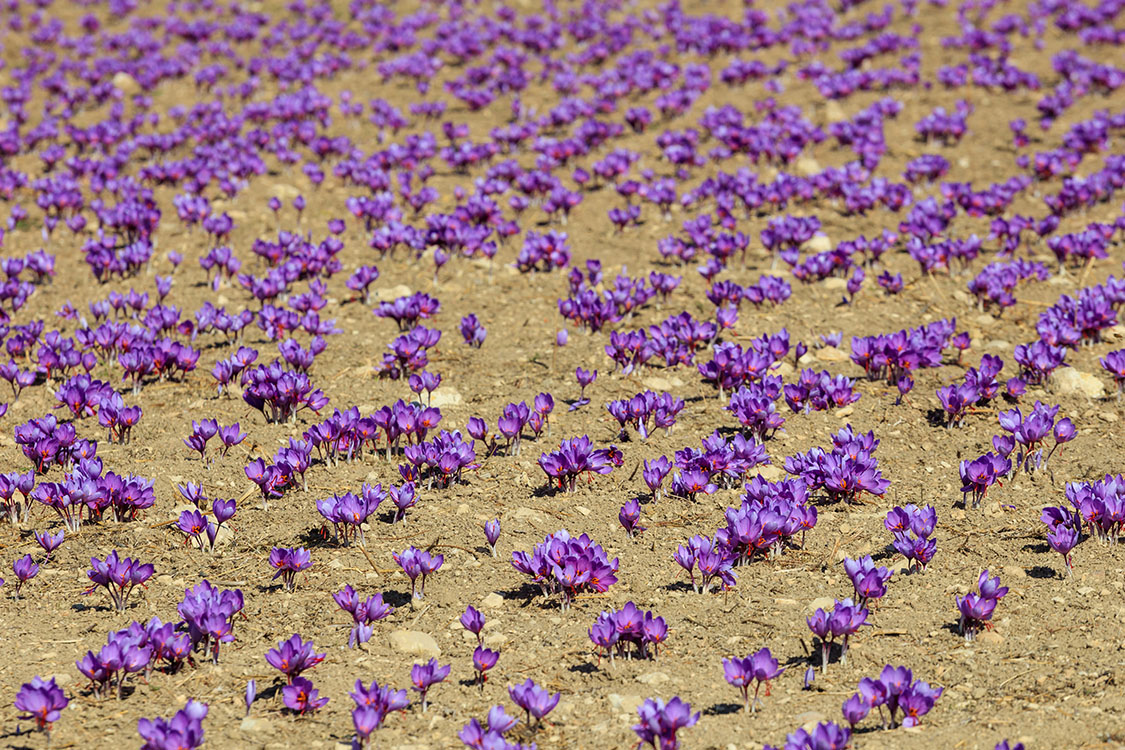
For Saffron farmer Ashiq Hussain, the flowering of the crop has been in abundance this year and the yield is more than last year, thanks to late rains in the month of October.
The 43-year-old farmer and his family have already plucked beds of the purple flowers in the five days in his village of Chandhara in south Kashmir’s Saffron belt of Pampore. He expects to pick more in the coming weeks.
“After an extended dry season, nature was kind as rains lashed the Valley in October which boosted the production of the crop. Last year, I had harvested around 2.25 kg of dry Saffron stigma (the spice) and this year, I expect it to cross 3 kg,” said Hussain, who plants the crop over 45 kanals of land.
For the second consecutive year, the Saffron farmers are expecting to harvest a bumper crop. Along with their families, they are busy plucking the golden flowers in the fields of Pampore in Pulwama district. The harvesting which started last week will continue for two weeks or till the end of this month, depending upon the flower pickings.
Kashmir experienced significantly high temperatures with heatwave to severe heatwave conditions in September with deficient rain in August and September.
Saffron growers association chairperson Abdul Majid Wani says that they had lost hope owing to the dry months.
“The rains came at the last moment and flowers bloomed abundantly. We already have done two pickings and expect more. This year we have 30% more production than last year,” Wani said.
Saffron is reputed to be the world’s most expensive spice and is known as the king of condiments. It fetches between ₹2 lakh and ₹2.5 lakh per kg.
In 2022, the annual yield of Saffron, the world’s costliest spice cultivated in Kashmir, had crossed 16 metric tonnes from 13 metric tonnes in 2020.
Agriculture department director Mohmmad Iqbal Choudhray was upbeat on how the production has turned out despite weather vagaries this year.
“Our crop estimation tentative report will come by November 20, but I am telling you with confidence that like a bumper paddy crop, this year we have a bumper Saffron crop,” Choudhray said. “The fields are full of flower blooms. People are happy,” he added.
The Saffron output is Kashmir, which mostly is cultivated in Pampore, and Budgam and Srinagar districts in central Kashmir crossed 13.36 metric tonnes in 2020, the most in a decade, which was largely attributed to the introduction of a government scheme -National saffron Mission, officials said. The scheme was launched in 2010 to rejuvenate the cultivation of the spice.
Saffron production had peaked in Kashmir in the 1990s with an annual average output of around 15.5 metric tonnes. However, then the production declined owing to untimely rainfall, drought and wanton constructions owing to conversion of Saffron fields into commercial enterprises. The production was 11.72 m tonnes in 2015 compared to 1.4 m tonnes four years earlier.
Saffron farmer Javed Ahmad said that this year many farmers had left their land fallow owing to scant rainfall which may bring down the overall production.
“Whereever Saffron corms were planted, the crop is good but there are large patches where the crop was not grown as the corms were not transplanted owing to the hard land conditions due to less moisture in soil. Some farmers had decided to give the land rest this year owing to the dry weather,” he said.
Wani said that Saffron is grown on 3,700 hectares in Pampore, Budgam and Srinagar with thousands of farmers associated with its production. He added that the spice park at Dussu in Pulwama with GI tagging of the Saffron was proving a game changer for the farmers who, earlier, were dependent on traders for rates.
Source - https://www.hindustantimes.com