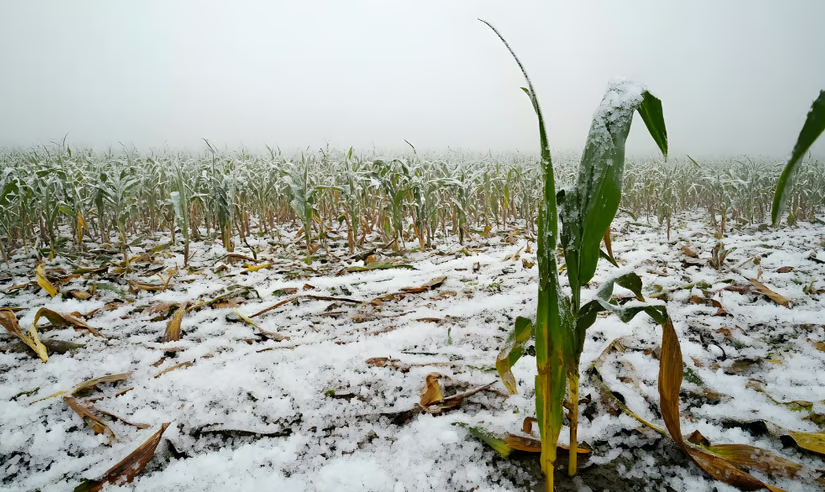
A run of severe hailstorms over the Christmas–New Year period has caused significant damage to arable crops in Canterbury, leading to a sharp increase in claims under the wheat sector’s disaster relief insurance scheme and adding to scrutiny of weather-related risk exposure.
United Wheatgrowers New Zealand (UWG) chair Michael Tayler said three separate hail events crossed key grain-growing areas of Canterbury in quick succession, hitting many more farms and hectares than in a typical year. “Historically, on average, one hail event would affect 10 [to] 15 farms, taking in 300 to 400 hectares. At this stage, from these events, I have had 71 claims come in accounting for almost 5,000ha of wheat, and that’s not all yet. This is the worst season for hail in the scheme’s history,” Tayler said, as reported by Farmers Weekly.
UWG, a levy-funded, grower-led body, administers a disaster relief insurance scheme that applies specifically to wheat crops, including feed and milling varieties. Tayler said the spike in claims reflects only part of the overall impact across mixed arable operations. “There are many stories of high-value seed crops, grass, barley, radish hit hardest, but these crops are outside of the UWG scheme. There are some [farmers] who have lost virtually everything; it’s just devastating. Millions of dollars’ worth of crops. People are stepping up; it’s farmers working for farmers,” Tayler said.
Most of the claims so far have come from Canterbury, with a small number from Southland and Otago. Tayler said: “Pretty much you could touch on any cropping farmer between the Rangitata and Rakaia rivers, mostly across the Ashburton district, and they will have been affected.” He said it is too early to finalise an aggregate loss estimate but added that “it will be enormous; millions and millions.”
Claims processing and coverage limits under examination
The scale of the damage and the clustering of events have required UWG to adapt quickly. Tayler said the organisation has brought in additional assessors and is working with the UWG Electoral Committee and Federated Farmers’ arable sector to carry out on-farm assessments and process claims. The pattern of losses is highlighting how sector-based disaster schemes operate in practice. While UWG’s scheme provides cover for wheat growers, damage to other arable and seed crops on the same farms is outside its scope. For insurers, brokers, and underwriters, that distinction points to potential exposure around multi-crop farm businesses, income volatility, and business interruption where not all crops are insured under a common framework.
Local farmer Duncan Copland, who farms just north of Ashburton, said the hail has forced him to revisit his crop planning and budgeting for the next season. “There are paddocks you just don’t know what to do with. Cut losses and start again is about it, but you have a crop rotation and a forward plan, what to grow, what will the companies want next season? You can’t rush it but you have actually got to make that decision and cut the losses,” Copland said.
Copland said about 200 hectares of his land have been hit by hail across wheat, barley, clover, kale, radish, and spinach. “They were looking amazing on Christmas Eve, but they’re worth nothing now, sliced off by the sheer volume and velocity of the hail. It sure is a shock when it happens, all that work. It’s income a year in the making, that’s the hardest part. There’s a lot of farmers much worse hit than me. It’s also the flow-on, the seed companies, and the export markets,” he said. He expects his own losses to be in the hundreds of thousands of dollars and said some neighbouring farmers are facing losses in the millions. “It’s sure been a mean event and we just have to get on with it now,” Copland said, as he turned to harvesting a pea paddock that avoided the worst of the storm.
Meteorologists identify supercell and severe convective conditions
MetService has linked the hailstorms in Canterbury and other parts of the South Island to one of the more intense thunderstorm systems observed this year, with evidence of a supercell over the southern Canterbury Plains. “There has been some very active weather in parts of the South Island, that east and south eastern area, all the way down to Southland, Clutha, North Otago, and Dunedin and up the Canterbury coast as well, there’s been lots of lightning, lots of thunder, and also hail. We’ve seen reports of widespread hail particularly in that Canterbury Plains area, as well as very long-lived thunderstorms and heavy downpours in that Canterbury area,” MetService meteorologist Devlin Lynden said, as reported by Otago Daily Times.
Lynden said thunderstorms of this nature can occur in any season, although the recent system was notable for its strength and duration. “Particularly in summer, it’s often we see thunderstorms in summer. But what is unusual just how intense some of these thunderstorms have been, one of our forecasters was saying the cell over Canterbury is one of the strongest he’s seen this year,” he said.
MetService said the most severe hail developed from a supercell thunderstorm, characterised by a rotating updraft. Such storms can persist longer than more typical thunderstorms and are associated with an elevated chance of large hail, strong winds and heavy rainfall. The agency noted that large hail can “cause significant damage to crops, orchards, vines, glasshouses, and vehicles” and advised that “should severe weather approach or if you feel threatened, take shelter immediately.”
Infrastructure impact and implications for insurance portfolios
The storm system led to multiple severe thunderstorm warnings and watches across the South Island, including Selwyn, Ashburton, Timaru, Christchurch, Central Otago, Southern Lakes, Dunedin, and Southland. Transport authorities deployed crews to State Highway 8 between Timaru and Fairlie after reports that hail had blocked parts of the road and flooded some vehicles, pointing to potential motor, commercial property, and public liability claims.
MetService warned that very heavy rain from the storms could lead to surface and flash flooding in streams, gullies, and urban areas, with associated visibility and driving issues. Horticulture New Zealand’s regional representative, Chelsea Donnelly, said there had been no confirmed reports of damage to horticultural crops at that stage, but monitoring and assessments were ongoing.
For insurers and reinsurers, the combination of concentrated hail damage in a major cropping area, the volume of scheme-related claims, and the confirmed severe convective storm activity is likely to be considered in upcoming reviews of storm risk assumptions, aggregate exposure management, and pricing across crop, rural property, and related portfolios in New Zealand. Market participants may also see increased interest in more specialised covers that combine yield protection, weather indices, and revenue insurance for diversified arable operations exposed to hail and similar weather events.
Source - https://www.insurancebusinessmag.com