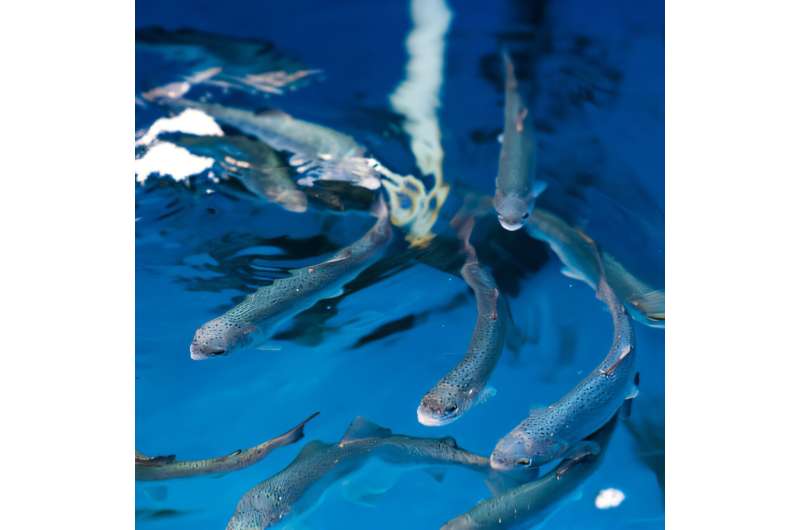
In their latest publication in the journal Foods, researchers from the ecological aquaculture lab at UC Santa Cruz shared a sustainable seafood innovation years in the making.
Building upon many prior experiments, the team developed new aquaculture feed formulations for farmed rainbow trout that replaced traditional fishmeal ingredients—produced by grinding up wild-caught fish—with varying levels of a new ingredient: a marine microalgal species called "Nannochloropsis sp. QH25." Researchers tested their feeds and found that they could fully replace fishmeal with the microalgae while maintaining the same levels of fish growth, nutritional value for humans, potential cost-effectiveness, and other key metrics.
These findings could potentially help to solve a major supply and demand problem in the seafood industry. Global demand for seafood is growing rapidly, but many wild fish stocks are currently dwindling. Aquaculture is one possible solution to fill that gap, but aquaculture itself has long been dependent upon wild-caught fish as feed ingredients for farmed fish.
Replacing fish-derived feed ingredients—namely fishmeal and fish oil—with alternative sources of protein and fat could "uncouple" aquaculture from wild fish stocks, allowing the industry to expand food production while also taking pressure off of ocean ecosystems.
"The world depends on fish farms," explained Assistant Professor Pallab Sarker, lead author of the new research. "Already, two-in-four of the fish we eat worldwide were raised on a farm. Aquaculture can help to feed our growing population, but right now, it too often comes at a surprising cost to wild fish. So we and others across the industry have been working relentlessly to find solutions that don't put further stress on ocean ecosystems."
Over the years, there has been major progress. Newer aquaculture feeds have been formulated using ingredients from land-based agriculture, like crops and animal byproducts. But a new challenge emerged: it's difficult to fully replace fishmeal and fish oil with land-based feed ingredients without changing the nutritional value for humans of the fish that you're growing.
In particular, fish fed with land-based ingredients often don't have the same levels of certain omega-3 fatty acids, like DHA, that provide important human health benefits. These nutrients are more plentiful in ocean food webs, which is why many feeds have kept using at least a small amount of fish-based ingredients. But, recently, scientists and industry innovators around the world have been developing new feed ingredients directly from the oceanic source of these nutrients: marine microalgae.
Microalgae, also called phytoplankton, are tiny, single-celled organisms that form the base of ocean food webs and use the sun's energy to make their food. Their role in the ocean is similar to that of plants on land.
Sarker has been working for years, alongside Professor Anne Kapuscinski and the rest of the UC Santa Cruz team, to create new feed formulations by recycling leftovers from marine microalgae that are already being grown commercially for use in human dietary supplements. Several years ago, the team had a major breakthrough in combining a few different types of microalgae to formulate a potentially cost-competitive feed for Nile tilapia that was totally fish-free and performed better than conventional feed in several key metrics.
But tilapia have the advantage of being natural vegetarians. It's more difficult to remove fishmeal and fish oil from diets for fish that are natural predators of other fish. Salmon and trout are two examples that fall into that category. While farmed rainbow trout from the U.S. are already a very sustainable seafood option, trout and their close relatives, salmon, remain some of the biggest consumers of fishmeal and fish oil globally. So the UCSC team knew they wanted to demonstrate their specific set of techniques on rainbow trout.
Some of their early attempts to replace wild-caught fish ingredients in trout feed with Nannochloropsis sp. microalgae formulations failed. Trout didn't grow nearly as well on early experimental diets. But in the process of that research, the team identified the problem: Rainbow trout were picky eaters. They didn't like the taste of the microalgae as much as fish-based feed, so they ended up eating less of it, and their growth was stunted as a result.
"Trout and salmon eat other fish, so they really like fish smell and fish flavor," Sarker explained. "After the disheartening results from our prior study, we learned that we could try adding taurine and lecithin as feeding stimulants, and that ended up being a breakthrough for the current study. Taurine is a chemical that fishmeal contains naturally, so when you exclude fishmeal, you also exclude taurine, and that's part of what we believe made the original feed unappetizing to the fish."
In their latest research, the team tried several new techniques that seem to have paid off. They added taurine and lecithin to their feed as flavor and smell enhancers, and they used new processing techniques. They extensively sieved feed ingredients, to improve mixing and texture, then formed pellets using an extrusion process with high temperature and pressure, instead of the "cold pellet" process they had used previously.
Trout gave the new menu rave reviews.
During a roughly two-month "growth study" with more than 500 trout, researchers assigned specific groups of trout to be fed twice a day with either a conventional reference diet or new experimental feed formulations that replaced fishmeal with microalgae at levels of 33%, 66%, or 100%. The results showed no significant difference in the level of fish growth between the conventional feed and the experimental feeds, even when fishmeal was fully replaced with microalgae. Estimated potential cost-effectiveness of the feeds and measurements of the nutritional value for humans from the resulting fish filets were also comparable.
Following this success, the team next aims to develop a formula that replaces fish oil too, in order to achieve a new fully fish-free trout feed. They'll also see if they can further increase the amount of microalgae used in their feeds, in order to replace some other feed ingredients typically sourced from land-based agriculture. They hope this could improve the nutritional value of the resulting fish, lower the carbon footprint of their feeds, and reduce aquaculture's competition for land-based food resources with people and livestock. Their ultimate goal is to contribute to the variety and quality of fish-free feed options available to fish farmers.
Overall, Sarker says marine microalgae have huge potential for helping the aquaculture industry grow sustainably, but he cautions that, in order to realize that potential, the microalgae production industry will itself need to continue to grow and improve. Currently, the only cost-effective way to use Nannochloropsis sp. microalgae in fish feed is by recycling leftovers from the production of human supplements, as the UCSC researchers did for their study. To grow this same microalgae from scratch specifically for use in aquaculture feeds would be too expensive at the moment.
"Microalgae is still a pricey ingredient, due to production and processing costs, but we hope that this type of research, showing the promises of microalgae, can lend further motivation to help the industry solve that problem of cost," Sarker said.
Microalgae production methods are already becoming more cost-effective, and the industry is in the midst of scaling up globally. Meanwhile, the aquaculture industry remains eager for new feed ingredients. Future partnerships between the microalgae production industry and aquaculture could be a great way to fuel continued growth in both spaces, while promoting sustainable food systems.
Source - https://phys.org