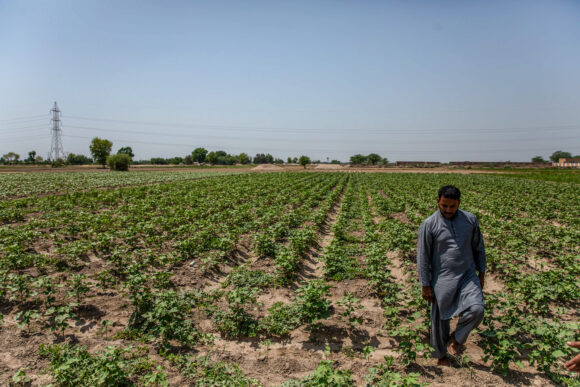
On his four and a half acres of land in central Pakistan, Izhar ul-Haq approaches farming as a science. He knows the precise acidity of the soil and the exact amount of brackish groundwater his crops can tolerate if mixed with water from the canals that snake through his wheat and cotton fields.
When he’s not working the plot, Izhar, 30, studies YouTube videos for new strategies to combat the water scarcity and high temperatures that plague Pakistan’s agricultural heartland. Shifting growing seasons and frequent droughts exacerbated by climate change mean that “old farming techniques don’t work anymore,” he says.
Yet, all that careful research won’t protect Izhar against heavy financial losses if a climate disaster strikes — like in 2022, when record floods decimated much of Pakistan’s farmland. None of his crops are insured. He’s never purchased commercial coverage, in part because his religion discourages it. Such contracts contain an element of interest, which is forbidden under Islamic law to prevent exploitative contracts.
The dilemma facing farmers like Izhar is sparking interest in takaful insurance, a financial product designed to adhere to Islamic principles. In this model, buyers pay into a pool to offset each other’s losses and, if there’s a surplus after service fees and other costs, are eligible to get some of their money back. The approach is one of several niche instruments, such as catastrophe bonds and weather derivatives, that are gaining popularity as homeowners, businesses, and governments look for ways to hedge against growing climate risks.
In Pakistan, “the economic impact of weather on food security is the biggest hitch,” says Zeeshan Hasib Baig, general manager of agricultural giant Syngenta AG’s local subsidiary. “The topic is at the top of the mind of all farmers across the board.”
Umair Ismail Ghaya, former executive director at insurance company Salaam Takaful, says the 2022 floods helped bring renewed attention to takaful insurance as a possible solution in Pakistan, which aims to shift a third of the country's financial industry from conventional to Islamic banking by next year.
“When a disaster happens, everybody is sensitive,” he says. “That sort of gave even more push and credence to our idea.”
In the past year, Salaam Takaful has partnered with large agricultural companies in Pakistan including Syngenta and National Foods Ltd. to pilot Islamic insurance programs. They also work with InFarmer, a satellite-data provider, and JazzCash, a popular mobile payment service.
Customers can pay their premiums in cash, a major perk since 79% of Pakistanis don’t have bank accounts. Payouts are delivered through the JazzCash app, bypassing the traditional banking system.
Salaam Takaful’s main offering incorporates another lesser-known insurance strategy that’s often used to protect against extreme weather. The instruments employ a parametric approach, which means they pay out when certain thresholds, such as average daily temperatures or millimeters of rainfall, are breached. The main advantage is that parameters are agreed upon ahead of time, so there’s no time-consuming loss assessment after a disaster occurs.
The potential returns can be attractive. For example, one of the parametric insurance products offered on Salaam Takaful’s website claims that if a farmer contributes $5 per acre per year, he stands to receive to receive around $18 per acre if a metric is hit.
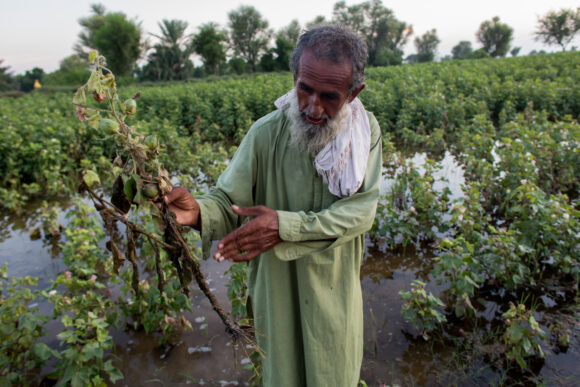
A farmer shows his flood-affected cotton farm in Shah Morio village in Sindh province, in August 2022. Photo credit: Asim Hafeez/Bloomberg
But for parametric insurance to be successful, policyholders have to be spread across a wide enough area that a single weather event doesn’t affect everyone. That will be challenging in Pakistan, one of the mostclimate- vulnerable countries in the world. By 2035 to 2044, about 5 million more people will be exposed to extreme river floods, according to the Asian Development Bank. The agriculture industry, which supports 2/3 Pakistan’s population, is especially vulnerable.
The global takaful insurance market, which was worth about $32 billion in 2022, is projected to grow to almost $127 billion by 2032 according to Allied Market Research . Demand is rising at about 10% a year, the United Nations Development Programme estimates, with significant footholds in Muslim-majority nations including Saudi Arabia and Malaysia.
Still, Pakistan has long lagged other countries in insurance penetration, which still hovers around 1% despite more than a decade of efforts to boost coverage. Uninsured losses from climate disasters accounted for about 10% of its gross domestic product over the past two decades. The 2022 floods alone caused some $30 billion in losses, almost none of which were covered.
For now, whether takaful insurance becomes widespread in Pakistan depends on who is promoting the tool and subsidizing premiums, says Naveed Alam, the founder of InFarmer. “Farmers still aren’t ready to pay directly from their pockets,” he says.
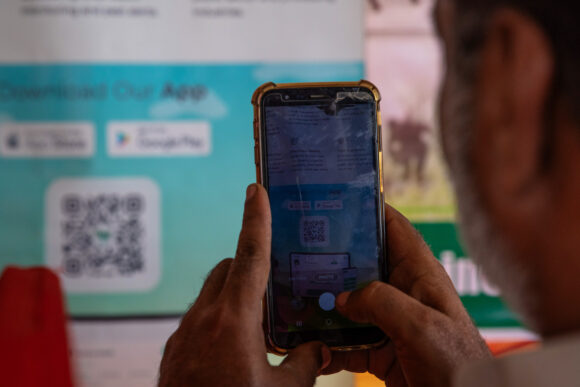
A participant scans a QR code for an app that provides parametric data at an outreach session in Toba Tek Singh, in May 2024. Photo credit: Betsy Joles/Bloomberg
Local non-governmental organizations and development institutions such as the World Bank have expressed interest in supporting such programs until they take off. And advocates say innovations in the takaful industry could help Pakistan overcome its insurance gap.
“When you are looking at climate change and the impacts of climate change, you need to have a financing mechanism that relates with [people’s] values,” says Muhammad Ali Khan, who authored a recent report on takaful insurance for UNDP and the Islamic Development Bank.
At an outreach session in Pakistan’s Toba Tek Singh district in May, dozens of small-scale farmers gathered for a sales pitch from Salaam Takaful. Over the whir of fans, representatives took turns explaining how weather conditions automatically trigger payouts that growers can claim even before their crop is harvested. Several farmers were interested, though they also had plenty of questions.
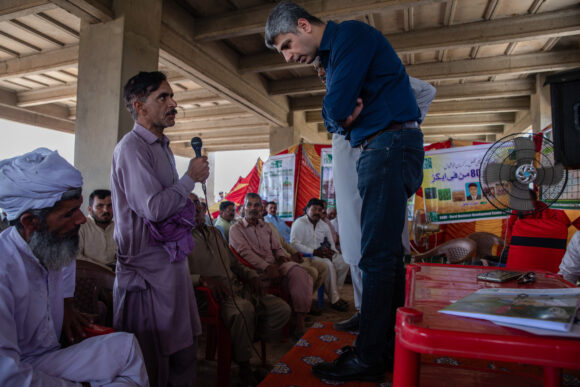
Naveed Alam answers questions from farmers at an outreach session, in Toba Tek Singh in May 2024. Photo credit: Betsy Joles/Bloomberg
In rural communities, it’s common to take advances from landlords, family members and loan sharks to help pay for raw materials like seed and fertilizer. That means that farmers “stand to lose pretty much everything” if they have a bad season, says Maha Qasim, founder of Zero-point Partners, a climate advisory firm in Karachi.
But entering the insurance market can also be intimidating. Many farmers would rather borrow from people close to them rather than go through the slow and bureaucratic process of dealing with a company, Qasim says. “I think it can be a little bit overwhelming.”
Source - Bloomberg