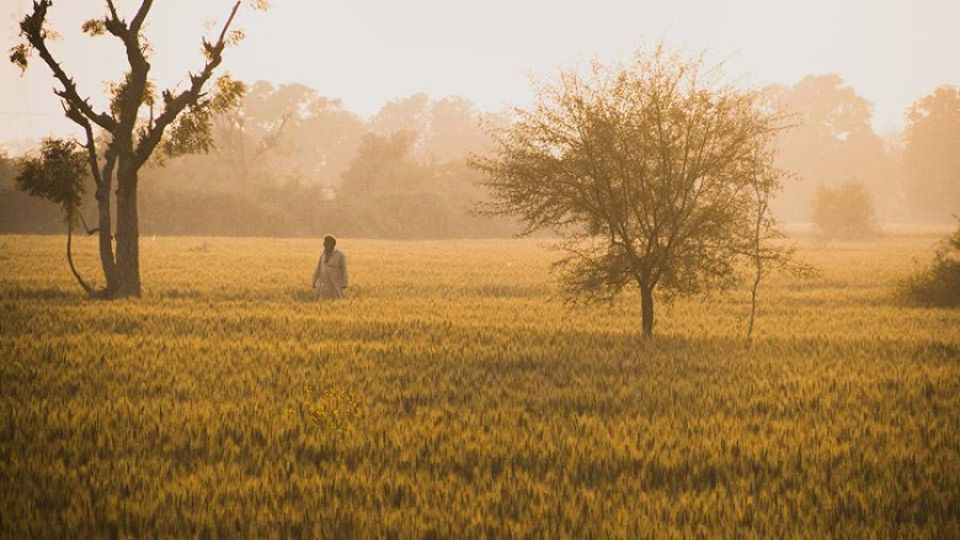
Climate change is much more than about floods and storms. Everyone remembers the ‘biblical floods’ of 2022 that devastated Pakistan’s agriculture.
Climate change is much more than about floods and storms. Everyone remembers the ‘biblical floods’ of 2022 that devastated Pakistan’s agriculture.
Sindh was the worst hit, with farmers losing half a billion dollars’ worth of the cotton crop and the same amount for the rice crop, and farm families lost over 42,000 animals.
What is less well remembered is the historic heatwave that took place earlier the same year and which significantly reduced wheat yields as the season jumped straight from the winter cool to the searing summer heat, skipping spring completely.
These are the climate events that are talked about the most. However, Pakistani farmers have long been sensing the impact of the more common perils on their crops. Their stories have been piling up for more than a decade. Here are some vignettes:
A seasoned farmer sat at his dera in Kunri, District Umerkot, in south-eastern Sindh in mid-November a decade ago.
For as long as he could remember, the ideal time for sowing wheat was from mid-October to mid-November.
Each week’s delay beyond this window was said to cost the farmer about one maund (40 kg) of yield per acre. But that year, even in mid-November, the chill in the air he had always felt since childhood was missing – the chill the wheat needs at the time of sowing.
Last year, a corporate farming team in District Rahim Yar Khan concluded at the end of August that the danger of an attack from the deadly white fly had run its course and was unlikely to hit the cotton crop in September. Traditionally, the lower September temperatures meant that the white fly would not be able to survive.
But changing climate patterns brought a surprise.
The September temperatures remained unseasonably high, giving the white fly another three weeks to destroy the cotton crop.
To control the white fly across the cotton belt of southern Punjab, the government of Punjab was forced to secure drones to spray pesticides at considerable expense. But the crop was still impacted heavily.
The rice crop in District Pakpattan has always been dependent on the water released by the Indian authorities into the Sutlej river every monsoon season.
Last year, excessive rain in India resulted in an inordinate amount of water running through the Sutlej, inundating large swathes of the standing crop.
These are some examples of how climate events related to water, temperature, and heat have impacted Pakistan’s farmers, with little relief available. Each crop lost sees farmers reel financially for the next few seasons.
Fortunately, farmers are now beginning to ask about crop insurance.
In 2008, the Government of Pakistan made some good decisions related to crop insurance when it launched the Crop Loan Insurance Scheme.
Crop insurance was made mandatory for all bank loans given directly to farmers.
The scheme is administered by the State Bank of Pakistan and pays the insurance premium for all borrowing farmers with less than 25 acres of land.
This was a beneficial scheme, even if we ignore the fact that less than 20% of Pakistani farmers have direct loans from banks.
The scheme served farmers well during the floods of 2010, and insurance payouts were made to flood-stricken farmers who were bank borrowers.
However, this scheme has been constrained from the start by two features that were introduced to kickstart the scheme and which were meant to evolve over time.
The first feature is the ceiling on the insurance payout, and the cap was set at a maximum of three times the amount of the insurance premium paid.
According to a recent report by the Securities and Exchange Commission of Pakistan (SECP), between 2008 and 2022, the scheme paid out a cumulative total of Rs 14.3 billion in premiums, although the insurance payouts totalled only Rs 6.5 billion.
This means that the payouts amounted to only 45% of the premium paid, despite so many calamities and climate events.
The other constraint is that the payouts are only made if the government declares a calamity in the area that was hit.
This unscientific approach means that payouts mostly happen when the untrained and naked eye of the government official sees an entire area under water due to flooding or excessive rainfall.
The flaw in this approach was evident after the failure of the cotton crop in southern Punjab and upper Sindh in 2020 due to an infestation of the pink bollworm and untimely rains. A calamity was declared in southern Punjab but not in upper Sindh.
As a result of these constraints, there is now a consensus that a review of the crop loan insurance scheme is overdue and options exist.
One option is weather-based or parametric insurance, which makes a payout to a farmer if specific weather parameters cross the agreed levels.
For example, there would be a payout if the temperature exceeded X degrees centigrade or if the rainfall exceeded Y millimetres.
This solution has been piloted in Pakistan by Salaam Takaful. Weather-based insurance is often limited by the fact that it does not address biological perils, such as pest attacks and plant diseases.
Furthermore, the weather parameters should be seen as inputs to the farming process rather than a measure of the outcome of their impact on the crop.
In many cases, the impact on the crop may be more than a single weather parameter can account for; for example, humidity plus high temperatures.
In 2021, a SECP-led task force under the National Financial Inclusion Strategy identified Area Yield Index-based Insurance (AYII) as the kind of crop insurance that addresses these concerns and is considered best suited to small farmers.
AYII eliminates the administrative and expensive cost of surveying every small individual farm. Instead, it takes the average yield achieved in the area insured as a proxy for the impact climate and biological perils have on the crop, so that farmers in a given area receive a payout if the yield goes below the area’s historical average yield by a pre-defined proportion (typically 30%).
The average yield is determined by a third-party surveyor (an insurtech firm) through weather and satellite data and on-ground crop cuts based on a random selection of the area’s farms.
As AYII is linked to the average yield of the area, it allows for multiple factors that may affect crops, such as heatwaves, pest attacks, disease, frost, excessive rain, floods, hail, droughts, windstorms, etc.
AYII has been successfully piloted in Pakistan by TPL Insurance, global reinsurer SCOR Re, and insuretech firm Pula Advisors (for borrowers of HBL and Bank of Punjab).
Under these pilots, farmers in District Sheikhupura received payouts for their wheat crop after the heatwave of 2022, farmers in District Pakpattan received payouts for the rice crop after the Sutlej River inundation in 2023, and the corporate farming project in Rahim Yar Khan received payouts for the cotton crop after a white fly infestation in 2023.
These pilots have served as a proof-of-concept, and the banking industry has recommended to the minister for finance that AYII-based insurance be added to the crop loan insurance scheme.
It is now for the government to do what governments the world over have done. Launch crop insurance schemes under which the insurance premium for small farmers is paid by the government. A robust solution is available and tested right here in Pakistan.
Source - Asia News