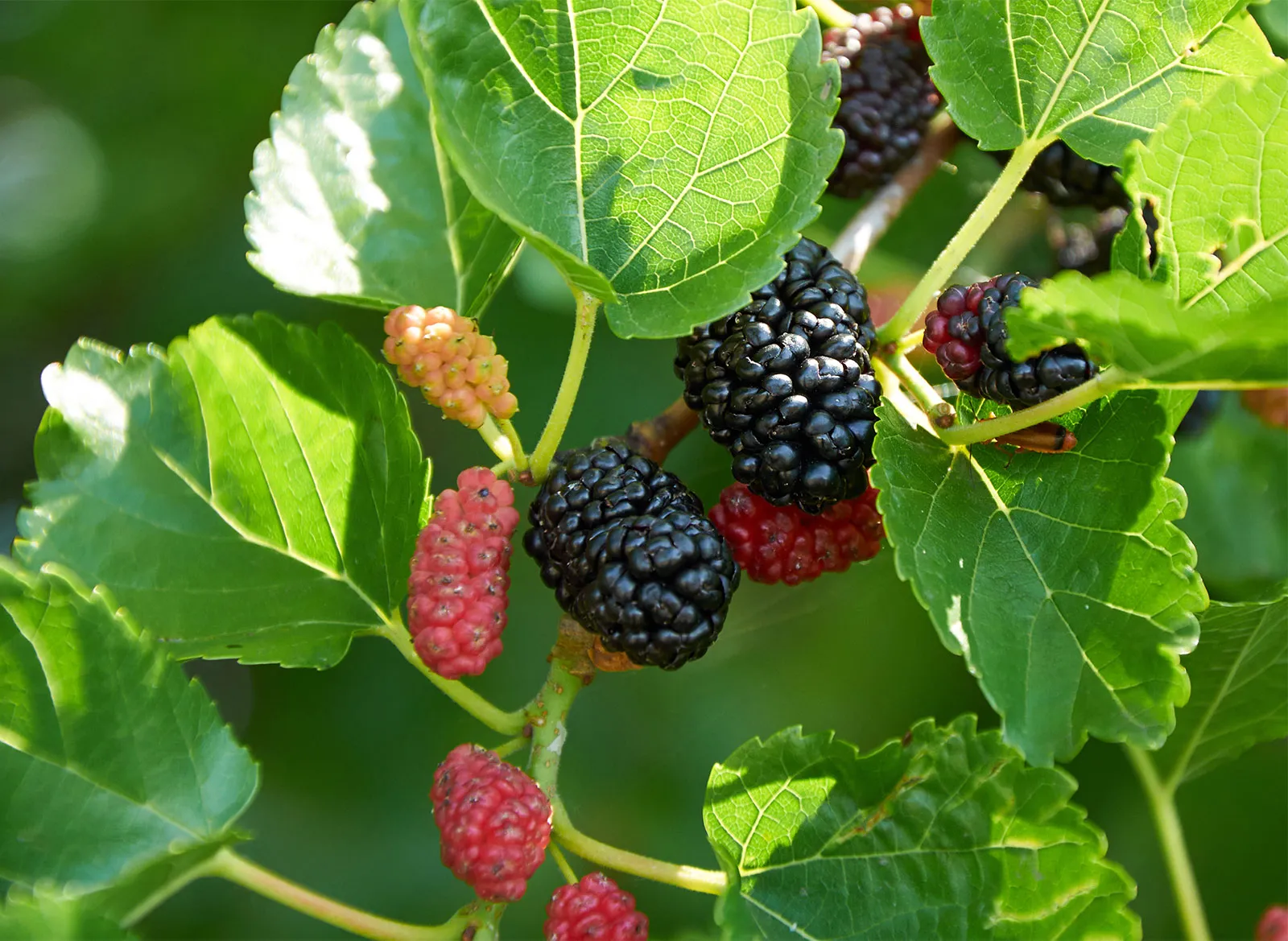
Farmers of mulberry in the southern Quneitra governorate have complained about selling their crops at low prices that are not commensurate with the costs, which exposes them to huge losses.
With the start of the harvest season last June, farmers began selling a kilo of berries to merchants for 1,800 Syrian pounds, and it recently reached 5,500 pounds (about half a US dollar).
A chronic problem that farmers suffer at the beginning of each season, and they face low prices and difficulty in selling on their own, despite the presence of the Directorate of Agriculture and agencies responsible for a strategic crop in the region.
“Low price”
Salem Hassoun, 65, a farmer from the town of Hadhar, who owns 35 mulberry trees (the age of the tree is 25 years old), told Enab Baladi that the amount paid for a kilo of berries is “very low.”
Hassoun said that he started selling a kilo for 1,800 pounds and reached 5,500 pounds, pointing out that the price should be 20,000 pounds compared to previous years, but the depreciation of the Syrian pound against the US dollar made farmers work in vain.
The farmer and his family pick 300 kilograms of ripe berries daily, which is a small amount due to the difficulty of harvesting the crop, pointing out that if he hired workers, the losses would be doubled.
($1=11,950 SYP) according to the S-P Today website, which covers the trading rate of the Syrian pound to the dollar.
Workers share profits
The low price of the crop and the difficulty of harvesting it prompted farmers to partner with harvest workers in their production to avoid incurring higher costs.
Umm Louay, 50, a widow, works with her two sons in picking berries, and they collect about 100 kilograms of berries every day, with work that lasts for ten hours.
The woman explained to Enab Baladi that she partners with the owner of the land and that she has to harvest the crop in exchange for taking half of its value. Her daily wage ranges between 150,000 and 200,000 Syrian pounds, and it varies according to the kilo sold and the amount of harvest.
Merchants: profit is “slight”
Mohammad Marioud, a trader from the town of Jubata al-Khashab in the northern countryside, buys berries from farmers and sells them to factories or the al-Hal market. He said that the profit margin is “slight.”
The merchant told Enab Baladi that determining the profit is related to what the main trader or the owners of berry factories pay, pointing out that the farmers are not satisfied with these prices.
Marioud explained that he cannot raise the purchase price on his own and lose, and he does not have the ability to buy a large amount of berries and put them in refrigerators, as some merchants do, until the price rises.
Conflicting numbers, “Disclaimer of responsibility”
Quneitra tops the list of Syrian governorates in berry production by 25%, according to the director of Quneitra Agriculture, Refaat Mousa, who said that the governorate’s production of mulberry this year amounts to about 300 tons, of which 260 tons are rain-fed berries, and 40 tons are irrigated berries.
Mousa attributed the farmers’ suffering to poor marketing and low prices due to the increase in production, as a kilo was sold for 2,000 pounds at the beginning of the season, and prices are expected to improve due to the increase in the sweetness of the fruit.
Mousa explained that the cultivated area of mulberry trees amounts to 1,337 dunams (961 rain-fed and 376 irrigated), an increase of about 120 dunams over the last season.
The number of mulberry trees in Quneitra is 13,370, of which fruitful ones are about 10,000 trees.
The Director of Agriculture in Quneitra did not address the directorate’s responsibility for disposing of, marketing, purchasing the crop, or assisting farmers, and his talk about increasing production was inconsistent with the numbers of previous years.
In 2020, the Ministry of Agriculture in the regime government said that the production of berries in Quneitra is estimated at 452 tons.
The Directorate of Agriculture in Quneitra estimated the governorate’s expected production of mulberry at more than 1,000 tons in 2021, which means that production in 2023 will decrease, not increase.
Source - https://english.enabbaladi.net