A co-insurance pool launching next year is designed to address it.
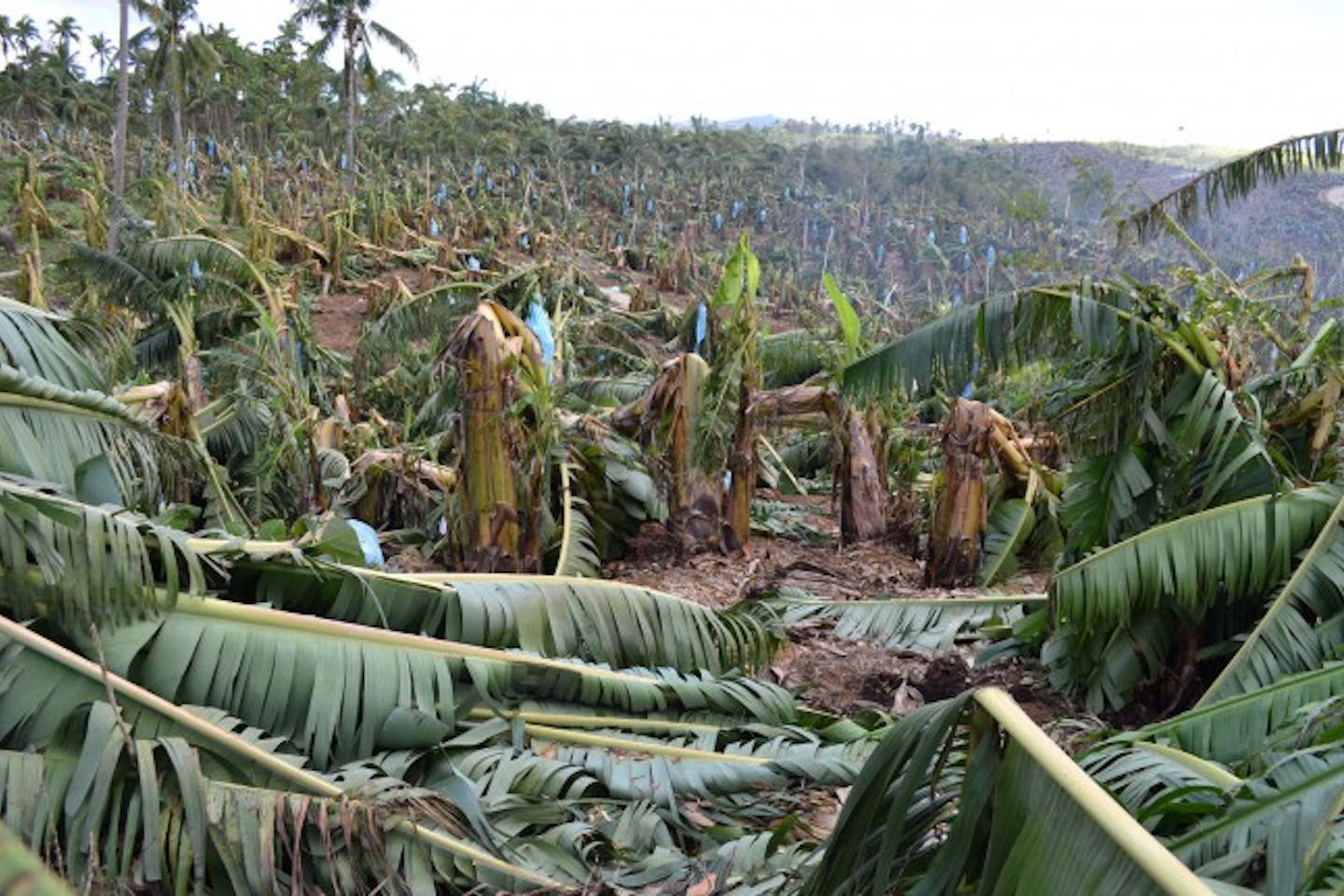
The P135.3 million in agricultural losses triggered by typhoons “Luis” and “Maymay” and an enhanced southwest monsoon is not, by recent Philippine typhoon season benchmarks, an outsized event. Its significance for insurance professionals lies elsewhere: it arrives as the Philippines prepares to launch its first agricultural co-insurance pool in January 2027, designed to introduce private sector capital into a market where the state insurer has carried its entire national portfolio without reinsurance for more than a decade – and where the majority of the farming population remains outside the insured pool.
What the damage data shows
The Department of Agriculture (DA) reported that 6,010 farmers across the Ilocos Region, Central Luzon, CALABARZON, MIMAROPA, and Western Visayas were affected, with 4,516 hectares of farmland damaged and estimated production losses of 4,465 metric tons, according to the Daily Tribune. Rice, corn, high-value crops, livestock, and agricultural infrastructure were among the affected assets. The DA said it would conduct field validation alongside the release of assistance rather than wait for a final damage assessment, and the figure remains subject to revision.
Agriculture Secretary Francisco P. Tiu Laurel Jr. directed DA regional offices to accelerate insurance claims processing alongside credit disbursements. “We need our people on the ground to move quickly so affected farmers can get the assistance they need, especially insurance claims and credit support. The faster we process these, the faster farmers can recover and get back to production,” Tiu Laurel said, as reported by the Daily Tribune. Insured producers will receive compensation through PCIC. Farmers without active policies may apply for up to P25,000 under the Agricultural Credit Policy Council’s Survival and Recovery Loan Program, an interest-free facility repayable over three years. The DA has separately allocated P106.5 million in seeds for distribution through regional offices.
The insured-versus-affected gap
No PCIC rapid assessment quantifying the number of insured farmers within the 6,010 affected had been published at the time of writing, as field validation across five regions remains ongoing. The pattern from comparable recent events is consistent: when Typhoon Tino struck in November 2025, a PCIC rapid assessment across nine regions identified 32,247 insured farmers with estimated indemnities of P250.6 million, according to the DA. When Severe Tropical Storm Kristine struck in late 2024, PCIC identified approximately 86,066 insured farmers across 10 regions with an initial estimated payout of P667 million, according to the DA’s own portal. In both cases, insured farmers represented a fraction of the total agricultural population in the affected areas.
The Philippines has 7.43 million farms, with 98.7% below seven hectares in size, according to the 2022 Census of Agriculture and Fisheries. The 2026 General Appropriations Act expanded PCIC’s budget by 45% to a record P6.5 billion, with projected coverage reaching 3.68 million farmers and fisherfolk in 2026 – subsidized and non-subsidized combined – up 12% from 3.29 million in 2025, according to the DA.
No reinsurance: the structural exposure
The PCIC retains all underwriting risk with no reinsurance, sovereign risk transfer, or internal actuarial segmentation, exposing the government directly to large fiscal liabilities when catastrophic events occur. The World Bank has confirmed that the PCIC does not purchase reinsurance for its agricultural insurance portfolio and is among very few agricultural insurers globally underwriting a national portfolio of crops, livestock, and fisheries against catastrophe risks without it. Private sector participation has historically been minimal: limited access to government subsidies, data gaps, taxes on private insurance premiums, and the perceived riskiness of the sector are cited as deterrents, according to the World Bank’s project information documents.
The Insurance Commission (IC) established a regulatory pathway for private sector entry through Circular Letter 2021-60, which set out guidelines for a regulatory sandbox for piloting agriculture insurance, according to the IC’s official register. Draft amendments to that framework – circulated by the IC and noted by the Philippine Insurers and Reinsurers Association (PIRA) in May 2026 – further streamline entry requirements, formally recognize parametric and index-based products, and allow cooperatives, farmer associations, and local government-linked entities to distribute coverage.
The co-insurance pool: funded, approved, and timed
The January 2027 launch target carries government-level authority. Agriculture Assistant Secretary Arnel V. De Mesa announced the timeline at the Philippine Insurance Summit after the pool’s creation received approval from the Cabinet-level Investment Coordination Committee, according to a June 2026 report. The World Bank’s board of directors was expected to approve the broader program on October 8, 2026, De Mesa said.
The pool sits within an $873 million World Bank-supported program – the Improving MSME Access to Finance for Productivity and Resilience to Climate Shock project – with $77.5 million specifically allocated to establishing the co-insurance pool, according to the Manila Bulletin’s reporting on the project information document. The Global Shield Financing Facility (GSFF) has separately endorsed an $8 million grant to operationalize the pool and unlock private capital for small farmers, according to its own project records.
The DA will provide policy leadership, while PCIC and PIRA will manage the pool jointly. The program will function as a coordinating mechanism rather than a separate legal entity, modelled on established schemes including Spain’s Agroseguro and Turkey’s agricultural insurance pool, according to PCIC, as reported by Business World. A first-loss facility funded through the program will absorb early claims, directly reducing the catastrophe aggregation risk that has deterred private market entry. More than 25 private insurers have expressed interest and are participating in sub-committee meetings, according to Dela Cruz. The pool targets coverage for 750,000 semicommercial farmers by 2030.
For brokers and non-life underwriters in the Philippine market, the pool represents the most significant structural opening in Philippine agricultural insurance since PCIC’s establishment in 1978. It converts PCIC from a monopoly carrier into a co-insurer, introduces index-based and parametric products alongside indemnity coverage, and provides a first-loss buffer that directly addresses the barrier that has kept private capital out of the sector for four decades. With a defined launch date, Cabinet approval, and more than 25 insurers already engaged, the question for the market is no longer whether private agricultural insurance in the Philippines will happen – it is how quickly brokers and underwriters position themselves ahead of it.
Source - https://www.insurancebusinessmag.com