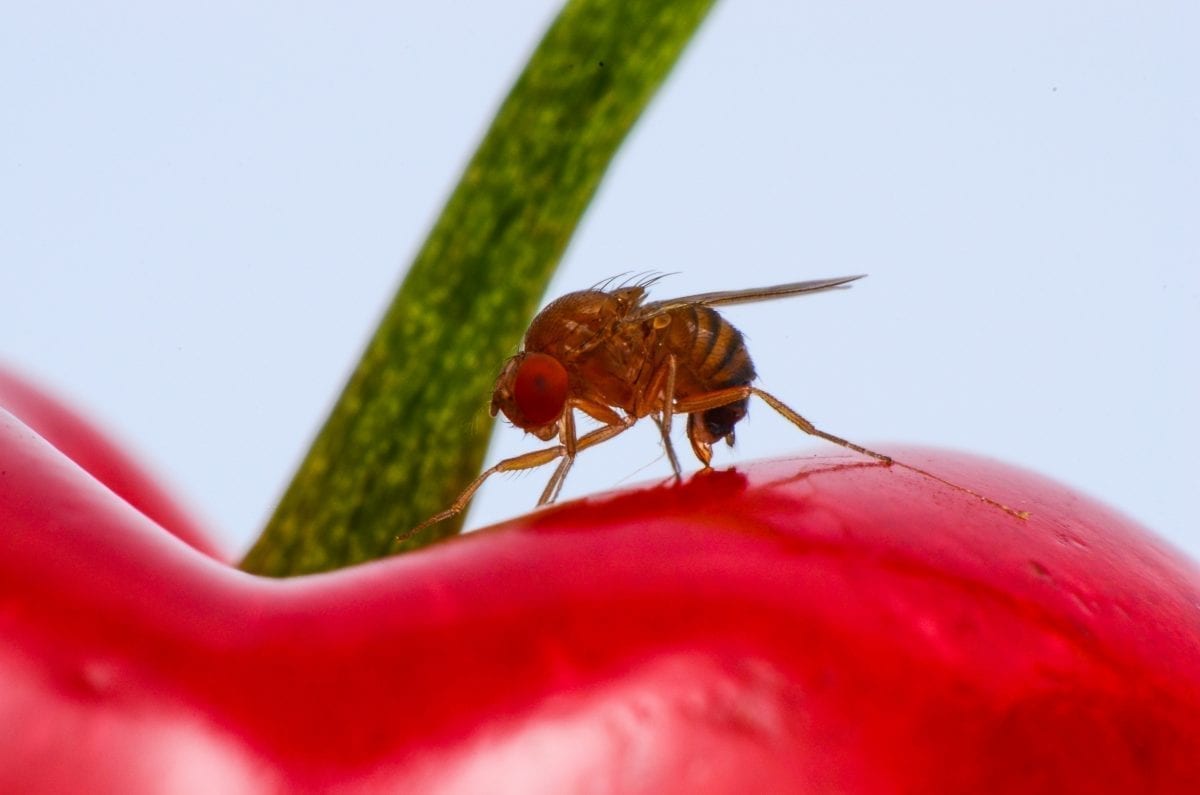
NIAB's Dr. Michelle Fountain explains some of the latest NIAB research on the invasive fly that changed the fruit industry.
Spotted wing drosophila (SWD, Drosophila suzukii) is a small vinegar fly specialized in exploiting fruit by laying eggs in fruits that are not yet ripe, presumably reducing its competition with other species that are more adapted to laying eggs in ripe, overripe, or even rotting fruit.
Consequently, SWD can accelerate the degradation of fruit before it is harvested in commercial crops, leading to massive crop losses, up to 90%, where controls are not in place.
The spread of SWD into major fruit-growing regions of the world where it is not endemic has been enabled by the export of fruit initially from the region of origin in Asia and subsequently between non-native regions where SWD has been established.
Early stages of invasion
SWD was first detected in the UK at NIAB’s horticultural research site at East Malling, Kent, instigating an education and training campaign to alert fruit growers to the threat and how the pest might be controlled. Unfortunately, early control relied heavily on insecticide applications, which disrupted well-established biological controls for other pests.
Early on, it was realized that insect-excluding mesh, crop hygiene (removing non-marketable fruit from the cropping area), sanitary disposal of waste fruit, and frequent harvesting were essential to reduce both SWD numbers inside crops and the reliance on chemical insecticide treatments.
Innovation in SWD control
Recent NIAB research has demonstrated that SWD is not very competitive with other species which lay eggs in softer fruit and that SWD females are deterred from laying eggs where the larvae of another common Drosophila species, Drosophila melanogaster, are actively feeding inside fruit. This is an exciting discovery that could be exploited for future control once the ‘signal’ involved has been identified.
Many parts of Europe are now able to release commercially available parasitoids, e.g., Trichopria drosophilae, to contribute to the control of SWD, but as this species has not yet been identified in the UK, it is not currently approved for release.
Instead, NIAB focused on quantifying the contribution that UK native parasitoids have been making to SWD control. In non-cropped areas, native species may be contributing to around 21% control of SWD. However, these parasitoids are not common within fruit crops due to pesticide use and frequent fruit removal.
It is, however, possible to reduce populations in semi-natural habitats and crops in the spring by mass trapping SWD in woodlands and hedgerows adjacent to crops throughout the autumn and winter. Although in temperate regions, SWD does not lay eggs in the winter, it is often active and feeds on warm winter days.
This offers the opportunity to attract and trap the adult flies in the absence of competing fruit to minimize the numbers of SWD locally at the beginning of the fruit growing season.
This strategy can give a good starting point to established technological approaches such as Sterile Insect Techniques (SIT) where wild populations of pests are controlled by releasing sterile males which outcompete the wild males and leave females infertile.
Repeated introductions of sterile males, therefore, help to keep SWD populations low throughout the season, which, in combination with hygiene measures, can further reduce reliance on chemical insecticides.
NIAB have worked with commercial company BigSis to demonstrate the efficacy of this strategy. BigSis uses X-rays to sterilize flies rather than genetically modified SIT technology, so its solution is approved for sale in England and four USA states.
Finally, NIAB also works with commercial companies Russell IPM and Microbiotech to develop SWD control strategies that combine reduced field doses of insecticides with baits attractive to SWD. Results show that using this strategy can reduce the amount of insecticide applied to an area in a single growing season by up to 95%, resulting in less environmental contamination and lower residues in fresh produce.
The future of SWD control
SWD has presented the UK fruit industry with a major challenge. However, by working with overseas researchers, innovative companies, and fruit growers and investing in research and development, solutions to the control of this pest have been developed.
As with many native and invasive pests, the reliance on one control approach rarely offers reliable control as the pest changes in its response to climate, different fruit varieties, and crop management practices. Hence, the industry needs to collaborate with researchers to tackle emerging changes in SWD adaptation and population fluctuations.
Future research should focus on complementary control strategies as part of Integrated Pest Management and on the automation of control. The aim is to reduce the reliance on labor while creating new skills and techniques in the industry that are able to react to changing pest and disease pressures in crops, including remote sensing and data interpretation.
Source - https://www.hortidaily.com