Suffolk farmers are facing a nail-biting end to the sugar beet campaign - because severe wet conditions have meant they can't get on the fields to finish their harvests.
And there are already fears that less food will be grown overall this year as a result of the dire conditions.
The clock is ticking on this season's East Anglian sugar beet crop as British Sugar - which processes the crop at factories including at Bury St Edmunds, Cantley and Wissington - prepares for its annual shutdown. The Bury factory is due to close tomorrow (March 9).
The crop is delivered to the factories over the autumn and winter months but at a certain point it becomes financially unviable to keep them open as loads dwindle.
James Forrest of Stonham, near Stowmarket, said the conditions were "unprecedented".
"It all started to turn a bit wet at the start of March and it's continued almost 12 months," he said.
"We didn't finish drilling the sugar beet crop until the third week of May - and we have still got sugar beet in the ground now."
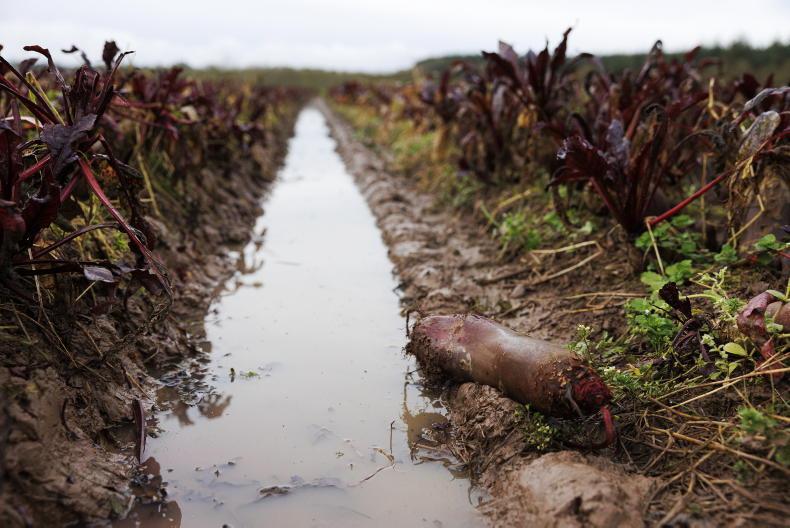
Although the beet factory would be keen to take his crop now, he can't get it out of the field without machines getting bogged down and soils badly damaged.
"Ours go to the Bury factory so if there's insufficient beet to continue economic production there does come a point they'll stop and it will be diverted elsewhere to Cantley or Wissington.
"In the past we have lifted in April. We are being as patient as we can so as to minimise the damage."
Even before October (Storm Babet) floods, things were not panning out well.
"We lost a lot of winter barley straw because the wet was so terrible we ended up having to chop the straw - so harvest was challenging to say the least," said James.
Cereal harvest was challenging because of the rain, and by October, farmers faced an "horrendous" time as their winter drilling window closed.
James managed to send off his beet consignments to the factory on October 14 then January 18 - but since then conditions have not allowed for more lifting of the crop.
"We would normally hope to have our beet out by Christmas or certainly by January at the latest and also cultivate the land after sugar beet," he said.
"But it just kept raining. There are times we could have got sugar beet out but we would have made a terrible mess and damaged the soil."
Luckily, the farm has its own self-propelled beet harvester which means that it can be called into action at short notice.
In January he had nearly a three week run and made excellent progress - but the harvester has now been sitting idle in the shed for a month.
The weather has also meant that like many farmers James weren't able to drill all their winter cereals.
He has got a few days' lifting left on his beet crop, he said, but he was staying patient.
"We have had a lot of rain in the last two or three weeks. I don't know where it's all coming from - I really don't," he said.
"Compared with people who have had their houses flooded it's insignificant really but the wet weather has had some quite significant impacts on our business.
"We had obviously planned for autumn cereals to be drilled. We have had to buy spring seed that has been in short supply and the price has reflected that - so that's had implications on cash flows."
James managed to get about three quarters of his drilling done last autumn before the heavens opened - but that still leaves much work to do.
"The spring workload is going to be immense - and we are not the only ones who didn't manage to get everything drilled in the autumn," he said.
Not only that, but the weather has caused damage to drainage systems - and on his own farm he has seen silting in fields - despite having under-drained fields. "I have seen wet sitting in areas I have never seen it sitting before," he said.
At the same time, grain prices have been tumbling.
"There are going to be some serious repercussions from this," he said. "There's great concern in the industry. We are sitting here with some pretty poor-looking crops because of the weather. Prices have dropped significantly. Things are not looking rosy.
"We have been preparing budgets and cash flows and it's not a particularly exciting outlook at the moment."
East Anglia has experienced its warmest and wettest February on record. An average of 106.4mm of rain fell across the month - beating the previous record of 95.2mm set in 1916. The mean temperature was 8.2C - surpassing the previous record of 7.6C set in 1990.
Like James, Andrew Francis, of Home Farm Nacton, near Ipswich, is frustrated. He has two or three hectares of beet still left to harvest.
"There's a chance we might not get them out in time. Anyone with beet left is facing factory close-downs," he said.
The tough choice might end up being having to pay much higher haulage costs to take them to a factory further away which is still open - or lose the crop, he said.
As well as harvest woes, he was also facing difficulty sowing crops - and estimated the wet had put back his vital sowing season by two or three weeks.
"What we are facing now is a work calendar that's condensing," he said. "We are probably already locked into some yield loss because of where we are in the calendar. Some of these fields are going to want one to two weeks to dry them."
He added: "There may well be areas of the farm that may end up with no food crop in them. We may put them in a cover crop for this season."
Andrew Blenkiron, director of the Euston Estate near Thetford, said conditions were "frustrating and costly" for sowing and harvesting crops this year.
This affected the sowing of autumn crops as well as the harvesting of sugar beet over winter - and left a riverside area where sheep usually graze flooded for most of the season.
"We can't get on and get any land work done now so we are struggling to prepare land for the planting of spring crops.
"We're probably a month behind where we would like to be and that's starting to be very frustrating.
"There will be a financial impact on not being able to get those autumn crops planted and the delay now is potentially going to impact on yields as we move forwards in the summer."
British Sugar, meantime, is winding down its operations and has given expected dates for the closure of some of its factories.
Dan Downs, head of operations for agriculture at British Sugar, said: "We are continuing to run all East Anglian factories at minimum throughput to extend campaign length as much as possible to help our growers, hauliers and harvesting contractors."
Expected campaign end dates for the factories are: Bury St Edmunds - March 9, Wissington - March 15, Cantley and Newark - early April - with dates dependent upon the volume of crop received.
"We continue to monitor the situation closely and are in regular communication with our growers and hauliers as we work together to bring the 2023-24 campaign to a close," said Mr Downs.
Source - https://www.eadt.co.uk