Erratic weather made 2023 a difficult year for some upstate fruit growers.
“We literally thought by the end of May that the year might be a tragedy,” says Amy Machamer, co-owner of Hurd Orchards, a 120-acre farm that’s just outside the Orleans County village of Holley.
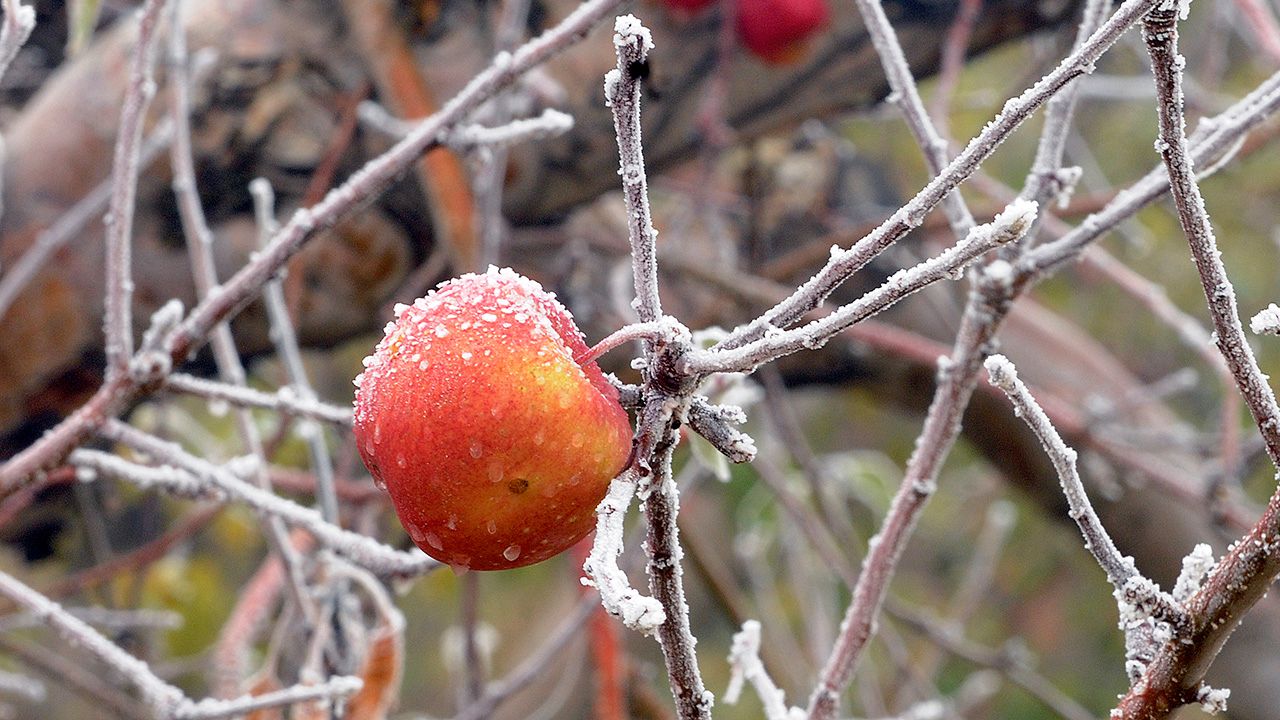
The chief culprit was a record-breaking cold snap that hit in mid-May, a time of year when apples and other locally grown fruits can be particularly vulnerable to the cold. Thermometers dropped below freezing in parts of New York from May 14 to May 25, but the lowest temperatures occurred overnight between May 17 and 18. Temperatures fell to 32 degrees in Holley early that morning, far below the average low temperature of almost 49 degrees for that date.
The abrupt drop in temperatures hit New York apple orchards and vineyards—including Finger Lakes wineries—particularly hard. The U.S. Department of Agriculture’s National Agricultural Statistics Service forecast that apple production, which stood at 1.3 billion pounds in 2022, would drop by 19 percent this year.
In response to May’s extreme weather event, the USDA designated 31 New York counties that had lost more than 30 percent of their fruit crops as “primary natural disaster areas.” Another 24 that had suffered less damage were designated as “contiguous disaster counties.” Farmers within those 55 counties became eligible for assistance from the department’s Farm Service Agency, including emergency loans.
Disaster zones
Craig Kahlke, team leader for the Cornell Cooperative Extension Lake Ontario Fruit Program, works with fruit growers in five counties with Lake Ontario shoreline: Orleans, Ontario, Wayne, Monroe and Niagara. Though they produce a variety of fruits, apples are a mainstay for many growers.
“We have 30,000 acres of apples in my five counties,” he says. “I doubt we have 700 of peaches, for instance.”
Growers generally have the option of offering their crops directly to consumers at farm markets or through “u-pick” operations, selling them to applesauce or cider makers or wholesaling them to distributors for eventual sale to retailers. Kahlke says most of the apples grown in the five counties he covers go to distributors.
After the cold snap, Orleans, Ontario and Wayne counties were designated as primary natural disaster areas and Monroe County as a contiguous disaster county.
“Some growers probably lost more than half of their crop,” Kahlke says. “They’re just, like, ‘This is a year I want to forget.’”
One Penfield fruit grower estimated that he’d lost 70 percent of his apple crop after the temperature fell early on the morning of May 18.
That kind of loss is difficult to shoulder, but not every fruit grower in the area suffered such damage from the cold. None who spoke to the Rochester Beacon for this article felt the need to apply to the USDA for federal assistance. A number of factors helped them get through the year, in some cases with flying colors.
The frost threat
In a nutshell, successful apple harvests depend in part upon predictable seasonal temperatures.
“The ideal, for a fruit grower, for just about all the fruit crops that are grown in the north, (is) a fall that has a very gradual drop in temperature,” says Machamer, who grows fruit on all but 10 acres of Hurd Orchards’ land.
As temperatures continue to fall, apple trees become dormant, a state that should allow them to avoid serious damage from seasonally cold temperatures. Under ideal conditions, they remain so until the thermometer begins to rise again in the spring.
“You want it to warm up gradually,” Machamer says. “Ideally, as fruit growers, we want that to be relatively late … here in the north.”
As temperatures rise, the trees bloom and begin producing fruit.
“You want it to be more of an assurance that your overall temperature range is safe for the fruit, that they won’t have a sudden frost when they’re at their most vulnerable,” Machamer says.
Extreme cold can kill a crop, or damage the fruit it produces. Kahlke says some growers found unsightly rings on their apples after the May frost that made the fruit too unattractive for retail sale. They were forced to sell the apples to processors at a much lower profit.
Proximity to Lake Ontario can help an orchard avoid destructive temperatures. The lake acts as a heat sink, cooling the summers and warming the winters.
“Lake Ontario offers the buffer,” says Austin Fowler, co-owner Fowler Farms, which has 2,200 acres of apple orchards in Wayne County. “Once you get outside that proximity of the lake, the more susceptible you are every single year for frost damage, or potentially freezing at the end of the season.”
Weathering impact
Fowler Farms’ acreage is broken into small plots of no more than 20 acres each that are spread around the county relatively close to the lake. When a plot is in a defile, a narrow valley or gorge, the family business takes measures to mitigate cold weather’s effects.
“We actually will dig ponds in low areas,” Fowler says. “It creates a little bit of insulation for heat.”
When necessary, the grower has installed large fans called wind machines in orchards that turn on when the temperature drops too low.
“They will bring the warmer air and they rotate it down,” Fowler says. “They’ll raise the temperature four or five degrees.”
As effective as such measures might be, they don’t always work. Fowler would not say how productive his family’s orchards have been this year, but admitted that he lost 1 percent to 3 percent of his apple crop to frost. Despite that, the orchards still yielded 85 percent of a full crop overall.
Robb Farms in Spencerport devotes 20 acres to fruit crops, mostly apples and peaches. Because of its location, the crops came through 2023’s weather relatively unscathed.
“We were not affected by the frost because we’re up on a hill,” says co-owner Margery Robb.
The farm sold the fruit through its seasonal u-pick operation and at its on-site market.
“For our business, we were just where we wanted to be,” Robb says.
Machamer appears a bit relieved that the year is drawing to a close.
“Our overall reflection about this year, 2023, is that every fruit is a miracle,” she says.
Hurd Orchards’ top crops are apples, sweet cherries and blueberries, but the farm grows other fruits, as well. Each type fared differently at the hands of the weather. Machamer says this year she had a “bumper crop of blackberries,” her peaches did very well and her orchards yielded “terrific” amounts of Snap Dragon and Ruby Frost apples. Though Hurd Orchards came up very short of Ida Red, Empire, Honey Crisp and Pink Lady apples, there were some trade-offs.
“Our Honey Crisp, every fruit was like a masterpiece,” she says. “Same thing on our Pink Ladies. They were short in volume, but again, every single apple is like an ornament.”
Machamer declined to say how much fruit her farm yielded this year and could not say whether the quality of its fruit will make up for the losses her orchards have suffered.
‘We are so grateful for what we did have,” she says.
She hopes to be better prepared for the weather in the future.
“Our whole farm’s planning is to try to position ourselves so we can have options for survival in a changing world,” Machamer says.
To that end, Machamer has begun researching ways to prevent extreme weather from damaging her fruit crops. “Managing the Uncontrollable: Cold Session,” one of a series of online seminars from the Lake Ontario Fruit Program, gave her a lot of information about beating the cold. Following its tips, Machamer plans to closely study her orchards and crops in order to determine their vulnerability to low temperatures.
“You have to really begin building your own case for each specific block (of land), each fruit variety, and even all the micro aspects of that,” Machamer says. “You have to build your own database.”
With that information, she hopes to be able to better safeguard her crops in the future as the weather changes.
“This year was the wake-up call,” Machamer says.
Source - https://rochesterbeacon.com