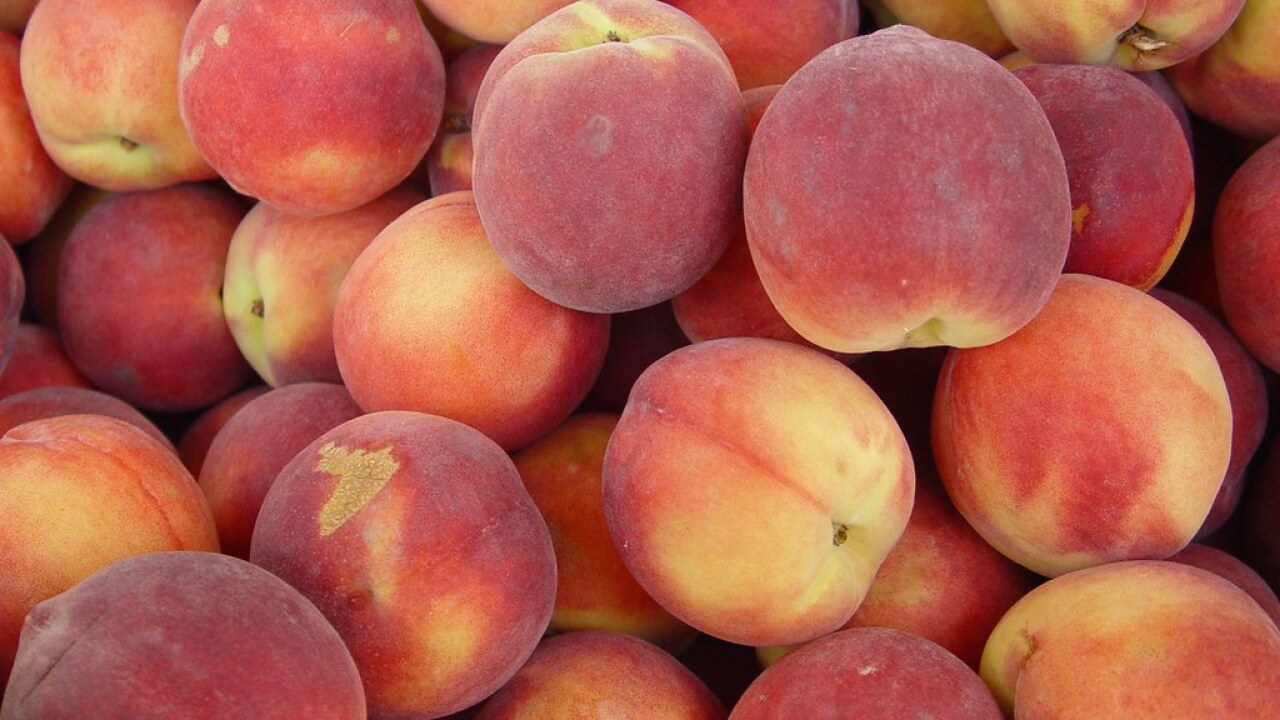
Farming is inherently risky, a profession that always involves an expectation of loss and damage. But among many farmers, peaches are considered an unpredictable crop, with high risks and high rewards.
“Farming peaches is like gambling in a casino,” said 44-year-old Robert Jackson II, of Lyman, South Carolina. The fruit bruises easily and is vulnerable to weather changes, but can earn handsome profits.
He and his 70-year-old father, also named Robert Jackson, live and work on a 33-acre farm where peaches are their main revenue stream. “One day, everything could be fine, and then the next day, you could have nothing.”
That’s been the case for many South Carolina growers, who produce more of the fruit than the neighboring “Peach State”, Georgia. This year, a late freeze destroyed about 70% of the state’s harvest. This year’s disaster followed the previous year’s disruption, another freeze that put a major dent in peach growers’ pockets and prospects.
As southern peach season draws to a close, farmers worry that climate change threatens the long-term survival of an industry that is an economic powerhouse and deeply tied to regional identity. What apple pie is to America, the peach has arguably become to many people in the south. From Charleston to Greenville, South Carolina, roadside stands advertise peach ice cream, and small Gaffney, South Carolina, has a 135ft peach-shaped water tower.
But this year, peaches have been scarce. At an Asheville, North Carolina, farmers’ market where most of the peaches come from South Carolina, fewer peaches were on offer. When they were available, they were more expensive: a half-bushel could cost as much as $60. “Still, every peach sold in a blink of an eye,” said Ellerslie McCue, marketing coordinator for the WNC Farmers Market.
In 2022, Jackson Farms picked 2,200 half bushels of peaches. This year, it only yielded 110 half bushels. Typically, the farm would have enough peaches to sell wholesale, as many peach farmers do with excess crop. This year it only produced enough to sell at the family’s roadside stand and local farmers’ markets.
“We didn’t think the temperature was going to drop as cold as it did,” he said. “But 2 or 3 degrees is the difference between success and failure with peaches.”
Peaches are notoriously difficult to farm, both labor-intensive and sensitive to minor fluctuations in weather. During the fall and winter, peach trees enter a dormant period. Depending on the variety, the tree needs a specific number of “chilling” hours during this time – basically, hours spent at temperatures between 32 and 45F. During this season, peach trees are pretty hardy and resilient to freezes. Once the weather warms, the trees begin flowering and eventually producing fruit. But, at that point, the tree and its fruits are a lot more vulnerable to cold and destructive weather, such as hail.
“This year is probably the worst year in my 38 years of working,” said Dr Gregory Rieghard, professor of horticulture and member of the Peach Breeding Lab at Clemson University. He estimated that Georgia lost even more of its crop than South Carolina, keeping only 5% of its peaches.
Rieghard said climate change is jeopardizing peach growing.
“What people don’t realize is that when you have warmer temperatures in the Pacific, that warmth moves towards the Arctic and displaces the cold air that is there and pushes it down into North America. So we have an increased risk of these late freezes due to polar vortexes.”
Frequent late spring freezes combine with warmer winters and irregular rainfall to make a perfect storm for crop destruction. As global temperatures rise, peach trees are not always getting those necessary “chilling” hours. Warmer air also holds more moisture. It might rain less frequently, but when it does rain, there often is a lot more of it. Both drought and torrential downpours can wreck a season.
Rachel McCormick’s family has owned McLeod Farms in McBee, South Carolina, for five generations and currently plants 1,000 acres of peaches. Her father, Kemp McLeod, “calls the National Weather [Service] phone number all the time. I think they have him on caller ID,” she said.
The period of regular freezes this year was a “long three weeks” for the family. But they fared better than many farmers, retaining most of their crop. Some of it was the luck of geography. McBee, situated in the state’s Sandhills region, didn’t get as intense of a freeze as more southern and western parts of the state.
McLeod Farms also invested heavily in protecting its peaches. Workers burned bales of straw around the periphery of the farm at night and ran dozens of wind machines, circulating warm air around the trees.
Wind machines are among a handful of tools that can protect peaches in the face of a freeze. Rieghard’s lab at Clemson is also working on breeding new varieties of peaches that bloom later in the spring at higher temperatures. For the farmers themselves, there is crop insurance, which can provide some financial protection. Jackson didn’t get crop insurance until after the 2017 freeze when the US Department of Agriculture provided disaster relief to peach farmers. That vital cash subsidized the cost of crop insurance, which can be prohibitively expensive.
Despite this, many peach farmers remain steadfast in their commitment to growing peaches. Risk sometimes comes with gain. Rieghard noted peaches often return higher investment than row crops; in South Carolina, 15,500 acres of peaches generate over $98m, to the tune of more than $6,000 an acre.
“Honestly, if 100% of our crop came, we wouldn’t know what to do,” joked McCormick. Her family farm expects to lose at least 20% of its crop per season. As it stands, she’s currently filling out the paperwork to bring the usual cohort of migrant workers over through H-2A visas to work 2024’s crop. She doesn’t expect the more frequent freezes will change her family’s commitment to peaches.
“There’s been a lot of talk about the peach industry this year because we were hit so hard, but I hope it has brought awareness to how this supply chain works and how environmental and economic elements can affect an industry,” she said.
For Jackson, the peach failure is a loss, but his family balances that part of their business with off-farm jobs and other crops.
“We still have the vegetables and watermelon and blackberries to save us. My dad says if you ever lose a blackberry crop, then there’s not gonna be anything because blackberries are the most resilient.” For now, the blackberries are fine.
But as they look ahead to the next year, Jackson said the family will plant more peach trees, as well as looking at investing in a wind machine. They also will prepare to burn frost-preventing “smudge pots” if another freeze occurs. “If you save one crop of peaches, it pays for itself,” Jackson said.
Besides, the work is also a payoff. “I love what I am doing, and I like the lifestyle of farming,” said Jackson.
His father originally owned a farm in South Carolina in the 1980s. After three freezes in a row, the elder Jackson declared bankruptcy and moved to Connecticut to work on an apple orchard, then a vegetable operation. But working for others dissatisfied him, and he returned to South Carolina and bought land to begin farming again.
Today, the younger Jackson’s kids roam the farm and pick fruits at will, just like he did as a youngster. So even if the peach industry is risky, it feels worthwhile to him.
“Everyone needs to taste the fruits grown right next to where they live, then they’ll understand.”
Still, he said, most people would do better putting their money into the stock market instead of a peach farm.
Source - https://www.theguardian.com