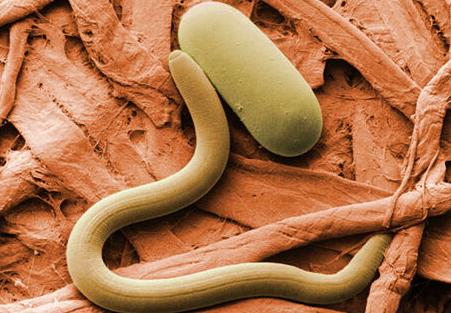
Even though roundworms are almost too small to be seen, they can pose major problems in corn, soybean, peanut and other crops. Collectively those roundworms are known as plant-parasitic nematodes, and they cause $173 billion in crop losses worldwide each year.
Those losses to crop yield and quality can occur even though chemical controls, resistant cultivars and other methods are available to farmers. So a team of U.S. Department of Agriculture Agricultural Research Service and university scientists decided to take a deeper dive into the basic biology of those nematodes and, more specifically, their genes for reproducing.
But the furtive nature of those millimeter-long pests and peculiarities of their lifecycle evaded the latest high-tech tools that the scientists had hoped to study them with.
Fortunately they found a "work-around" in the form of electroporation. In short, the technique involves immersing nematodes in a Plexiglas chamber with a buffer solution and pulsing it with small jolts of electricity. That stuns the creatures and temporarily opens pores in their bodies through which the solution's chief "active ingredient" can enter -- namely, bits of genetic material called NanoLuc luciferase mRNA.
Luciferase is an enzyme that oxidizes a compound called luciferin, producing a type of light called bioluminescence, such as that emitted by fireflies. In that instance, scientists "retooled" a luciferase coding sequence taken from a bioluminescent, deep-sea shrimp and electroporated it into the nematodes.
"Nematodes have primitive nervous systems," said Leslie Domier, a retired plant pathologist with the USDA Agricultural Research Service Soybean/Maize Germplasm, Pathology, and Genetics Research unit in Urbana, Illinois. "When they were electroporated, they were immobilized for up to an hour, but then recovered and behaved normally."
Scientists then harvested the nematodes so that the contents of their cells, including luciferase, could be blended into a mixture called a "homogenate." Next, they mixed the homogenate with a luciferin-like chemical called furamazine and presto -- bioluminescence achieved!
Rather than observe that with the naked eye, the scientists used biochemical assays and sensitive light-detecting equipment to gauge the strength of the homogenate's bioluminescence and determine how well their experiments had worked. So far the researchers have successfully electroporated luciferase mRNA into the likes of soybean cyst nematodes and root-knot nematodes -- both costly crop pests -- and Caenorhabditis elegans, a free-living species that doesn't require a host in which to reproduce.
According to Glen Hartman, another retired plant pathologist on the research team, the approach opens the door to introducing other synthetic mRNAs into nematodes to reveal how they change and where, as well as when the nematode's own genes are activated in cells.
There may be pest-control applications, as well. Electroporation could offer a way to rear laboratory colonies of soybean cyst nematodes that carry pieces of genetic code whose sole purpose is to skew the ratio of male-to-female offspring. In theory releasing those lab-reared nematodes to mate with those in the wild would eventually cause a generational population crash.
Domier said, "We hypothesized that if we could interfere with the sex determination in nematodes, we could reduce nematode populations below crop-damaging thresholds.”
That, in turn, could diminish the need for chemical controls or help prolong the effectiveness of elite, resistant cultivars favored by growers, among other potential benefits.
More details about the technique and its implications for nematode control were reported in the journal Molecular & Biochemical Parasitology by Domier, Hartman and co-authors Thanuja Thekke-Veetil and Kris Lambert -- both with the University of Illinois -- Nancy McCoppin of the USDA Agricultural Research Service, Reza Hajimorad of the University of Tennessee and Hyoun-Sub Lim of the Chungnam National University.
Source - https://agupdate.com