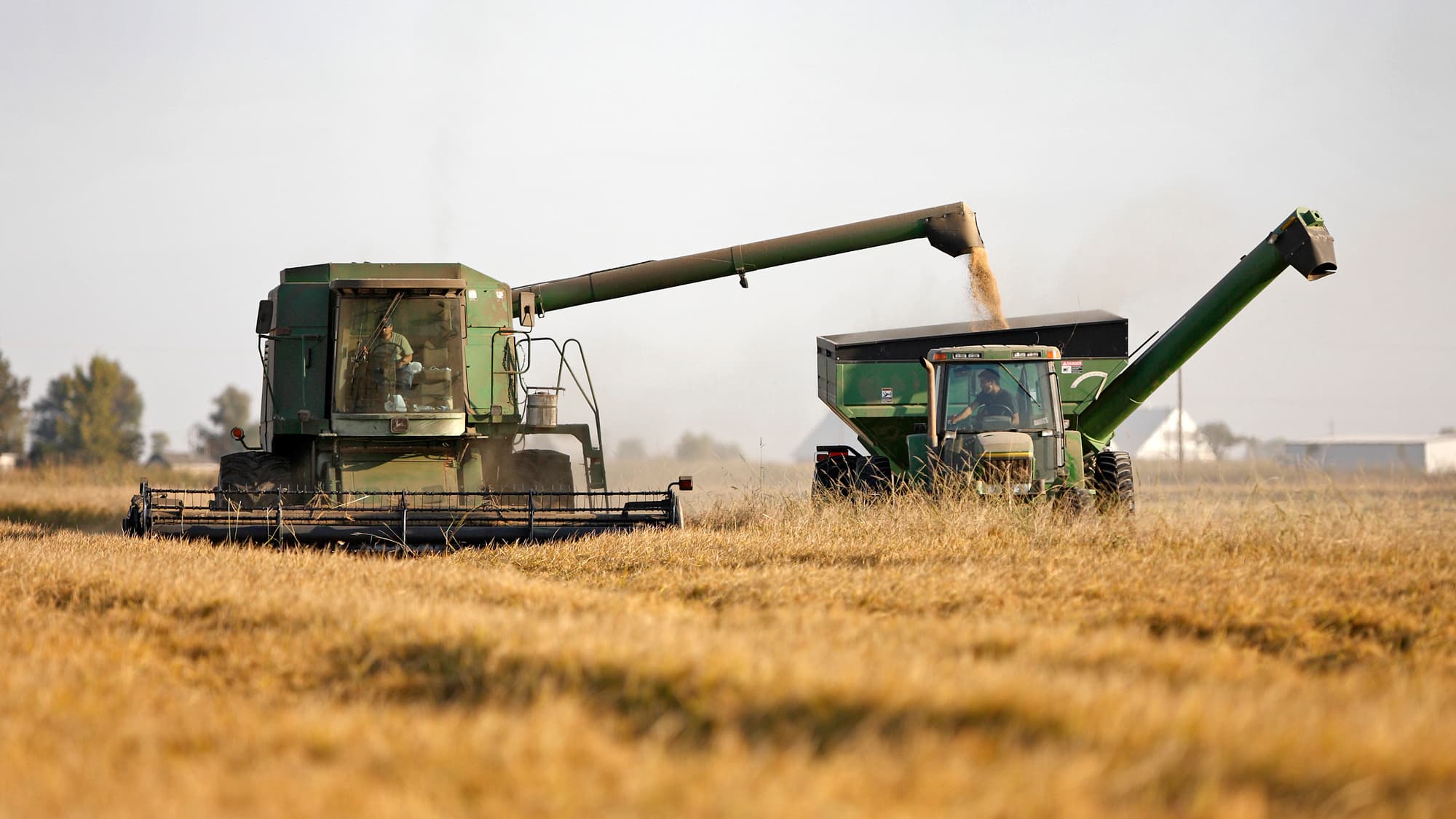
A sweeping law that governs crop insurance, conservation programs, and nutrition assistance is up at one of the toughest moments for farmers in recent memory.
Every five years or so, Congress considers, discusses, and eventually passes a new version of what’s known as the farm bill. It’s a simple name for a massive law that governs a lot of agricultural and food programs.
The farm bill sets the “rules of the road” for the food and farm economies, according to Michael Happ, program associate for climate and rural communities at the Institute for Agriculture and Trade Policy.
“It's got 12 sections or titles, things ranging from commodities and crop insurance to conservation and nutrition,” he said.
Nutrition programs, he said, help folks pay for food at grocery stores — part of farmers’ income — and policies in the farm bill set the payments and assistance some farmers receive.
Scott Myers and his family grow seven crops, including “a lot of hay,” at Woodlyn Acres, an organic farm in Ohio. When there was a drought last year, Myers said the farm lost almost half of the hay crop. But hay insurance, which is federally subsidized under the farm bill, made a big difference.
“It didn't make us money, but in the end, it did help bring us up to where we at least broke even for the year,” he said.
Not everyone is eligible for that type of support, though.
“I don't have access to any of that kind of a safety net in the farm bill,” said Hannah Bernhardt of Medicine Creek Farm in Minnesota. There, she raises grass-fed beef and lamb, and pastured pork. “The only place I can get some help from is through those conservation programs.”
Through one of the programs under the farm bill, she agreed to do adaptive rotational grazing, “which is really good for soil health. They would help me install permanent fences and water lines so that I could raise my livestock here.”
The debate over what should and shouldn’t be included in the next farm bill comes at a time that’s extremely tough for farmers, per Joe Maxwell, president of Farm Action Fund.
“We've had to face tariffs, which drove our largest soybean buyer — China — away, depressing our prices,” he said.
These days, the numbers just aren’t adding up, Maxwell added. “All of us are facing these higher fuel prices, fertilizer costs up, and it is beginning to be a challenge to see how much money is in the bank to carry you through a year.”
Maxwell said he expects bankruptcies to rise, though the University of California, Davis’ Dan Sumner pointed out that “consumer trends go up and down, and sometimes environmental problems hit and weather hits. So there are always farms struggling, and the farm bill isn't really addressed to those kind of struggles.”
But, Sumner added, the federal government has and could pass subsidies and spending outside of the bill to help farmers.
Source - https://www.marketplace.org