The old trailer with a floor made of wooden planks – packed with state officials troubled that many of the farm’s apples never had a chance this season due to a late frost – rolled up the slight incline on Friday, surrounded by small trees with bright green leaves that, nevertheless, looked naked.
Charles Souther, who, along with his wife, Diane, owns the Apple Hill Farm in Concord, sat up ahead, rumbling on a tractor with huge tires. The trees, lined up in formation like a platoon of well-trained soldiers, had suffered a shock to their systems four months ago when a night freeze ended fruit production cold.
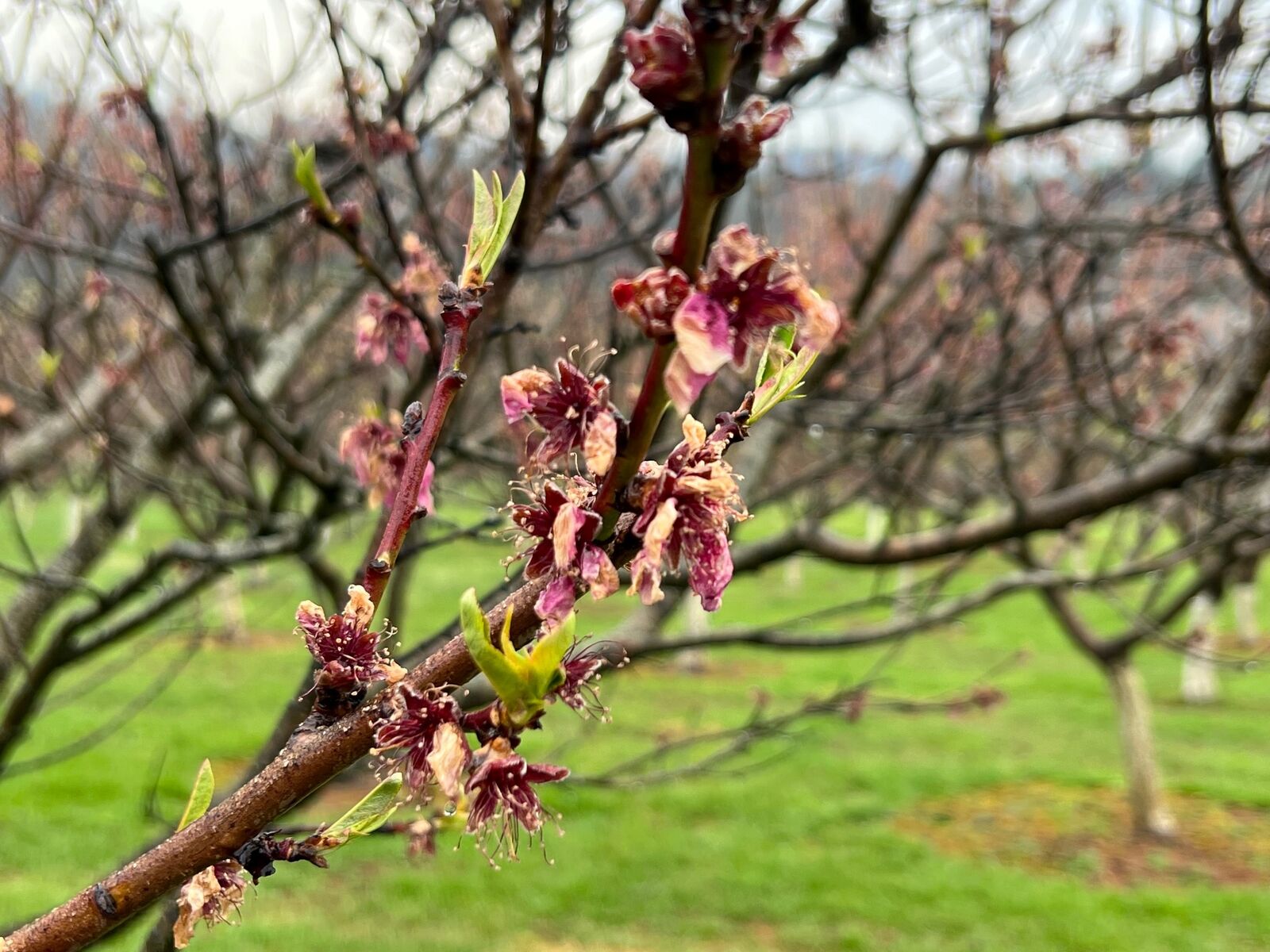
“It made it so we can’t pick our own apples, because we have no apples,” Diane Souther said. “Our entire crop was lost. The frost caused the apples to freeze and the trees aborted them and they dropped free.”
With climate change and the resulting weather extremes bouncing temperatures up and down like the stock market, the news has been filled the past few years with stories about floods, droughts, hurricanes and, in this case, spring frosts that have arrived later in the season and lasted longer than before.
This apple-killing villain moved in on the night of May 19. An official survey conducted since then estimated that the Granite State’s apple industry has lost $9 million due to recent events connected to the climate. In a normal year, the apple trees that cover 35 of the farm’s 200 acres would be loaded, almost ready for pies and lunch boxes.
“As you can see, there’s not an apple on a tree,” said Jeremy DeLisle of the University of New Hampshire Extension. “These were unprecedented temperatures that lasted, and that doesn’t usually happen. Trevor and I figured out that it started at 10 o’clock at night and it never stopped until 8:30, 9 o’clock the next morning, so we never had any kind of warm breeze or anything.”
DeLisle was referring to Trevor Hardy of Brookdale Farm in Hollis, another individual sizing up the damage while seated in the slow-moving trailer. Ideas were tossed around, about more funding and newer equipment and more crop insurance. Sen. Jeanne Shaheen was on board, showing concern for her state’s farmers.
Also on hand were reps from the Small Business Administration, Meadow Hill Farms, The New Hampshire Farm Agency, Sunnycrest Farm, the New Hampshire Farm Associates, and Poverty Lane Orchards.
Some of the apple orchards in the state suffered limited damage last May. Others were hit hard, like Apple Hill. A few apples remained at the tops of trees because of warmer air there. The final total of lost apples had still not been totaled.
“There’s no number yet, because what we’re doing is anything on the tops of the trees we’re picking and putting through our package systems,” said Dan Hicks, owner of Sunnycrest Farm. “But with frost rings and deformed apples, we won’t have those until the end. That’s what frost does. If it doesn’t drop a crop, it deforms them.”
While the climate has shifted in recent times, Diane Souther said this year’s long-lasting frost was something she hadn’t seen. “Not in our lifetime,” she said.
Added DeLisle, “I’ve been doing this for 40 plus years and have never been in a situation where they’ve had no apple crop, so this is relatively unprecedented.”
The consensus was that climate change has affected farm production. But rather than pointing fingers or debating its cause, the farmers and officials were discussing ways to adapt, certainly no easy task.
“For climate adaptation, we’re doing a lot of different things for vegetables,” Hardy said, “but we haven’t done a lot of new things for fruits and small fruits. It’s the way the national programs are written through the (Natural Resources Conservation Service), but their programs are not covering that. They’re only covering micro-irrigation because it is not a water conservation program, but it is a climate adaptation program.”
Shaheen was thanked for her efforts to support farmers and their apple orchards, but the problem persists. That was obvious on the slow ride on the old trailer.
Most individuals had no choice but to reflect on a night that had a profound impact on their lives. The freezing night of May 19, when no one knew they were about to be ambushed.
“Us in the southern part of the state were at eight or 10 millimeters in size and we didn’t think the cold air was going to have much of an impact,” Hardy said. “Two or three days later, Danny (Hicks) calls me and says, ‘Trevor, you cutting up any fruit?’ and I said, ‘No, why, should I be?’ We thought we were okay after that frost.”
Said Hicks, “That wasn’t a fun call to make, by the way.”
Source - https://www.concordmonitor.com