Air dancers. Propane blast cannons. Scary eyes. Effigies.
Farmers have come up with all kinds of solutions to reduce bird damage in sweet corn and other crops. But there’s a new option in this ongoing battle, thanks to research and development at the University of Rhode Island and field testing by Cornell Extension vegetable specialists in New York.
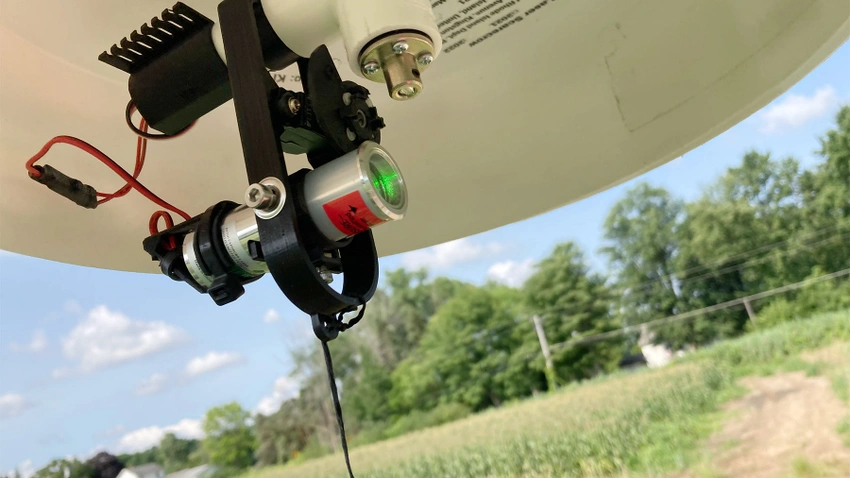
Rebecca N. Brown, plant sciences and entomology, and David H. Brown, computer sciences and statistics, both professors at the University of Rhode Island, designed and developed a 50-milliwatt green laser that rotates in a horizontal plane and moves vertically through a 45-degree arc from horizontal down to the ground.
The direction and speed of horizontal rotation is randomized to prevent birds from predicting the location of the laser beam. The laser moves through a full circle, but it can be programmed to turn off when it is pointed away from the crop.
“Birds learn to ignore balloons, effigies and propane cannons,” Rebecca says, “but they don’t get acclimated to the random patterns of the laser. Our conjecture on why the laser works is that the birds may see it as a solid object and move away from it. The primary effect is it stops the birds from perching on the corn.”
Initial findings from the Browns and other researchers show that a moving laser light appears to deter species such as geese, gulls, blackbirds, robins, cowbirds, starlings and cedar waxwings.
Deploying the units
The unit can be set to cover varying heights. For corn, it should be set to sweep across tassels to prevent birds from perching to feed. The beam can be angled to move across ground-level or sloping-field crops. An additional setting will move the light vertically.
Users should be aware that the URI laser scarecrow uses class 3b lasers that have the potential to cause eye injury. Eye protection should be worn when setting up the unit, and units should not be operated when anyone is in the field.
The laser beam is not visible to humans in full daylight, but it can cause glare if it strikes a windshield, so it should not be aimed across roads. The URI unit will not tilt up past horizontal and has an automatic off switch if the unit tilts or falls to keep the light from impacting aircraft.
The Browns developed the unit for use in smaller acres. Commercial designs for fields as large as 100 acres are not cost-effective for smaller areas.
“Our unit covers about 5 to 9 acres with a beam-effective radius of 300 feet, perhaps up to 600 feet, when mounted on an irrigation unit on a flat field,” Rebecca explains.
In 2021, the New York Farm Viability Institute provided funding for two years of URI laser scarecrow field testing by Julie Kikkert and Chuck Bornt, Cornell Extension vegetable specialists, and Marion Zuefle of the New York state Integrated Pest Management program.
Kikkert set up her field units with smaller, easier-to-handle 23-pound batteries rather than the large marine-type battery in the URI design.
“With so many sweet cornfields in New York less than 5 acres, the URI units were economical and easy to move to quickly cover the smaller acreages with multiple units,” Bornt says. “The larger commercially available lasers are hard to move and have to be either mounted on their own trailer or left stationary.”
“The farmers on our review panels were highly supportive of this project,” says David Grusenmeyer, executive director of the New York Farm Viability Institute. “They’ve seen how bird damage can affect many crops and wanted to understand if this laser-based approach might be a strong solution for New York-scale fields.”
In-field testing
“For more than 20 years, when I ask growers their main issue with sweet corn, the response is almost always bird damage,” Bornt says.
New York state grows more than 27,000 acres of sweet corn with a fresh market value of $22 million, making it the fourth-largest producer in the U.S., according to the U.S. Census of Agriculture. A Cornell survey notes that 84% of growers report bird damage with yield losses of 3% to 40% of their crop.
Kikkert says the institute-funded field trials allowed growers to see for themselves the laser setup and maintenance needed. On the plus side, the units worked well enough for some farmers to tell others about it. One grower thought that it helped deter crows from pulling early-germinated corn. Another felt that it decreased the number of bird flights into the corn.
On the other hand, one farmer did not consider the unit to be very useful. Another grower said that the light sensor did not turn the unit off at dusk and it ran all night, an issue that could be fixed.
“The Browns listened to growers and others on how to improve the unit’s functionality and durability, making the design progressively more user-friendly and sturdier, and not for use just in sweet corn,” says Bornt, who began working with lasers in 2017.
Growers throughout the Browns’ three-year development have tried laser scarecrows to reduce bird damage in grapes, blueberries and other specialty crops. Bornt worked with a grower who tested the unit to deter birds from pecking tomatoes and purchased a second unit just for use with his tomato crop.
There was even an unexpected result on one farm.
“One unit became available just as a grower with extreme bird pressure in August 2023 was finishing harvest in one field and about to move to the next,” Kikkert says. “He had already suffered $10,000 worth of crop loss. As I drove up to the farm about 4:30 in the afternoon, a huge flock of starlings was landing, and I thought there was no way we would see any success. But we set the unit up in the field that was ready to harvest, and we saw no bird damage in that field.”
Bornt had a similar experience where a bird invasion caused nearly 70% damage. “I knew we were not going to save that planting, but there might be a chance to save the ones next to it,” he says. “Damage there was reduced to less than 10%. The birds were still present in hedgerows and flying but were not landing in the corn.”
Most of the growers in New York tried the laser simultaneously with other deterrents.
Source - https://www.farmprogress.com