A new infestation of the pesky spotted lanternfly was discovered in Holyoke in late August, according to the Massachusetts Department of Agricultural Resources.
Holyoke is now one of a handful of cities and towns in Massachusetts contending with the invasive species that officials say should be squashed on sight. The colorful pests seem to be spreading in the state, and they can cause significant damage to fruit crops and other trees.
The new infestation is yet to be added to the department's maps charting lanternfly populations in the state. The agency issued an alert about the infestation in early September, notifying Holyoke residents that surveyors will check area trees for the bugs and that locals should report any sightings of them.
The discovery shows the bugs have spread around the state since the first individual lanternfly was found in Massachusetts in 2018, said Jennifer Forman Orth, a biologist with the agriculture department.
In addition to Holyoke, Springfield, Fitchburg, Shrewsbury and Worcester each face known infestations. (An infestation is defined either by multiple insects congregating or by discovering egg masses) Individual lanternflies have been found across the state from Berkshire County to Boston — and even on Martha's Vineyard.
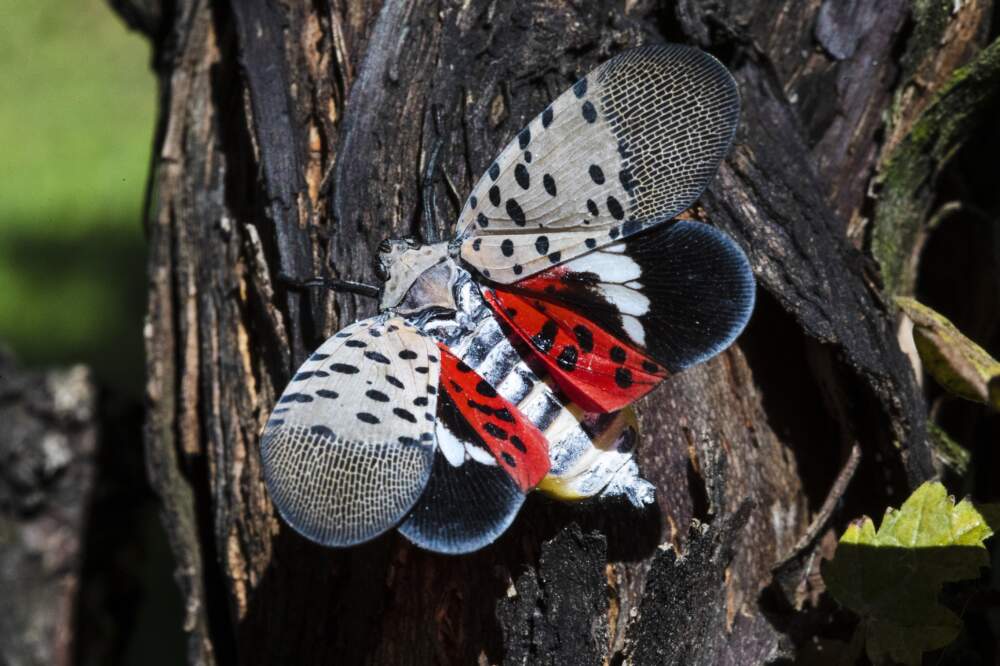
The lanternfly is about an inch long, with black-spotted wings and smaller, bright red underwings. And the species can cause a lot of agricultural problems.
Lanternflies eat sap inside trees or plants by jabbing their straw-like mouthpieces into tree trunks or plant stems. Their plant of choice is the tree of heaven (which is an invasive species as well), but they'll feast on other important New England trees and crops, including apple trees, grape vines, maple trees and hops. Their feeding habits damage plants and ultimately lead to crop loss.
When they feed, spotted lanternflies excrete a sticky, sap-like substance called honeydew that collects on surfaces, eventually fermenting and growing a smelly black substance called sooty mold fungi.
Honeydew and sooty mold fungi are not toxic to humans and won't immediately kill a plant, said Forman Orth, but the black fungi can make it harder for plants photosynthesize and more vulnerable to outside environmental impacts.
"If there's other environmental issues going on, like drought or flooding, or some other disease, then they're potentially going to be more susceptible to that," she explained.
Lanternflies also tend to swarm together, especially in late summer, which can be a problem for businesses that rely on outdoor events.
"There's a potential impact to orchards, especially any orchards that do pick-your-own-fruit type activities where they want the public to come out and enjoy the farm and be out in nature," said Forman Orth. "In states where they have major infestations, that swarming behavior of the lanternflies can make it really difficult to enjoy the outdoors."
Pennsylvania and New York are both dealing with large infestations of the pest. Officials in those states and from the U.S. Department of Agriculture are asking residents to squash the bugs whenever they get the chance. (You may have seen videos of people killing the pests on social media.)
"I think citizens are doing a great job and controlling the ones they can by stepping on them," said Brian Eshenaur, an invasive species specialist with Cornell working for the New York State Integrated Pest Management program. "They're not in every place yet, and we want to slow the spread as much as possible."
Lanternflies are originally found in China in a climate similar to that of the northeastern United States, and were first spotted in the U.S. in 2014. They lay masses of 30 to 50 eggs around late September or October. The masses are hearty enough to last through cold winters and hatch around April.
Eshenaur said it's too early to tell if the warming climate is having an impact on the species' spread, but that warmer springs could mean their eggs hatch earlier. He also noted that adults lay eggs until they die at the first hard frost, so a delayed start to the first frost because of a warmer fall season could make for a longer egg-laying season.
Spotted lanternflies are excellent hitchhikers, which is part of what makes them so difficult to contain. Despite their name, Forman Orth said they are not strong fliers, so any time they pop up in a new state or town that seems far from other infestations, it's likely they caught a ride there.
They climb onto people, clothing, wheel wells of vehicles or onto truck beds. They fly through open car windows. It's believed that the lanternfly first came to the United States on shipments of stone sent to Pennsylvania.
Eshenaur said part of the reason they're so good at hitchhiking is that spotted lanternflies are always on the move. The pests constantly need to feed and are in perpetual search for food.
He also noted that while the insect often lays its egg masses on tree bark or firewood, it can deposit eggs on nearly any surface.
"We have found that they will lay on camp chairs, on outdoor seat cushions," Eshenaur said.
If a lanternfly lays its egg mass on something that gets moved to a new location, it's possible that its eggs could hatch somewhere the species hasn't been found yet.
"If they're traveling on a vehicle or a shipment of wood or anything like that, then there's no finite limit to the amount of miles they can go. And that makes it very challenging to predict," said Forman Orth.
For that reason, she said people who live or work in places with infestations should check their cars for any nuisance hitchhikers before they leave the area. The agriculture department has a series of guides on what homeowners, landscapers, drivers and others can do to keep from carrying the lanternfly to new places.
Forman Orth emphasized that if Massachusetts residents see what they believe to be a lanternfly, they should take a photo and report the sighting via a form on the department's website.
"We're putting all of our efforts into trying to determine the extent of the infestation and when we can do that, then in some cases we are doing limited treatments of the lanternflies to try to knock the population back," said Forman Orth. "We need all the information we can in order to do that kind of management work."
Source - https://www.wbur.org