New LRP Coverage Aims to Reduce the Risk of Retaining Heifers for Breeding.
Following a week of beef import and meat-processing fights, the U.S. Department of Agriculture on Monday announced new incentives for ranchers to retain heifers through the Livestock Risk Protection (LRP) program.
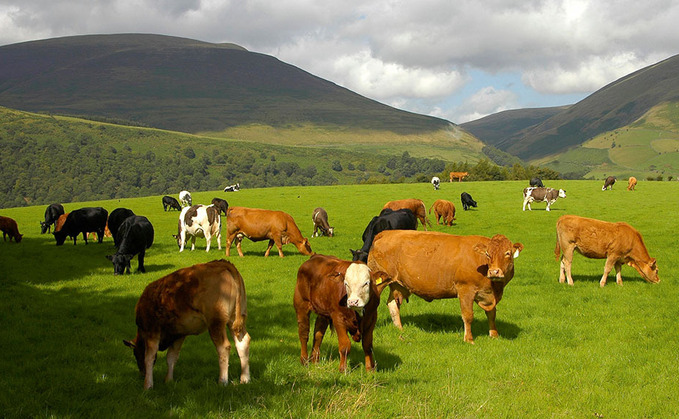
The livestock insurance program will now protect a heifer's value based on its expected slaughter value at the time of enrollment to "insure the economic value of retaining a heifer for breeding over a two-year period."
The endorsement is called Beef Retention and National Development, or BRAND.
Under the new endorsement, if at any point a heifer's projected or realized slaughter value exceeds the economic value of retaining the animal as breeding stock, the insurance policy would pay the difference.
By encouraging ranchers to retain heifers rather than send them into the beef supply chain, USDA hopes to increase the number of breeding cows and, ultimately, the number of calves produced by the U.S. cattle herd.
The endorsement for heifer retention insurance does not yet have a rollout date.
LRP policies cover a price range of 70% to 100% of the expected ending value of cattle.
Used more heavily for feeder cattle than fed cattle, participation with feeder cattle rose sharply in recent years, reaching 6.11 million head in 2025, or 6% of the U.S. beef herd.
Nearly 50% of policies come from five states: Nebraska, South Dakota, Texas, Kansas and Oklahoma.
According to 2026 Risk Management Agency estimates, roughly 570,000 fewer feeder cattle are insured this year, yet the value protected by those policies is more than $1 billion higher.
The agency included the actions as part of its "Ranchers First Initiative Actions."
Today's announcement included notice that USDA will allow producers to use the Emergency Conservation Program, or ECP, on Grassland Conservation Reserve Program, or CRP, acres to speed recovery after wildfires and other natural disasters.
"40% of those acres, about 11 million, are currently enrolled in that grassland CRP. But as of today, we are prioritizing the enrollment of an additional 1 million new grazing acres into that grassland CRP to provide new space to grow our great American beef herd," USDA Secretary Brooke Rollins said Monday afternoon in Nebraska.
Ranchers can repair fencing, water infrastructure and other grazing-related infrastructure more quickly, reducing the risk that disaster damage takes land out of production for an extended period.
The agency also added guaranteed loans to its Strengthening Processing for U.S. Ranchers (SPUR) program, which offered $500 million in payments to processors to offset higher cattle acquisition costs in June.
When the president expressed interest in changing federal meat-processing regulations to challenge the control of the Big Four packing firms last week, Agriculture Secretary Brooke Rollins wrote on social platform X, "We're on it Mr. President!", adding that "big announcements" were starting Monday.
No comments and actions were provided on meat processing de-regulation as of Monday night.
Rollins said more would come this week, plus an end of week announcement with the President.
Rollins said they would include waiving red tape in processing, expanding ranchers' ability to sell across state lines, rescinding outdated guidance, adding technology for faster safety data, growing real support for small processors through funding and deregulation, fighting consolidation so small processors can compete and expanding truth in labeling.
Despite the perception that farmers lack local control over meat processing, DTN's Chris Clayton wrote last week, "Farmers already can slaughter livestock for their own household consumption under federal law. The larger regulatory issue is whether meat processed outside a federally inspected facility can be sold to consumers, restaurants or retailers -- particularly across state lines."
Source - https://www.dtnpf.com