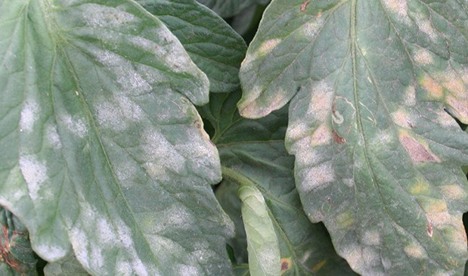
Leaves on infected tomato plants develop irregular, bright yellow blotches; severely affected leaves die but seldom drop. Spots of dead tissue, sometimes surrounded by a yellow halo, eventually appear in the blotches. Abundant white sporulation may be observed on upper or lower leaf surfaces. There are no lesions on stems or fruit. As the disease progresses, leaves die, resulting in sunburn damage on fruit, reduced soluble solids, and weakened plants.
Comments on the Disease
Powdery mildew occurs in most tomato-growing areas of California. The fungus infects weeds and crops in the solanaceous family; spores are carried by wind to tomato plants. The disease usually is most severe late in the season. High relative humidity favors disease development. Mild temperatures favor infection, while higher temperatures hasten the death of infected leaves. Plants stressed by other problems appear to be more susceptible to powdery mildew.
Management
When conditions are conducive to disease development, and sporulation is abundant, fungicide applications may be necessary to control powdery mildew.
Organically Acceptable Methods
Some sulfur sprays may be acceptable for use on organically certified produce. Check with your certifier before use.
Monitoring and Treatment Decisions
A weather-based forecasting model is available online. The model attempts to predict the occurrence of powdery mildew based on temperature, relative humidity, and leaf wetness. However, since 2007, the disease has been more severe and faster developing such that disease severity and fungicide timings have not been well predicted by the model in recent years.
Fungicides may not be needed on early-season crops harvested in July or August. In the Central Valley, disease outbreaks generally start in July or August and mainly affect plants that are in full bloom or a later stage. Multiple early applications of sulfur dust are the most effective option; once the disease becomes severe, control is difficult. Apply fungicides if needed preventatively or during the early infection period. When disease pressure is high, repeat fungicide applications at 7-day intervals to control the disease. Stop treatments within two weeks of harvest.
There are no immune tomato varieties in California, though varieties vary in susceptibility.
Source - https://www.freshplaza.com