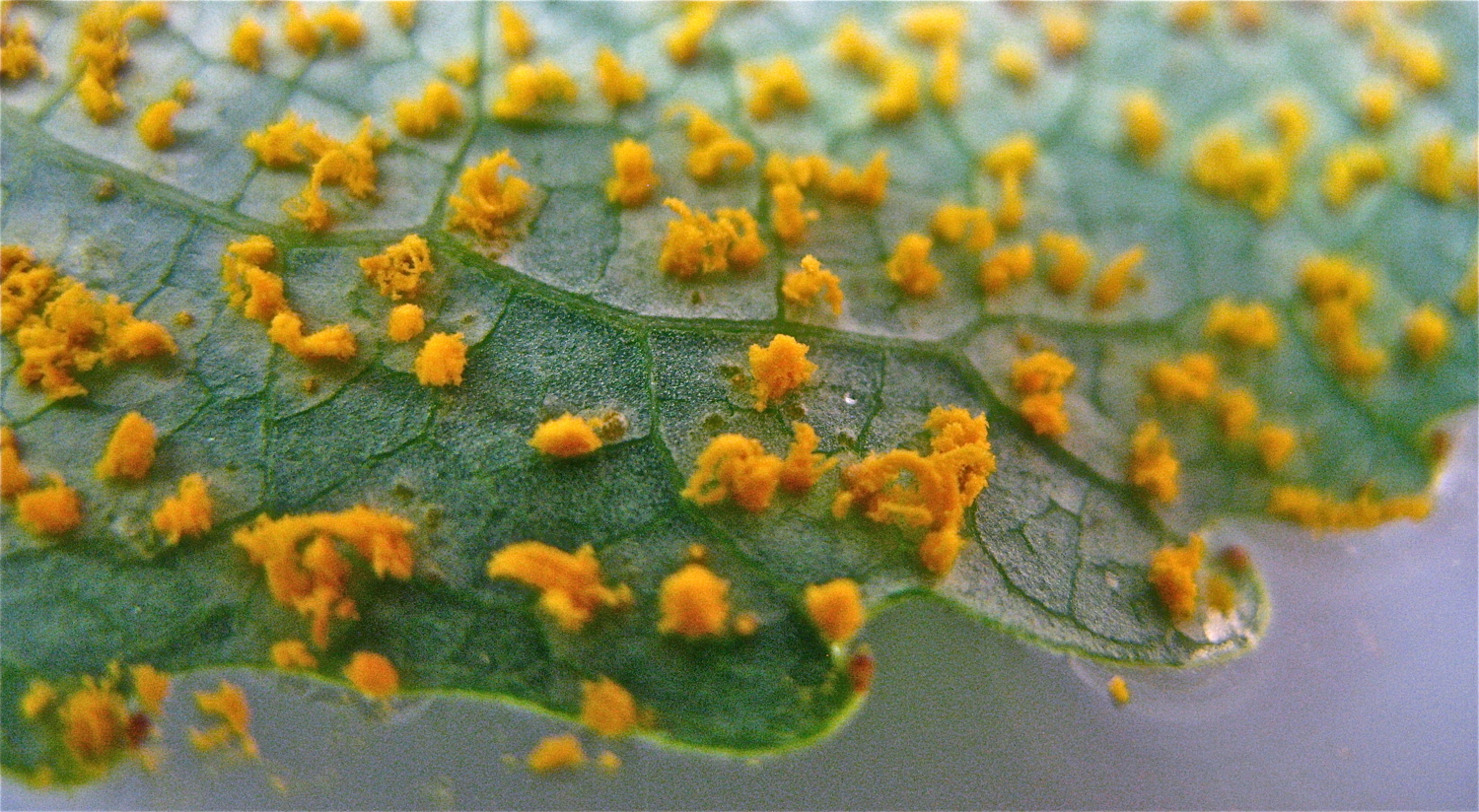
Scientists at the U.S. Department of Agriculture’s Agricultural Research Service have put the spotlight on a fungus that causes one of the world’s worst wheat diseases. They found that fungus can sense light and alters its expression of genes depending on the color of the light.
“Septoria tritici blotch is a major disease of wheat that causes millions of dollars in crop losses around the world every year,” said Stephen Goodwin, plant pathologist at the USDA Agricultural Research Service Crop Production and Pest Control Research unit in West Lafayette, Indiana. “Better understanding of the basic biology of the fungus that causes this disease could lead to improved methods to reduce losses in the future.”
Scientists have long known that plants, animals and many fungi can sense and respond to light, but almost nothing is known about whether the fungus that causes septoria tritici blotch has that ability. To test whether that fungus -- Zymoseptoria tritici -- can sense and respond to different wavelengths of light, Goodwin’s team grew cultures under white, blue and red lights and compared them to control cultures grown in darkness.
Test results showed large differences in gene expression among the treatments, proving that the fungus can sense and show different responses depending on the wavelength of light.
“Some of the genes with strong responses are known to be important for pathogenicity to wheat, indicating that light could be important for the infection process,” Goodwin said. “Many of the genes involved have no known function, so the complete nature of the responses remains unknown. But knowing that light is important for the biology of this fungus could help guide the development of improved methods for disease control in the future.”
Septoria tritici blotch affects most wheat production areas worldwide, Goodwin said.
“Resistance genes and fungicides can manage disease, but the fungus can quickly evolve to overcome them, so new methods are always needed. Knowing that the fungus can sense and respond to light provides another area of its biology that we could target to understand the mechanisms of host defense and to design new fungicides.”
According to Goodwin, crop losses to septoria tritici blotch average three percent to five percent per year in the United States but are much greater in Europe and Africa. In 2021 U.S. wheat crop loss to the disease was estimated at $357 million; growers in Europe lost about 720 million Euros -- about $800 million -- in 2015.
“Our experiment was the first step in understanding the photobiology of this pathogen,” Goodwin said. “We now need follow-up experiments to see how these genes are expressed on the plant and to better understand the timing of their expression and its relation to the disease process.”
Goodwin believes his experiment could guide future research. Specifically he said scientists need to learn how light affects gene expression during a 24-hour cycle, about the speed of the response, how much exposure to light is required to trigger a change, and which proteins act as light receptors and how they transmit signals to alter gene expression.
“Although we assumed it was true, it is good to now have proof that this fungus can sense and respond to light,” Goodwin said. “Photobiology of plant-pathogenic fungi is not well understood. Most people know that plants respond to light, but probably are not aware that fungi also are affected by light, even though they do not use it for photosynthesis.”
Source - https://agupdate.com