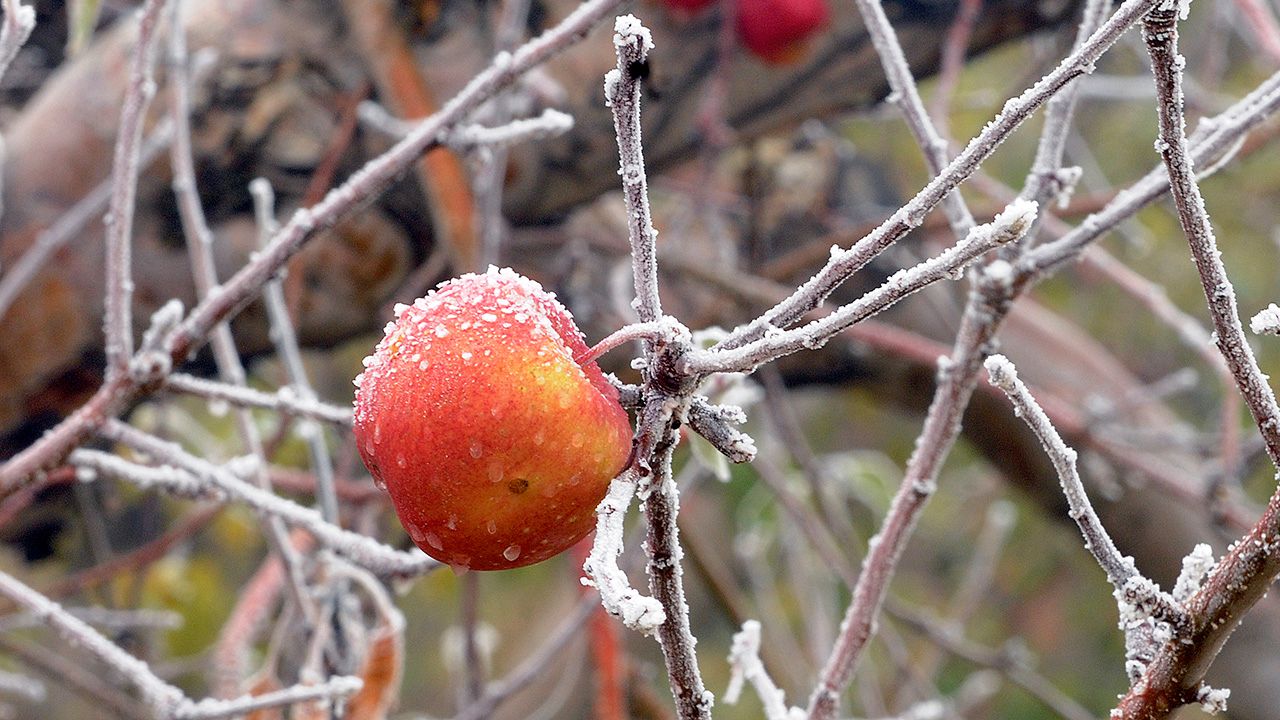
On the night of May 17, the temperature plunged to about 25 degrees at Scott Farm in Dummerston, where they grow some 130 varieties of heirloom apples. That’s low enough to kill nearly all of the young fruit on an apple tree.
The air died down and the cold settled like a rock across these gentle sloping hillsides above the Connecticut River.
The orchard lost about two-thirds of their apples.
“It honestly was a heartbreak I’d never experienced,” said Erin Robinson, the orchard manager.
“I have children, and I love my children more than anything in the world, and this orchard is right behind them,” she said.
Some of the apples have deep slits, like a bear clawed the fruit and it’s trying to grow back, and some just have slight frost rings around the bottom.
There are rows of trees without a single apple on them, or clumps of small, misshapen fruit, while some varieties thrived with all the rain this summer.
Robinson had to cancel all of her pick-your-own business, but she’s still hoping visitors come out this fall to visit the market on the orchard.
But that’s not normal either. “Because that gaping hole of no peaches, no plums, no fruit, no cider,” Robinson said. “And having to apologize to the people who are, ‘Where is your sweet cider?’ You know, I would love to have sweet cider for you, but my hands are tied. So it’s a humbling experience.”
Across the state, every orchard looks a little different.
“I’m not really seeing a good pattern here,” said Terence Bradshaw, a tree fruit specialist with the University of Vermont Extension program. “I’ve seen growers who have no honeycrisp, and I’m seeing orchards with a full crop of honeycrisp.”
He estimates the state probably lost more than half its apples overall, but not evenly.
Orchards down in the Champlain Valley, along the lake, stayed just slightly warmer and did OK, while some orchards in colder pockets of the state lost almost all of their crop.
“This is the most devastating freeze I’ve ever seen, and most growers I’ve talked to have ever seen,” Bradshaw said.
But he thinks it could have been even worse.
“If trees read text books, we should have almost nothing in the state, but they didn’t read the text books. And so we are seeing some fruit,” Bradshaw said.
Like at Whitman Brook Orchard in Quechee, first planted a century ago, which now has over 140 apple varieties.
They still had flowers on most of their trees when the May frost came.
“What had been this vibrant white bloom was just starting to fade. And then you could see it browning and dying,” said Terry Dorman, the owner and manager of the orchard.
He says that was in the lower parts of their fields. Higher up, temperatures didn’t get as cold and some of the trees hadn’t yet flowered.
Over the next few months, trees dropped apples prematurely, fruit looked ripe when it wasn’t, a few trees were almost all bare. But overall, they fared well.
“We have a reasonably good crop. We’re thinning apples this morning,” he told Vermont Public at the end of August.
Other apple growers were barely hit by the frost.
“Today I’m painting signs, my husband is out there mowing the lawn. We’re getting everything ready,” said Christine LaFreniere, the owner of Monkton Ridge Orchard.
She’s expecting a busy U-pick season.
“It’s actually a heavy crop,” LaFreniere said.
“There is one thing that I’ve noticed — that on one tree, you’ll have apples that are very different sizes. You’ll have some really big apples, you’ll have some really small apples. But there’s a lot of apples — a lot.”
Every orchard is making the best use of whatever apples they have.
At Whitman Brook, fallen fruit that's not damaged will go to local food shelves though the nonprofit Willing Hands.
The apples that aren't fit for people to eat will feed bear cubs at the Kilham Bear Center a few towns over in New Hampshire.
In Dummerston, at Scott Farm, manager Erin Robinson says there’s not a perfect apple in the orchard. But whatever they have should be treasured.
“We’re going to just sell what we have, informing people about what happened and to be open-minded to the fruit,” she said.
“They are certainly champions in their own right, that they’ve made it as far as they did.”
Source - https://www.vermontpublic.org