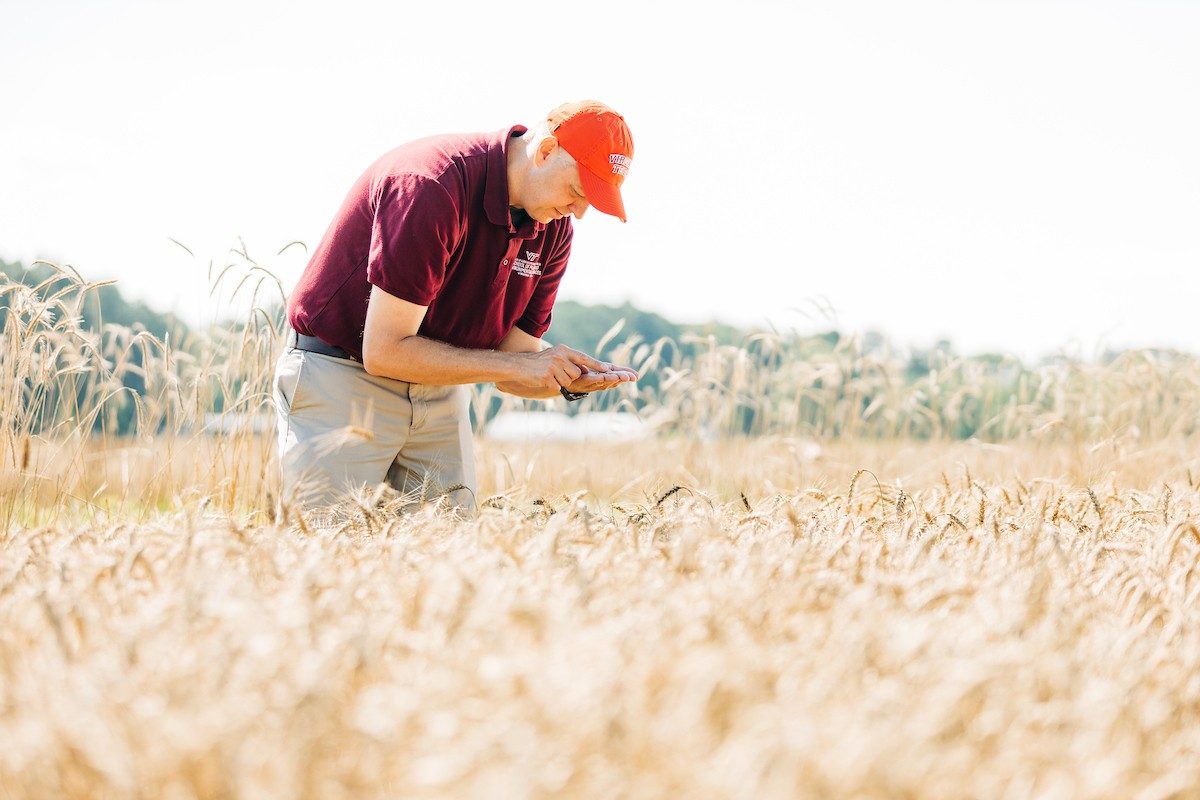
The $80 million USDA-funded project — the largest grant in Virginia Tech’s history — provides financial support for farmers in selected counties in four states to implement agricultural practices that protect water, soil, and air.
The Alliance to Advance Climate-Smart Agriculture at Virginia Tech enrolled over 1,300 farms representing more than 202,000 acres in the first year of a landmark project that incentivizes agricultural producers in four states to adopt climate-smart practices.
The project, led by Virginia Tech’s College of Agriculture and Life Sciences and funded by a historic $80 million grant from the U.S. Department of Agriculture, is a three-year national pilot program that aims to enroll 4,500 producers representing over 470,000 acres of farmland in Arkansas, Minnesota, North Dakota, and Virginia. At least 40 percent of the program’s participants – or more than 1,800 – will be historically underserved producers. Producers on farms of all sizes and commodities receive $100 an acre or animal unit to implement sustainable practices that can boost crop yields, build climate resilience, and protect soil, water, and air quality.
“We are thrilled that this program has had such substantial reach in its first year,” said Tom Thompson, principal investigator on the project, associate dean of Virginia Tech’s College of Agriculture and Life Sciences, and director of CALS Global. “This program not only provides farmers with the financial support they need to transition to climate-smart practices, but also sets a powerful precedent for what’s possible on a national scale. Our hope is that this project will generate innovative ways to incentivize and reward farmers for adopting agricultural practices that protect the soil, water, and air.”
Producers interested in joining the program should sign up for the Alliance Newsletter to learn about upcoming application periods and meetings in their states.
The program’s first round of applicants is receiving over $18 million in federal funds to employ practices that include no-till farming, precision nutrient management, prescribed grazing, conservation crop rotation, pasture and hay planting, and comprehensive manure management. Over the program’s three-year duration, a total of approximately $57 million is expected to be distributed. Eighteen state and national partners are working on the ground to support farmers throughout the process.
If scaled up nationally, the program could help producers reduce agricultural emissions by 55 percent and total greenhouse gas emissions in the United States by 8 percent after 10 years. Currently, only about 3 percent of producers participate in carbon reduction programs, mainly due to the high costs of implementation.
“This program got me to do something I probably wouldn’t have done because of the expense of complying with all the recommendations,” said Rob Harrison, who raises cattle in Albemarle and Louisa County, Virginia, and is enrolled in the program. “When you do conservation, you’re not just helping yourself, you’re helping everybody.”
Harrison had already taken measures to fence and protect streams near his cattle farm. With payments from the Alliance to Advance Climate-Smart Agriculture, he was able to work with experts to develop a nutrient management plan that will optimize farm yields while also delivering environmental benefits.
“Farmers get kind of a bum rap on carbon emissions,” he said. “I’m interested in seeing more data from this study on what kinds of biomass the cows are producing and what’s happening to the soil, water, and air.”
In addition to payments to farmers, the grant also funds research and outreach activities led by Virginia Tech to:
- Measure and verify total net and gross greenhouse gas benefits resulting from climate-smart investments.
- Quantify in dollar value the public benefits of climate-smart practices.
- Investigate consumers’ willingness to pay for various climate-smart labels.
- Test the feasibility of a certificate program for climate-smart producers.
- Train producers to assess and report greenhouse gas emissions using the Carbon Management Evaluation Tool (COMET) and Field to Market’s Fieldprint Calculator.
- Build a network linking climate-smart producers with companies and organizations interested in paying for certified climate-smart commodities.
- Develop a tool to model the environmental, public, and economic benefits of climate-smart livestock practices by region.
- Reduce barriers to farmers’ implementation of climate-smart practices.
“As farmers work to meet the needs of a global population expected to exceed 9 billion by 2050, it’s clear that supporting them in adopting climate-smart practices is not just an environmental imperative — it’s an economic necessity," Thompson said. “By incentivizing climate-smart practices today, we’re not only protecting our planet for future generations, but we’re also helping to ensure that farmers can continue to produce the food, fiber, and fuel the world will need in the decades ahead. This initiative is a model for the future of agriculture — a future where innovation, sustainability, and productivity go hand in hand."
In addition to Thompson, Virginia Tech faculty leading the research include:
- Mark Reiter, professor and director, Eastern Shore Agricultural Research and Extension Center
- Elinor Benami, assistant professor, Department of Agricultural and Applied Economics
- John Bovay, associate professor and Kohl Junior Faculty Fellow, Department of Agricultural and Applied Economics
- Wei Zhang, assistant professor, Department of Agricultural and Applied Economics
- Robin White, associate professor, School of Animal Sciences
- Ryan Stewart, associate professor, School of Plant and Environmental Sciences
Source - https://news.vt.edu