USA - Wild weather ride affects Minnesota apple volume

22.11.2023 600 views

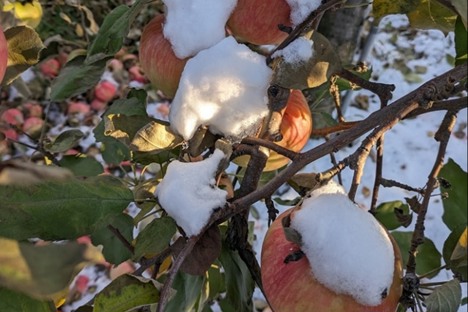
Following good spring bloom weather, Minnesota saw a roller coaster of weather events this season and in turn, its apple crop is down. “It was a difficult growing season,” says Aaron Brand of Brand Farms in Farmington, Minnesota. “We were very dry all summer--once we got into the middle of June, the rain shut off and I didn’t have any rain between early July until harvest. Then the first rain we had was in harvest season and it was almost four inches in 12 hours. We saw it coming and we picked as hard as we could."

That meant at harvest time, Brand Farms had two instances where there were five to six days where that rain impacted the ability to harvest. Add to this that September in Minnesota was one of the hottest on record.

That did leave some fruit with issues. “Some of us have never seen cracking on the fruit so bad--especially on the SweeTango and the Honeycrisp varieties. I’d never seen the fruit split in half like that,” Brand says, noting that his farm doesn’t have irrigation. He does add that growers who did have irrigation didn’t experience cracking to the same degree, though it still happened.

Freeze at the end
Then, in the last week of October and into November, the first freeze hit though that was later than usual. “That side of things in the fall isn’t that big of a problem. We had most of the fruit off anyways and what’s on there at that time isn’t worth harvesting like split Honeycrisps,” he says, noting that the end of the season also saw some hail.

In Minnesota, the state doesn’t send much of its fruit to the commercial marketplace as much as powerhouse apple-producing states such as New York or Washington do. “We’re more on the direct-to-consumer, U-pick/agritourism side,” Brand says. In turn, the state still has many of its older varieties growing such as Haralson, Honey Gold, Fireside, SnowSweet, Cortland, Zestar and more.

As for demand for apples, it looked similar to last year and pricing for Brand Farms was also similar to last year, in part to accommodate a crop that saw hail late into harvest.

Source -https://www.freshplaza.com

02.09.2026

Philippines - Bayambang declares state of calamity over P31-M agricultural losses

The municipal council of Bayambang has placed the town under a state of calamity after Tropical Storms “Luis” and “Maymay” and the enhanced southwest monsoon, or habagat, caused more than P31 million in agricultural losses.

02.09.2026

USA - Lynndyl farmers assess crop losses after 100 mph winds and hail

Farmers in and around Lynndyl are beginning to assess severe losses after a powerful weekend storm ripped through fields with destructive winds and hail just as some crops were nearing harvest.

02.09.2026

USA - New Insurance for Breeding Heifers

New LRP Coverage Aims to Reduce the Risk of Retaining Heifers for Breeding.

02.09.2026

Corn's $6 Surprise Could Change the Profit Math for U.S. Farmers

Corn may already be worth more than the board suggests as farm payments and incentives add about 52¢ per bushel to producer revenue.

02.09.2026

Philippines - Iloilo turns over P10M for farm, fishery insurance

The Iloilo provincial government has turned over P10 million to the state-owned Philippine Crop Insurance Corp. (PCIC) to expand insurance protection for farmers and fisherfolk vulnerable to losses from El Niño, La Niña, typhoons, pest infestations and other calamities.

02.09.2026

India - AP sees 1,263% rise in non-loanee crop insurance

The State witnessed a remarkable 1,263% jump in non-loanee farmer registrations, with their participation rising from 2 lakh in the previous Kharif season to 25.26 lakh farmers this year.

01.09.2026

South Africa - Grain SA calls for affordable crop insurance as dry weather threatens Swartland wheat

Severe rainfall shortages threatening the Swartland wheat crop have highlighted the need for government support to make crop insurance affordable for dryland producers.

01.09.2026

USA - Florida farms face nation’s highest disaster loss rate

Natural disasters destroy billions of dollars in U.S. agricultural production each year. From drought and wildfires in the West to hail in the Midwest and hurricanes in the Southeast, farms lose an average of $5.1 billion in crops and livestock annually, according to the Federal Emergency Management Agency.