The wave of atmospheric rivers that swept across the state this winter has created the right conditions for plant pathogens that haven’t been seen for decades in California. University of California, Davis, plant pathologist Florent “Flo” Trouillas is getting more calls from growers and farm advisors concerned about potential crop damage.
“Generally, whenever you have rain events, you’re going to have problems,” said Trouillas, a Cooperative Extension specialist who is based at the Kearney Agricultural Research and Extension Center in Parlier. “In wet years we get really busy because most pathogens need and like water.”
Trouillas is like a disease detective. He splits his time between the field and the lab, working to diagnose pathogens, diseases and other ailments that strike fruit and nut crops such as almonds, cherries, olives and pistachios.
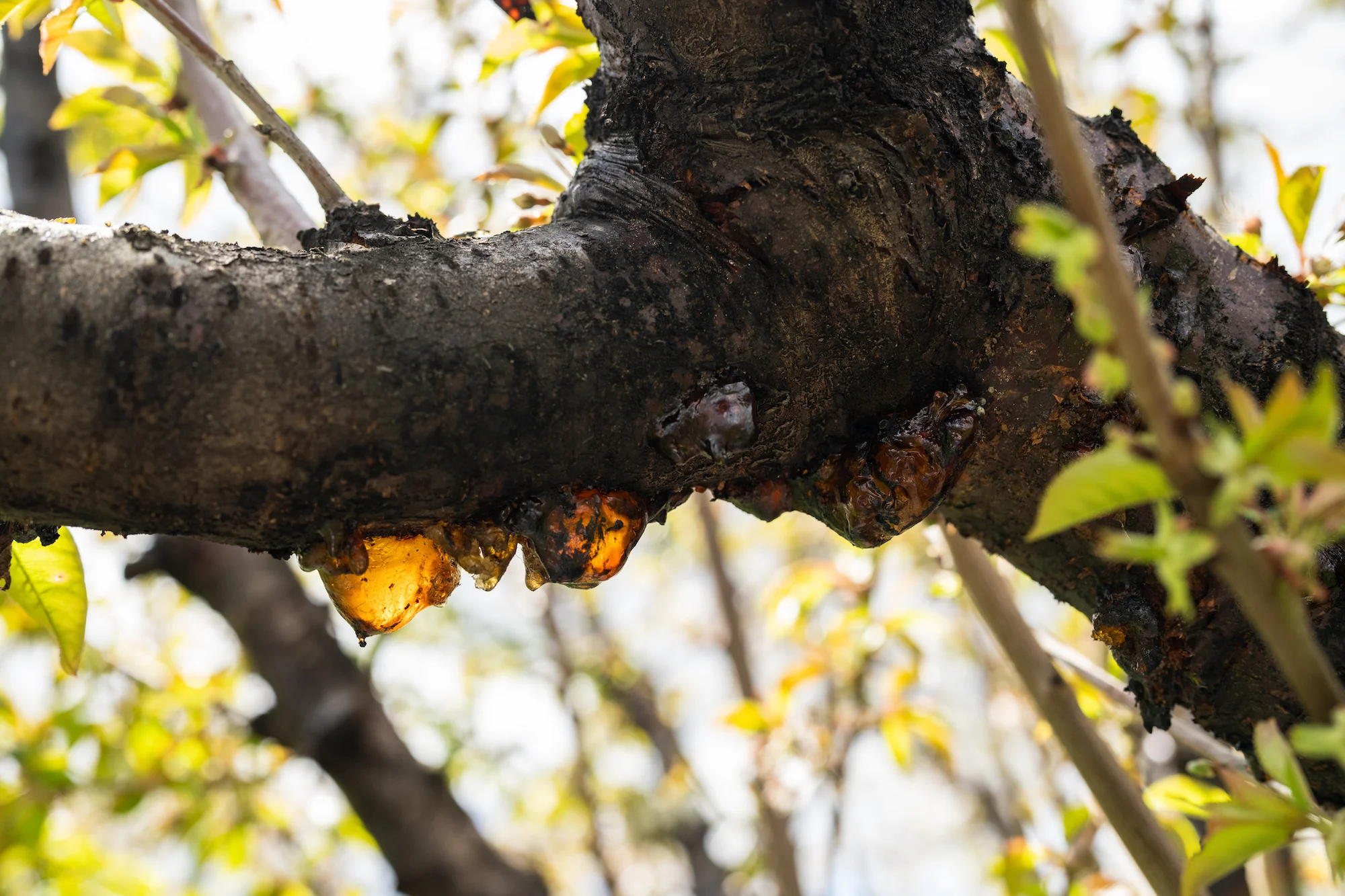
On a recent visit to an almond orchard near Fresno, Trouillas joined Mae Culumber, a nut crops farm advisor for UC Cooperative Extension Fresno County. A few weeks earlier, the two had walked the orchard, taking note of the base of some trees that had gumming — a thick, jelly-looking substance indicating a pathogen had taken hold.
“A lot of what Florent is doing is trying to assess patterns on a landscape,” Culumber said. “Sometimes things may look like they are one thing, but it could be another problem.”
When the two returned weeks later, the amber-colored gumming had moved into the canopy, looking like gumballs stuck to branches, some of which were already dead. “It’s getting out of control from before,” Trouillas says. “This branch was killed. This is widespread.”
From the field to the lab
Lab testing confirmed what Trouillas believed was the culprit: Phytophthora syringae, a pathogen that can affect almond crops but is rarely seen in California. If it is found, generally the site of infection are wounds caused by pruning, but that is not the case here, where the infection began in the canopy at twigs, or small branches.
It is a threat to a key crop, which according to the California Department of Food and Agriculture, generates $5 billion annually. The last time Phytophthora syringae hit California was in the 1990s after a series of El Niño-influenced storms. Trouillas, who has a photographic memory, remembered reading about it in an old manual.
“It’s rare for California and one that we see mostly following atmospheric rivers,” he says.
“The disease will only happen following these extremely wet winters.”
Phytophthora is soilborne, mostly found in tree roots, and doesn’t generally spread up into branches. But the intense storms created the right conditions for the pathogen to “swim” up trunks as winds blew spores into the air and rain dropped them back down into the canopy, Trouillas said.
Some of the trees in this orchard will die; others can be saved by pruning infected branches and applying a recommended fungicide, he said.
Identification, diagnosis, education
Trouillas is one of more than 50 Cooperative Extension specialists at UC Davis and each is charged with identifying problems and developing solutions for those issues in support of agriculture, the ecosystem and communities throughout the state.
In his role, Trouillas focuses not only on pathology and research but also on educating growers, nursery staff, pest control advisors and others in agriculture about ways to manage potential threats and how to prevent crop damage.
“His role is very crucial,” said Mohammad Yaghmour, an orchard systems advisor for UC Cooperative Extension Kern County. “He’s not only on this mission to educate growers but he’s also a source of education for us.”
Trouillas typically conducts one or two site visits a week, usually after a farm advisor reaches out about a problem they can’t solve on their own.
“This allows us to be at the forefront of disease detections in California,” he said.
He likens these visits to house calls a doctor would make, only to fields instead. And one of those calls recently took him to a cherry orchard in Lodi.
“These guys help me quite a bit,” said Andrew Vignolo, a pest control advisor with Wilbur-Ellis who asked for a consult. “I bug them a lot.”
The visit starts like any consult in a doctor’s office, only the questions come fast as they walk around the Lodi orchard where branches are dying, there is gumming and the trees appear stressed. Some look to be sunburned from exposure. Old pruning wounds show cankers, indicating that past disease treatments didn’t get rid of whatever was affecting the trees.
Trouillas asks about the cultivar of the trees because some varieties are more susceptible to pests or diseases. He focuses on stress because that opens the door to disease.
Do they prune in the dormant winter months or in summer when pathogens are more prevalent? Does the soil get tested? How old are the trees? What about nutrition?
“I’m trying to figure out how they got infected so bad,” Trouillas said, walking the orchard. “Bacterial canker is a very mysterious disease.”
He thinks it might be a bacterial canker disease and shaves some bark to take to the lab for testing. He wants to come back next winter to take some samples to see where the pathogen is overwintering.
“We’ll know in a few weeks if we have a fighting chance,” Vignolo said.
Be it Lodi, Fresno or elsewhere in the state, Trouillas focuses on local conditions. But what is learned in one field can be passed on to others, providing early warnings or advice for those in similar situations. “All these efforts at collaboration, from the field, to the lab, going through research projects, there’s only one goal here — to help the farmers of California.”
Source - https://www.ucdavis.edu