The harvest of white cabbage in Uzbekistan was seriously affected due to the abnormal cold in Central Asia in January of this year. As a result, cabbage prices rose sharply, and the export volume decreased by more than twice compared to the same period last year.
In Uzbekistan, seedlings of winter white cabbage are planted mainly in August, and, depending on the variety and the vegetation period, the harvest is from November to April of the next year. Early varieties are harvested in November-December, mid-season varieties are harvested in January-February, and late varieties are harvested in March and early April of the next year.
From the beginning of November 2022 to the end of the first decade of January 2023, white cabbage in Uzbekistan was harvested as usual, but the cold air mass that covered the entire territory of the country changed this and caused huge losses of white cabbage that had not yet been harvested by that time.
We remind you that anomalous cold weather was observed in Uzbekistan on January 10-16, 2023, with the air temperature in the country’s capital dropping to -13 C in the daytime and to -17 C at night. Starting from January 17, there has been a gradual warming – up to the 25th of January, the temperature was slightly above zero in the daytime and dropped to -7 Cat night.
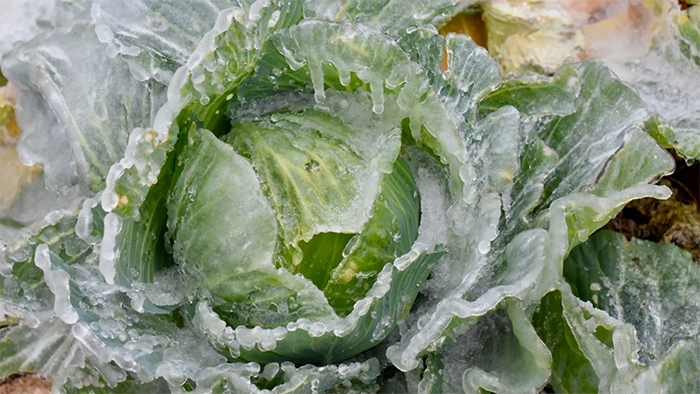
Due to the prolonged exposure to low temperatures, most white cabbage that had not yet been harvested by that time froze in the fields. With the onset of warming in late January and early February, frozen cabbage in the fields began to rot. As farmers say in the southernmost region of Uzbekistan, Surkhandarya, which is one of the main regions for the production of “August” white cabbage, crop losses are about 80% -90%.
A quite obvious consequence of the huge reduction in the supply of white cabbage in the domestic market of the country was a sharp increase in its prices. According to the results of a retail audit of supermarket chains in the capital of Uzbekistan in mid-November 2022 when the harvest of early varieties of “August” cabbage began, its average retail price in supermarkets was 2 400 UZS/kg ($0.21). As of February 08, 2023, white cabbage was sold in supermarkets in the capital of Uzbekistan at an average of 6 000 UZS/kg ($0.53). In other words, retail prices for cabbage have increased by 2.5 times since the start of harvesting the cabbage of the new crop.
However, fresh white cabbage is not a that important vegetable in the consumer basket of Uzbeks, nor is it one of the main ingredients in traditional Uzbek cuisine compared to potatoes, onions, or carrots. The share of expenses for fresh white cabbage in the total cost of the “vegetable basket” of the average consumer, as well as in the purchases of catering and fast food enterprises in Uzbekistan can be considered insignificant. Therefore, such a sharp rise in prices for white cabbage remained almost unnoticed, against the backdrop of a significant rise in prices for the main types of vegetables.
However, white cabbage is one of the main positions in fruit and vegetable exports of Uzbekistan. As noted by EastFruit experts in the final article, 2022 was very successful for white cabbage producers, as was 2021. Uzbekistan exported a record volume of white cabbage last year – 121 000 tonnes, exceeding the previous record in 2021 by 28%. Unlike previous years, this year began with negative developments for Uzbek producers of white cabbage. Besides the huge crop losses due to abnormal January frosts and the absence of available volumes of a quality suitable for chain retail, there is a low demand for Uzbek cabbage in the main markets.
Uzbekistan exported 5 900 tonnes of white cabbage in the first month of 2023, which is 1.8 times less than in the same period last year. At the same time, after damage to the crop by the January cold weather, the volume of exports in the second half of January 2023 amounted to 2 800 tonnes, which is 2.4 times less than last year.
As market participants report, most of the white cabbage exported in the second half of January and in the first ten days of February does not meet the quality requirements of supermarket chains in the main markets. It is purchased by importers for subsequent sale in food markets since the proportion of products damaged by abnormal cold in these batches and the extent of such damage is difficult to determine. Accordingly, such cabbage is purchased at a lower price. On the other hand, this is an opportunity for Uzbek producers to sell part of their products, albeit at a low price, and thereby mitigate their losses.
According to Uzbek exporters, after the January cold weather and its damage to the crop of white cabbage in Uzbekistan, it has become a very difficult task to form batches of good quality cabbage on the domestic market starting from mid-January. Given the weak demand for Uzbek cabbage in the main sales markets, importers’ orders for high-quality cabbage are almost impossible to fulfill. Thus, farmers hope for a good harvest of the late varieties of “August” cabbage, which have not yet formed heads by the time the abnormally cold weather started and suffered much less.
Source - https://east-fruit.com