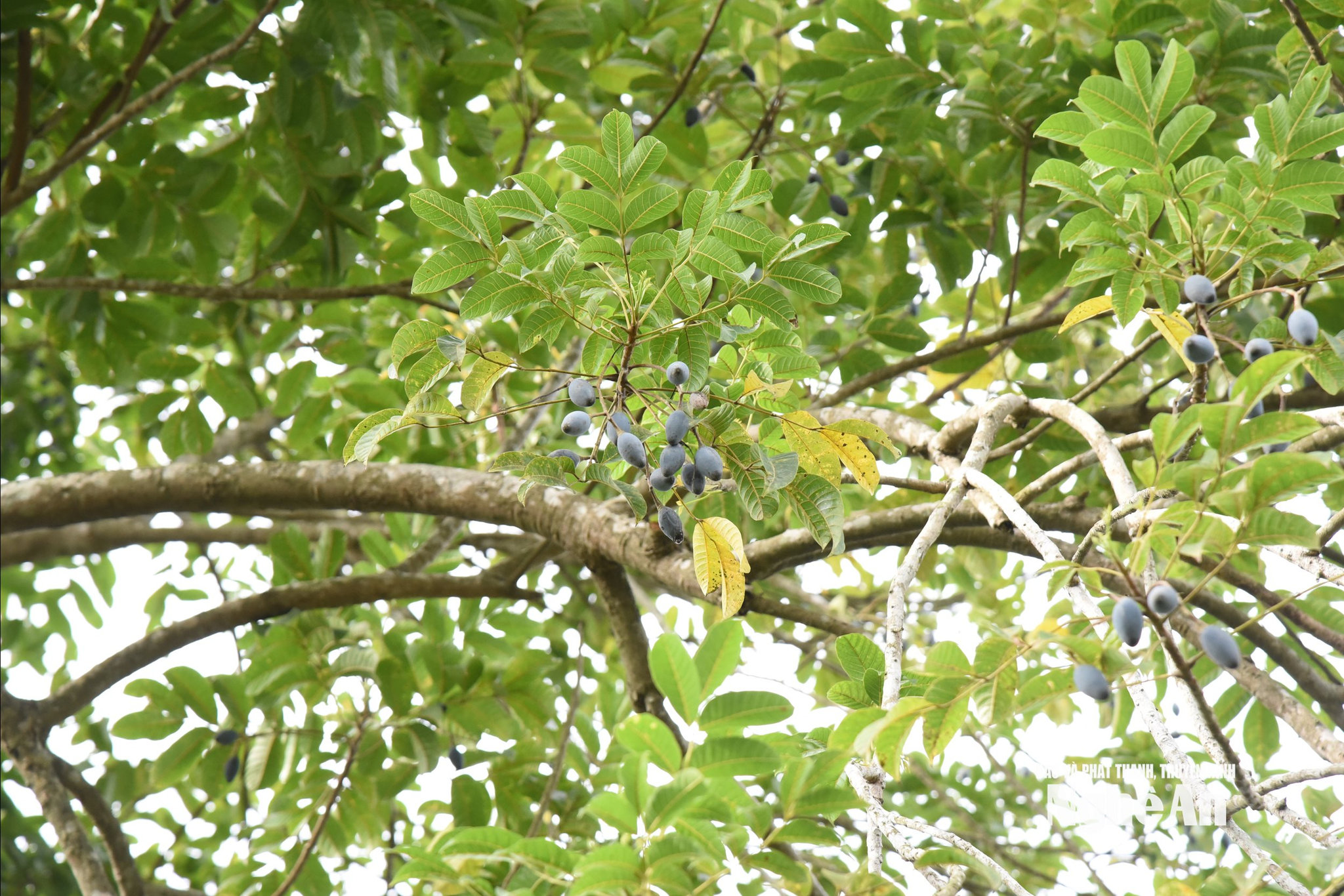
Following the torrential storms of 2025, thousands of black olive trees in the mountainous region of Nghe An province were broken, uprooted, or severely damaged. As a result, this year's olive harvest suffered a serious failure, with yields in many areas only a fraction of those of previous years. While olive prices have risen due to the scarcity of supply, this is insufficient to compensate for the losses, leading to financial ruin for growers, traders, and seasonal workers alike.
When the plants wither, the growers lose their source of income.
Black olive trees have long been a specialty crop closely associated with the lives of people in many mountainous areas of Nghe An province. From Cat Ngan, Tam Dong, Hanh Lam to Yen Xuan, Do Luong..., these old olive trees not only provide a valuable food source but also create livelihoods for many families. In the Cat Ngan, Hanh Lam, and Tam Dong areas of the former Thanh Chuong region alone, there are currently about 1,000 old olive trees and about 5,000 grafted olive trees. In good harvest years, the region's olive production can reach several hundred tons, bringing in a significant income for the people.
However, at this time, when the harvest season is in full swing, many orchards are quite deserted. After the storms of 2025, many orchards suffered broken branches and uprooted trees; those that remained were also severely affected by prolonged waterlogging, resulting in poor growth and reduced flowering and fruiting. In Tam Dong commune alone, considered the "capital" of orchard cultivation, the total yield this year is estimated to be only about 10% compared to previous years.
According to Mr. Duong Dac Thang, Chairman of the Farmers' Association of the commune, the Terminalia catappa tree is widely planted among the people, ranging from households with only 1-2 trees to those with dozens, even hundreds of trees. Some grafted Terminalia catappa trees, only 5-7 years old, have already started bearing fruit, while others are 50-80 years old, producing delicious fruit with stable yields and production. After the 2025 rainy season and storms, a large number of trees were knocked down, causing a 50% decrease in Terminalia catappa production in the area; the remaining trees also weakened, and their productivity decreased sharply.”
For households with long-standing Terminalia trees, the loss is not just in one harvest but also in the loss of a fairly stable source of income. Ms. Nguyen Thi Hoa, from Thanh My 1 hamlet, has 6 Terminalia trees, aged from 10 to 30 years.
In previous years, each Terminalia catappa tree provided her family with an income of about 3-5 million VND, a significant amount each season. However, after three storms last year, the trees had their branches broken and were submerged in floodwaters for a long time, causing them to weaken. This year, the yield is only about 1/10 of last year's.
"Every year, when the persimmon season comes, traders come directly to our house, and each tree sells for several million dong. This year, the trees bloomed but very few fruits set. They came to buy the whole trees; three trees fetched 5 million dong, while the other three had no fruit at all," Mrs. Hoa said.
Not only did Mrs. Nguyen Thi Huong's family in Thanh My 1 hamlet lose income from a single persimmon harvest, but they also lost an ancient persimmon tree that had provided a stable source of income for many years. Each year, the tree yielded several hundred kilograms of fruit, selling to traders for 12-15 million VND. After the 2025 rainy season and storms, the tree was uprooted, felled, and died.
“The olive tree was 40 or 50 years old, bearing abundant fruit every year. It was known for its delicious olives, providing an extra source of income during the harvest season. However, after the storm in 2025, the tree was uprooted and died, beyond saving, and the family lost this source of income,” Ms. Huong shared.
In Hanh Lam commune, the extent of the damage clearly shows the impact of natural disasters on the Terminalia catappa trees. Le Dinh Tuan's family has 150 trees in their productive stage, making them the household with the largest number of Terminalia catappa trees in the commune. In previous years, Mr. Tuan earned about 150 million VND per harvest. This year, after the storm, many trees had broken branches, were uprooted, and died; the remaining trees, although they survived the disaster, were weakened and had not yet recovered, resulting in a sharp decrease in yield. "Some trees that yielded 120-150 kg of fruit last year only got about 20-30 kg this year, and some only 3-5 kg. Even after salvaging everything from the entire orchard, we only managed to sell about 20 million VND," Mr. Tuan said.
Workers who depend on the plum harvesting season face unemployment.
Not only are growers suffering losses, but the poor harvest of black olives is also disrupting the entire supply chain and services associated with this specialty fruit. In the old Thanh Chuong region, where there were dozens of black olive purchasing facilities, the atmosphere, which was usually bustling during the harvest season, has become quiet. With such a limited supply, businesses specializing in collecting, processing, retailing, or transporting black olives to Hanoi and other northern provinces are all facing shortages.
Ms. Tran Thi Thuy, a trader in Dai Dong commune, said that at this time last year, her facility imported tons of olives daily, requiring dozens of workers to sort and pack them. This year, the amount of olives imported has decreased sharply, with some days having almost no produce to process. When raw materials are scarce, purchasing facilities cannot maintain their previous scale of operation. The shortage of olives not only reduces the amount of goods available on the market but also decreases the demand for labor in sorting, processing, and packaging.
Even seasoned traders are finding it difficult to avoid losses. Nguyen Huu Hung, a trader with 20 years of experience in the Canarium fruit trade, said he has never witnessed such a severe crop failure as this year. The nature of the Canarium fruit trading business is that traders usually buy trees when they first bloom, estimating yield based on their fruit-setting ability. This year, many trees bloomed profusely but failed to bear fruit due to weakening after the storm, putting buyers at significant risk.
“There are some trees that look heavily laden with flowers when they bloom, making you think it will be a good harvest, but then they don't bear fruit. The trees were weakened after the storm, so they no longer have the strength to nourish the fruit. Since I bought the whole tree, I have to accept the consequences. In previous years, I would have spent around 600-700 million VND to buy the trees when they first bloomed, but this year I only dared to spend about 200 million VND. Even so, I still lost about 60 million VND because many trees didn't bear fruit or the yield was too low. I've been in this business for 20 years, but I've never encountered a more difficult persimmon harvest than this year,” Mr. Hung added.
Crop failure also causes those who depend on the persimmon season to lose a significant amount of income. In previous years, during the harvest season, persimmon climbers usually worked in groups of 2-4 people, moving between growing areas to pick fruit for hire.
Although the work is arduous, it provides a decent income: Those who climb the trees to harvest apricot blossoms are paid around 800,000 - 1 million VND per day, while those who pick the blossoms earn about 300,000 VND per day. Nguyen Duy Hai, an apricot blossom climber in Hanh Lam commune, said that last year, he and his wife went with traders to harvest apricot blossoms, earning about 1.3 million VND per day. The peak season lasted nearly two months, providing a significant income for the family. This year, work is inconsistent, and the apricot blossom season is expected to last only about a month due to crop failure, causing significant losses for those who depend on the season for their livelihood.
Notably, the price of black olives this year is at its highest level in many years due to scarce supply. According to market surveys, black olives are currently selling for around 150,000-200,000 VND/kg, while in 2025 the common price was 110,000-150,000 VND/kg. However, the price increase cannot compensate for the significant drop in yield. When an olive tree that used to bear several hundred kilograms of fruit only produces a few tens of kilograms, or even no fruit at all, the increased value per kilogram is not enough to offset the lost income.
This year's decline in persimmon production is not just a story of one harvest, but also raises the challenge of restoring the raw material area after natural disasters.
For trees that have been uprooted, broken, or died, it will take people many years to replant them and get them to bear fruit. The surviving trees also need care and restoration of their growth before they can return to their previous productivity. Meanwhile, the black ebony tree is a perennial tree, and the value of these ancient trees cannot be compensated for in just a few seasons.
Therefore, to gradually stabilize the supply of Terminalia catappa trees, growers not only need to wait for favorable weather but also need solutions to care for and restore areas that are still capable of being harvested, and gradually regenerate the trees that have been lost.
Source - https://baonghean.vn