Retired army officer Francis Mugwika has fought and won many battles. But he has lost the fight against locusts not once, not twice, but thrice in just two months.
This past week we found an inconsolable Mr. Mugwika on his 12-acre farm in the rocky Kathuri hamlet in Tharaka North.
His green grams and millet were first attacked in early January.
The pests that entered the country on December 28 and have now covered 20 counties would, in their second and third visits, wipe out the entire crop.
For a model farm, the loss could not have been more devastating. Now, what remains are browning fruitless stalks that seem to mock his efforts.
A visit by Agriculture Cabinet Secretary Peter Munya and Governor Muthoki Njuki on February 17 offered him a glimmer of hope that was soon dashed.
“County officials told us not to disturb the swarms so that they could be sprayed to prevent them from spreading to other farms. They told us that they would compensate us for offering our farms as a sacrifice to save others. But nothing has come of the promise,” said Mr. Mugwika.
He said that had he been allowed to fight the pests he would have saved some crops. The loss is all the more shattering as it came following a prolonged drought.
“It hadn’t rained properly for three years and we were hopeful. We bought seeds at a very high price. They have finished me and I now leave everything to God,” he lamented.
He was expecting 12 bags of green grams, which would have gone for at least Sh100 a kilo, and 36 bags of millet, which is sold at Sh40 a kilo.
“We had never seen anything like it before. We saw them at 6 pm and began beating tins, sulfuric and anything we could lay our hands-on, but they were too many. Help came too late,” he said.
The voracious pests did not spare even shrubs, a valuable goat feed in the semi-arid land.
“We had been told that an aircraft would come to spray them but it never came. We were relying on the crop for everything. We plead with the government to compensate us.”
So virulent was the second attack that help from pupils of a nearby primary school could not save the crop from the ravenous pests that eat their own weight in a day.
“Every time the vegetation tries to sprout it is nipped in the bud by another attack,” Mr. Mugwika said.
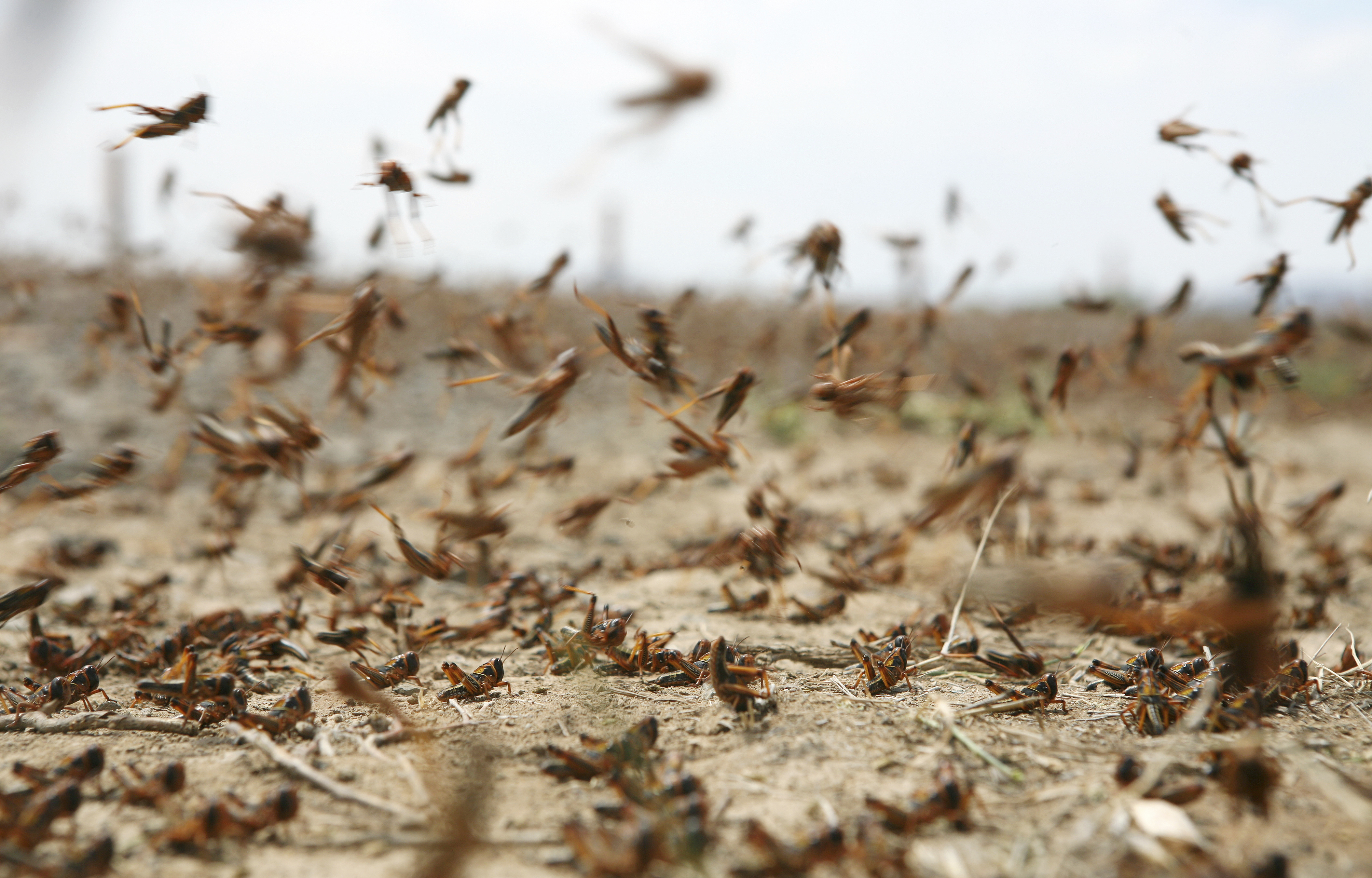
The eggs laid during the first visit have hatched and the pests are approaching maturity.
During the tour, the Nation team spotted a few hoppers. They are brown and markedly different from the mature yellow ones. In the fertile plains of Mwingi West in neighboring Kitui County, we visited Thitoni in the aftermath of spraying, which farmers lauded as successful. Thitoni location chief Josephine Mathenge told the Nation that three swarms of locusts landed in the area on Monday last week and were promptly sprayed.
“We called agricultural officers who sprayed them. Some died while others flew towards Machakos County,” Ms. Mathenge said.
She said that the chemicals work well and refuted claims by some residents that government efforts were ineffectual.
In Uiini, Kilela and Mbaunzo villages, which were attacked, much of the maize and green grams remained untouched. Ngula Mwendwa, 83, said the 1954 locust invasion was worse than the present attack. “They died immediately after they were sprayed. Then the next day there was an awful smell in the air,” he said. The county government of Kitui has singled out Tharaka and Tseikuru wards in Mwingi North as the most affected with Mgatra, Ngongoni and Gacigogo villages being the worst hit.
Breeding sites have been identified in Kyuso and Tseikuru wards. During our visit on February 19 and 20, Dr. Wathe Nzau, the deputy governor, explained that spraying had been halted because of “normal servicing” even as skeptical experts suspected shortage of resources.
In Central Kenya, the pests descended on farms in Mukurwe-ini, Nyeri County, but the damage was minimal. A Nation team that toured the region to assess the extent of damage caused by the pests met desperate farmers who said they used all in their means to chase the insects away. “They are like lawnmowers. They ate my napier grass and sweet potatoes to the ground,” said Ms. Mary Gathoni. She said that had it not been for the trees in the forested Mukurwe-ini, the effect on coffee, the region’s most important cash crop, would have been devastating.
But experts reckon the insects would not have stayed for long in the cold environment.
In Embu, intensive spraying was ongoing in Mbeere South where the pests have attacked mainly pasture and shrubs sporadically since January 24, with Kiambere and Mavuria wards being the most affected.
A situation report presented to the County Assembly by the Agriculture executive said locusts destroyed mainly acacia trees.
“The locust control unit responded quickly and sprayed using fenitrothion,” says the report.
Surveillance team
It estimates that little was lost because much of the crop had been harvested by the time of the attack. “The only crop affected was cowpeas. We estimate to have lost about 50 hectares, green grams (25), sorghum (20), napier grass (six), tomatoes (six) and acacia (200).
The report also refers to a “peculiar case at Isako where one woman was affected by the pesticide and was rushed to a near dispensary”.
No effects on livestock were reported.
The executive formed surveillance teams to monitor the pest and speed up response, says the report.
The national government trained and deployed 40 National Youth Service personnel to assist in spraying chemicals.
“The county has sensitized the community on the use of integrated locust control methods (use of smoke, noise, and throwing stones at swarms), the report says.
Dr. Timothy Njagi of the Tegemeo Institute of Agricultural Policy and Development, a think tank, warns that while there have been little effect on crop growing areas, arid and semi-arid lands have suffered huge losses.
But it has not been all gloom. The Swahili saying vita vya panzi neema ya kunguru (a hoppers’ fight is a raven’s gain) might as well explain the windfall for dogs in locust-infested areas.
The canines, most of which have to make do with leftover food in most rural homes, have had a field day.
Yet despite all evidence of the richness of the insects as a source of protein for humans, the culture has not caught on in Kenya and the food goes to waste.
In a hilarious video doing the rounds on social media, a man purportedly from western Kenya laments that the food is being sprayed indiscriminately yet he and his friends would have been hired to go and clear them.
In reality, though, there has not been any serious uptake from Kenyans.
Dr. Muo Kasina, the Entomological Society of Kenya chairman, says that a lot can be saved if the government adopts the consumption of locusts as a control measure.
“The government needs to be convinced about this. It has not been discussed by the government as major food and feeds source,” he said in an interview.
“It is a great protein supplement for animal feeds. I am happy about reports of Kenyan business experts willing to buy locusts for feeds. They are superfoods and feeds.”
The latest regions to be invaded by the pests are Bungoma, Baringo, and West Pokot.
What complicates locust control is that while the pest is suited for harsh conditions, it takes advantage of good conditions to breed and thrive.
Three cyclones — two in 2018 and one last year — are responsible for the explosion of the pest’s population in the Middle East and the Horn of Africa.
A cyclone from the Indian Ocean hit a remote area of the Arabian Peninsula known as the Empty Quarter, and the arising wetness gave the huge sandy area excellent conditions for egg-laying and breeding.
Scientists now predict that the cyclones will become more frequent as rising sea temperatures supercharge storms.
Insecurity in Somalia and Yemen, lack of resources and safety concerns in densely populated areas hamper a more robust control drive that experts say is needed to prevent the situation from becoming a catastrophe.
In Kenya, the pest is breeding fast and is expected to multiply 20-fold by crop planting time next month.
To deal with the problem, experts urge the upscaling of control efforts. So far, the UN says $22 million (about Sh2.2 billion) of the $76 million (about Sh7.6 billion) it needs to combat the menace has been either received or pledged.
Yesterday, Agricultural Research Principal Secretary Hamadi Boga said NYS personnel would be sent to other affected regions after deployment in Isiolo and Samburu.
“Their role is mainly ground control. Fifty to 100 youths will be trained in every county to support them,” Prof Boga said.
Source - https://mobile.nation.co.ke