The developer of a robotic apple picker says his goal is to have it ready for commercial use in orchards in the fall of 2018.
“It will work at a productivity rate that will be lower cost than human picking,” Dan Steere, CEO of Abundant Robotics of Hayward, Calif., told attendees at the Washington State Tree Fruit Association annual meeting, Dec. 6.
That was his response when asked how many bins of apples per day the picker can pick. Steere said he didn’t want to reveal that yet, nor an estimated price per unit. However, he said it will be practical and affordable within the next 10 years.
A robot able to pick apples fast enough and gently enough to be economically viable could be a huge boost to the apple industry in labor savings and in meeting labor shortages.
Steere and his Abundant Robotics co-founders, Curt Salisbury and Michael Eriksen, are robotic software and hardware engineers, developing a robotic harvester with a $550,000 grant from the Washington Tree Fruit Research Commission in Wenatchee and funding from SRI International in Menlo Park.
Abundant Robotics is working with its third prototype in 18 months with improvements made after fall harvest testing in Central Washington and spring harvest testing in the Southern Hemisphere, Steere said.
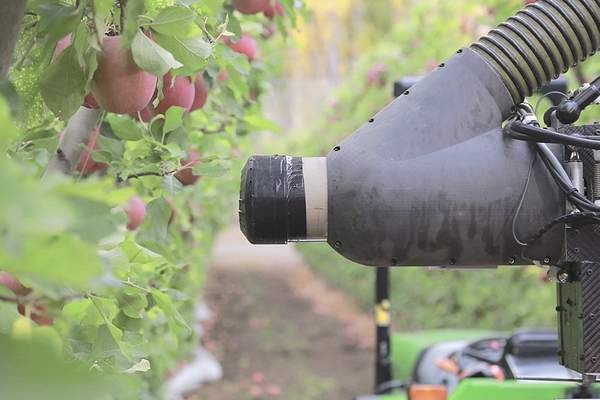
Here’s how it works: A robotic arm and vacuum tube, guided by computer aided by cameras and sensors, detects apples and sucks them off trees at one apple per second and delivers them into bins. Steere showed a video that he said was real-time.
He said the picker detects 95 percent of apples and isn’t bothered by leaves or new growth but is obstructed by wood such as limbs.
Leaves were stripped from part of a tree in one test, leaving 21 apples. Six of the 21 were not detected because of limbs, he said.
The system isn’t built to work on large old trees, but new high-density spindle or V-trellis plantings where the plane of the fruiting wall is 2 to 3 feet in depth.
“We think we’re good at hardware and software. That’s what we know. We’re not experts on (tree) canopies, so we’ve been trying to talk to growers,” Steere said.
He said he’s eager to hear from a cross section of growers and that there are probably multiple best canopies.
The robot was tested this fall in several varieties and orchards with the fruit graded on packing lines.
Gala ran at 5.3 percent cuts, punctures and bruises, just slightly above 4 percent of conventional hand picking, Steere said. Granny Smith was high at over 20 percent and Fuji also at 16, but Steere said he thinks he knows ho the damage occurred and how to bring it down.
“We’re definitely on a path to production rather than figuring out from a blank page of R&D (research and development) if it’s possible or not,” he said.
The key, he said, is unobstructed access to the apple. He said he’s staying focused on apples and not yet thinking of pears or cherries.
Source - http://www.capitalpress.com